10 min read
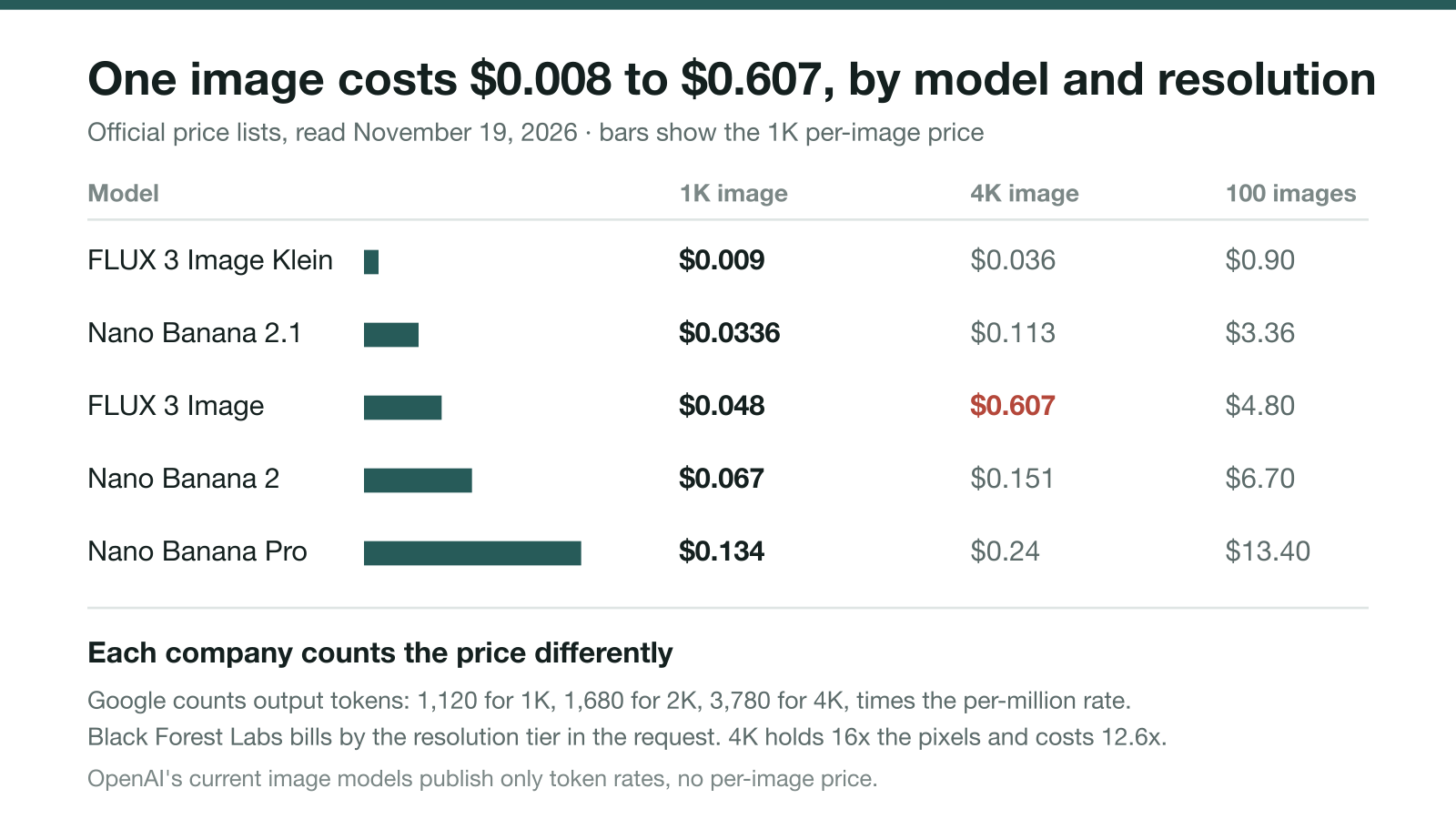
Generating one AI image costs between $0.008 and $0.607 as of November 19, 2026[1][2]. That is a spread of more than seventy times for the same single picture. The company you pick matters less than which model you call and what resolution you ask for.
Most of the time that number stays hidden behind a monthly subscription. When you generate a picture in ChatGPT or the Gemini app, you never see what the image cost. You only see a message when you hit a limit. The developer price lists published by the same companies do show it, down to fractions of a cent, and those numbers say what a subscription is actually buying.
Every figure below comes from the official pricing pages, opened and read on November 19, 2026. Prices change often, so check the links again before you pay for anything.
Resolution and model set the price
Image services bill by resolution tier, written as 1K (around 1,024 pixels on a side), 2K and 4K. The cheapest combination available today is Black Forest Labs’ FLUX 3 Image Klein at 768×768 pixels: $0.008 per image[2]. The most expensive is the same company’s FLUX 3 Image at 4K: $0.607. On Google’s side, Nano Banana 2.1 runs $0.0336 for a 1K image, while the higher-end Nano Banana Pro costs $0.134 for 1K or 2K[1].
At a hundred images those gaps turn into real money: $0.90 for Klein at 1K, $3.36 for Nano Banana 2.1, $13.40 for Nano Banana Pro, and $60.70 for FLUX 3 at 4K[7].
What a per-image price covers
A listed price describes one request that produced one usable image. In real work you often generate five or six to keep one, which multiplies the bill by the same factor. Retry count moves the total more than the unit price does.
The three companies count different things along the way. Google does not charge for the interim “thought images” a model produces while working out a composition, and it counts a reference image you supply as 560 tokens, about $0.0011[5]. You can mix up to 14 reference images. Black Forest Labs includes prompts and reference images at no extra charge, and does not bill for failed generations or for images its safety filter blocks before delivery[2]. OpenAI adds 100 output tokens per preview frame if you switch on the setting that streams a rough version while the image renders[4].
Resolution is counted differently from one company to the next. Black Forest Labs bills by the tier named in the request and spells out the pixel count of each tier: 768×768 is roughly 0.6 megapixels, 1K about 1, 1.5K about 2, 2K about 4, and 4K about 16[2]. So 4K costs 12.6 times what 1K costs because it holds sixteen times the pixels, not because the unit price rose. Per megapixel, 4K works out to $0.038 against $0.048 for 1K[7].
Google prices images by output token
Google treats an image as a bundle of tokens, the units a model uses to count text or pixels, and charges per million of them. Nano Banana 2.1 bills image output at $30 per million tokens, and a 1K image consumes 1,120 tokens, a 2K image 1,680, a 4K image 3,780[1]. Multiply those out and you get the $0.0336, $0.0504 and $0.113 printed on the page (the last one rounded from $0.1134).
| Google image model (paid tier, standard) | 1K | 2K | 4K | Notes |
|---|---|---|---|---|
| Nano Banana 2.1 | $0.0336 | $0.0504 | $0.113 | Batch is half: $0.0168 / $0.0252 / $0.0567 |
| Nano Banana 2 (Gemini 3.1 Flash Image) | $0.067 | $0.101 | $0.151 | Adds 0.5K (512px) at $0.045 |
| Nano Banana 2 Lite | $0.0336 | not listed | not listed | Low latency tier, batch $0.0168 |
| Nano Banana Pro (Gemini 3 Pro Image) | $0.134 | $0.134 | $0.24 | Input image counted at $0.0011 |
| Nano Banana (Gemini 2.5 Flash Image) | $0.039 | not listed | not listed | Shuts down March 15, 2027 |
Every number in that table is from Google’s pricing page[1]. Nano Banana Pro sits at $120 per million output tokens, four times the 2.1 rate, and spends 1,120 tokens on a 1K or 2K image and 2,000 on a 4K one, which is why its 1K and 2K prices are identical at $0.134 and only 4K rises to $0.24[1].
Picking by version number can cost you money. Nano Banana 2.1 is the successor to Nano Banana 2, and it is cheaper at 1K: $0.0336 against $0.067, because Google cut the token rate from $60 to $30 per million[1]. At 4K the gap narrows, since the two models spend different amounts on the same resolution, 3,780 tokens for 2.1 and 2,520 for 2[1]. The older model also keeps one thing 2.1 lacks: 512-pixel output[5].
FLUX prices images by resolution tier
Black Forest Labs publishes a straight per-image number instead of a token rate, so there is nothing to calculate[2].
| FLUX model (API) | 768×768 | 1K | 1.5K | 2K | 4K |
|---|---|---|---|---|---|
| FLUX 3 Image | $0.041 | $0.048 | $0.07 | $0.10 | $0.607 |
| FLUX 3 Image Klein | $0.008 | $0.009 | $0.011 | $0.014 | $0.036 |
Those rates and the editing rates below are from the company’s price list[2]. Editing is priced on its own table: FLUX.1 Kontext comes in a standard version at $0.04 per image and a premium one at $0.08, while tools such as outpainting (extending a background past its original edge) and erase (removing an object) are billed by the megapixel of the result.
OpenAI no longer publishes a per-image price
OpenAI’s current image models, GPT Image 2.6 in its Sunburst and Flare variants, have no per-image figure on the pricing page. The page lists token rates instead: $30 per million image output tokens, $8 per million image input tokens, $5 per million text input tokens[3]. Quality has five settings (low, medium, high, xhigh, max), and the documentation notes that token counts can differ between models at the same quality setting[4]. Token counts for a given combination appear only in a calculator embedded in the docs, which is drawn in JavaScript and could not be read as text.
The previous generation still shows the range. Through GPT Image 2, OpenAI published a per-image table for 1024×1024: $0.006 at low quality, $0.053 at medium, $0.211 at high[4]. Low to medium is nearly a ninefold jump, medium to high is four times[7]. The quality switch drives the bill more than anything else. Those are last-generation numbers, so for current models the only reliable figure is the token usage returned with each response.
The three price lists differ in how much they tell you up front. Google and Black Forest Labs publish the cost before you spend it, while OpenAI shows it afterwards. The smaller your volume, the harder it becomes to predict a monthly bill.
A monthly subscription buys a usage limit
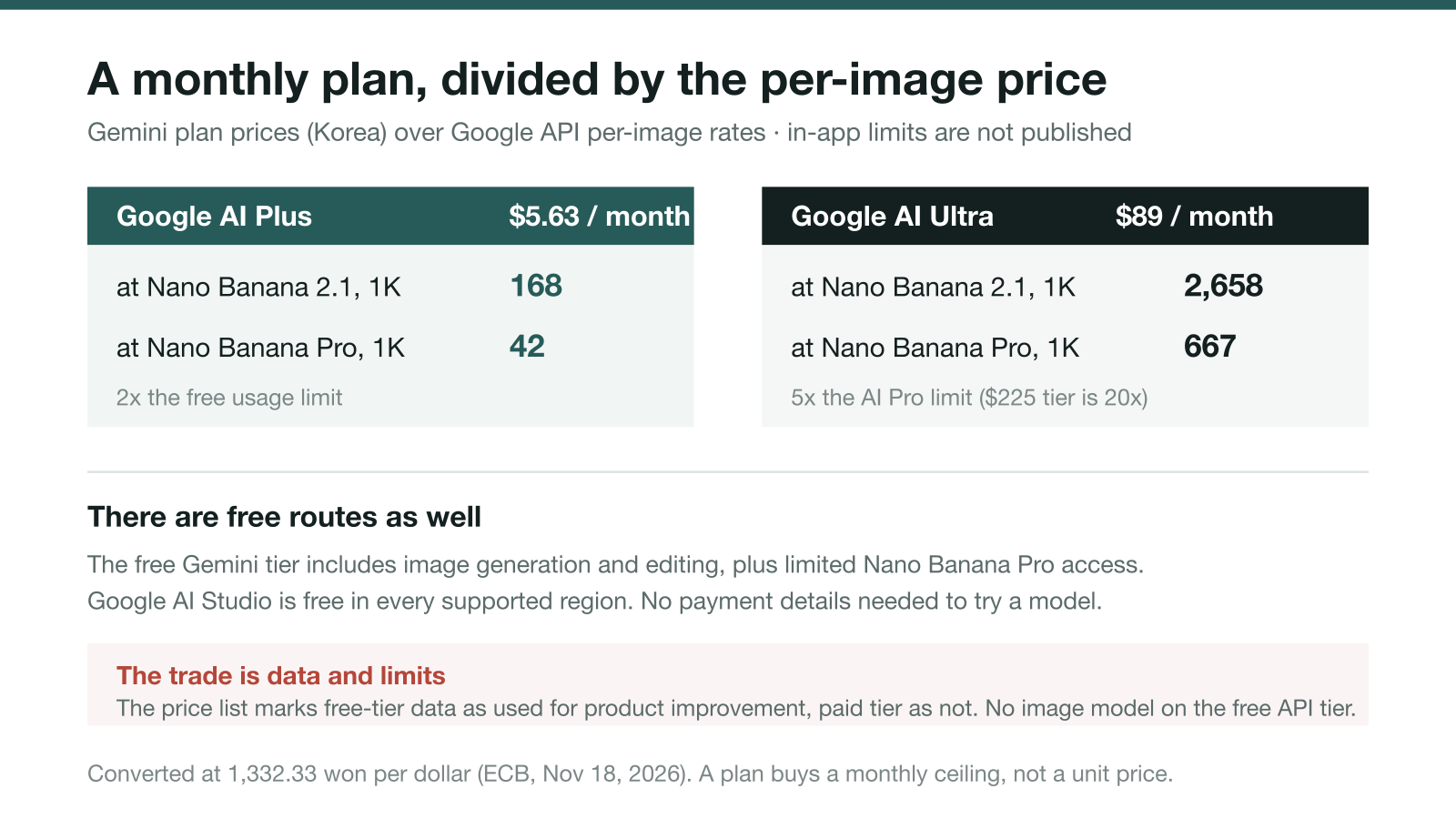
What most people actually pay is an app subscription. Google lists its Korean prices in won on the official page, the version that was readable: free at ₩0, Google AI Plus at ₩7,500 a month (about $5.63) for twice the free usage limit, and Google AI Ultra at ₩119,000 (about $89) for five times the AI Pro limit or ₩300,000 (about $225) for twenty times that same AI Pro limit[6][7]. The free tier includes image generation and editing plus limited access to Nano Banana Pro. Google AI Pro, the tier in between, is described as four times the free limit, but no amount appeared in the page, so it is left blank here.
Divide a subscription by a per-image price and you can see what kind of number it is. The ₩7,500 tier covers 168 images on Nano Banana 2.1 at 1K, or 42 on Nano Banana Pro. The ₩119,000 tier covers 667 Pro images or 2,658 on 2.1[7]. Real in-app limits are different and are not published, but the comparison shows that a subscription prices a monthly allowance rather than marking up a unit cost. Generate a few dozen images a month on a top tier and most of what you paid for goes unused.
ChatGPT and Midjourney subscription prices are missing here. Both official pricing pages (openai.com, midjourney.com) refuse automated requests, so there was no primary source to quote. For monthly plan comparisons checked in October, see ChatGPT vs Claude vs Gemini plan pricing.
The free options and what they cost you
Google AI Studio (aistudio.google.com) is free to use in every supported region[1]. You pick a model in the browser, type a prompt, and get a result without entering payment details. For a first comparison of image models, that is the cheapest place to start.
The free tier of the API is another matter: it carries no image models at all. For both Nano Banana 2.1 and Nano Banana Pro, the free tier column reads “Not available”[1]. The same table says data sent through the free tier is used to improve Google’s products, and that paid-tier data is not. That line is worth reading before you upload company material or someone else’s face. On what not to put into a chatbot at all, see using AI without giving away your data.
Price aside, generated images arrive with a marker attached. Google states in its documentation that every image produced by Gemini includes a SynthID watermark, a signal embedded in the pixels rather than a visible logo[5]. If the picture is going into a blog post or an ad, that marker goes with it.
Running open-weight models yourself
Some FLUX models ship their weights, the numbers a model learns during training, so you can download them and run the model on your own machine instead of calling a server. The Klein and dev lines work this way. Run them yourself and the per-image charge disappears, leaving electricity and hardware. Klein is published at a size that fits on a single consumer graphics card, 5.6 billion parameters[2].
Commercial use is licensed separately. Black Forest Labs sells self-hosting licenses by monthly volume and domain count: the Builder tier covers 10,000 images a month, one domain and ten licensed users; the Platform tier covers 100,000 a month; anything larger is priced by the sales team[2]. A non-commercial license exists on its own terms. Hobby use and company use fall under different agreements, so read the license first if the output is going into a product.
Checklist
- Draft on the cheap combination. There is no reason to spend $0.134 per image while you are still testing composition. Work in the $0.008 to $0.0336 range and save the expensive model for the final version.
- Do not leave 4K as a default. It is 12.6 times the cost of 1K on FLUX 3 and 3.4 times on Nano Banana 2.1[7]. For anything viewed on a screen, 1K is enough.
- Send bulk jobs through batch processing, where you submit many requests at once and collect the results later instead of waiting. Google’s batch rate is exactly half[1].
- Do not read the version number as a price. Nano Banana 2.1 is $0.0336 per 1K image; Nano Banana 2 is $0.067.
- Count how many images you actually generate per month before picking a tier. The ₩7,500 plan covers 42 images on the Pro model.
- Start on Google AI Studio if you just want to compare models, and read the line about free-tier data being used for product improvement before you upload anything sensitive.
- For work use, check the watermark and the license before paying. Google images carry SynthID, and commercial use of open-weight models is a paid license.
- For how token pricing works in general, see how AI pricing is counted in tokens.
Both tables on this page will be updated when the price lists change.
References
- Gemini API pricing
- Gemini image generation docs
- Black Forest Labs pricing
- OpenAI platform pricing
- OpenAI image generation guide
- Gemini subscription plans
Notes
- Gemini API pricing page, read November 19, 2026. Token rates and per-image equivalents for Nano Banana 2.1 ($30 per million output tokens; 1,120 / 1,680 / 3,780 tokens), Nano Banana 2 ($60 per million; 747 / 1,120 / 1,680 / 2,520 tokens), Nano Banana 2 Lite, Nano Banana Pro ($120 per million; 1,120 tokens for 1K and 2K, 2,000 for 4K) and Gemini 2.5 Flash Image; batch rates at half; free tier availability and the data-use column; the note that Google AI Studio usage is free of charge in all available regions. Link ↩
- Black Forest Labs pricing page, read November 19, 2026. Per-image prices by resolution tier for FLUX 3 Image and Klein, FLUX.1 Kontext and image tool rates, the billing FAQ (tier-based billing, reference images and prompts included, failed and withheld generations not charged, megapixel count per tier), self-hosting license tiers, and Klein’s 5.6 billion parameters. Link ↩
- OpenAI platform pricing page, read November 19, 2026. gpt-image-2.6 Sunburst and Flare at $8 per million image input tokens, $30 output, $2 cached input, $5 text input, and half those rates in batch. Link ↩
- OpenAI image generation guide, read November 19, 2026. The five quality settings, the note that token counts can differ by model at the same quality, 100 extra output tokens per partial image, and the legacy per-image table for GPT Image 2 at 1024×1024 ($0.006 / $0.053 / $0.211). Link ↩
- Gemini image generation documentation, read November 19, 2026. “All generated images include a SynthID watermark”, up to 14 reference images, interim thought images not charged, 1K/2K/4K support and the 0.5K option limited to Gemini 3.1 Flash Image. Link ↩
- Gemini subscription page with country set to Korea, read November 19, 2026. Free tier at ₩0 with limited Nano Banana Pro access, Google AI Plus at ₩7,500 (2× the free limit), Google AI Pro listed at 4× with no price rendered, Google AI Ultra at ₩119,000 (5× AI Pro) and ₩300,000 (20× AI Pro). Link ↩
- Hundred-image totals, per-megapixel rates, quality-step ratios, dollar conversions of the Korean subscription prices and the images-per-subscription figures were calculated from the published rates above, using the European Central Bank reference rate of 1,332.33 won to the dollar on November 18, 2026. Link ↩