Author: AI Signal

  • BIS Remote Access Rule: What It Means for Hong Kong Companies Using Cloud AI

    A rule from the US Commerce Department’s Bureau of Industry and Security (BIS), in effect since November 19, 2026, requires a license when data centers abroad provide remote use of advanced AI chips to companies headquartered in China and certain other countries. The rule places the license requirement on chip exporters and data center operators.[1] Law firms read it as ordinarily leaving the companies that use the service with no licensing obligation of their own.[8] The rule does not ask where the data center is. It asks where the user’s ultimate parent company is headquartered. As a result, Hong Kong-headquartered companies with no mainland business may see the terms of their cloud AI services change.

    The case-by-case readings below follow the rule’s text and commentary from law firms and research groups. The rule is an interim final rule, which takes effect first and collects comments afterward, and much of it is unsettled. Nothing here is legal advice, and real transactions need professional review.

    In Hong Kong, ordinary businesses are covered companies too

    In mainland China, the rule appears mostly to affect the companies that build AI models. Its target is contracts to rent chips in data centers abroad for training, and the Center for a New American Security (CNAS) says the largest deals involving Chinese AI labs easily exceed the threshold.[2] According to 2024 reporting, OpenAI lists mainland China and Hong Kong as unsupported regions, which left ordinary mainland businesses with little formal access to US models running in data centers abroad.[6]

    In Hong Kong, Microsoft said after OpenAI tightened its blocking in 2024 that it would keep providing OpenAI models to eligible enterprise customers through regions outside Hong Kong.[6] If that route is still open, banks, insurers and retailers in Hong Kong can use US models in overseas data centers for everyday work, and under this rule they are covered companies.

    A mainland company’s overseas subsidiary that uses AI services in a local cloud is counted the same way, because the rule looks at the ultimate parent’s headquarters and not at where the using entity sits.[1]

    Three questions that decide coverage

    The first is who is using the compute. Covered companies are those headquartered in Macau or a Country Group D:5 destination, and those whose ultimate parent is headquartered there.[1] D:5 is the US list of arms-embargoed countries, which includes China, Russia, Iran and North Korea. Hong Kong is treated as part of China under US export regulations, as explained in the Hong Kong section below.

    The second is what the workload runs on. The rule counts the processing power of advanced AI chips and the servers that contain them. US export regulations score a chip’s processing power as total processing performance (TPP), and chips scoring 4,800 or more are among those classified as advanced computing items.[1] The classification is aimed at AI accelerators, of which Nvidia GPUs are the best-known example. Ordinary servers outside that classification are not counted.

    The third is how much. A license is needed when the TPP of the chips a data center provides to covered companies adds up to more than 12 million.[1] Whether the sum covers one customer or all covered companies is taken up below. The law firm Morgan Lewis calculates that this equals roughly 760 Nvidia H100 or H200 GPUs, or three of the latest GB300 racks (just over 200 GPUs). It also notes that the threshold measures hardware performance, not GPU-hours, tokens or spend.[8] Tokens are the unit AI services use to meter usage. In servers holding eight H100s each, 760 GPUs is 95 servers (760 divided by 8, this guide’s arithmetic).
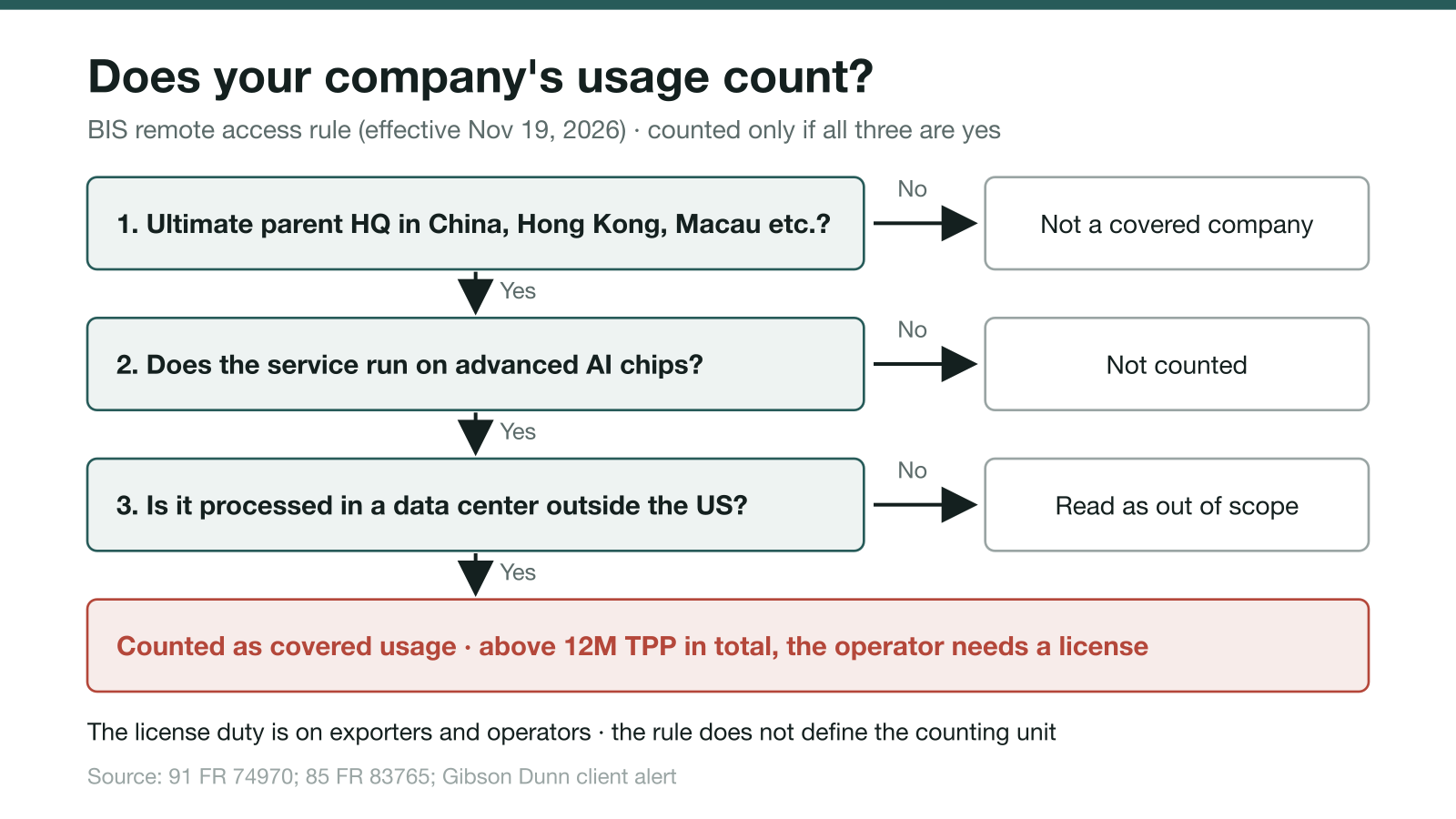
    The order of questions for deciding whether a company's usage counts under the remote access rule
    The order of questions for deciding whether a company’s usage counts under the remote access rule

    The license obligation falls on the exporter of the chips and the operator of the data center. US export rules treat a change in how chips abroad are used as needing authorization, in the same way as a shipment across a border, which is why the operator holding the chips is the one that needs the license.[1] Morgan Lewis explains that the rule regulates covered hardware and the persons who export or transfer it, and does not license cloud or AI services as such, while the commercial effect reaches every service that depends on that compute.[8]

    Hong Kong companies

    A company headquartered in Hong Kong is a covered company. US export regulations have treated Hong Kong as part of China since December 2020, when BIS removed it as a separate destination and stated that limitations applying to China’s country groups, D:5 among them, would also apply to transactions involving Hong Kong.[4] The new rule’s text does not mention Hong Kong by name. The law firms A&O Shearman and Morrison Foerster both state in their notes on this rule that China, for these purposes, includes Hong Kong.[9][10]

    The rule draws no line by industry. The only use-based exception is for commercial recommender systems of the kind used by online retailers and social media, and generative AI that produces text or images is excluded from that exception.[1] A Hong Kong-headquartered bank, insurer or retailer is a covered company. Whether its ordinary API use is actually counted toward the threshold is unsettled, as discussed below.

    Case Effect
    A Hong Kong-headquartered company uses AI services in a data center abroad Covered-company usage. Whether API use counts toward the threshold is unsettled
    Its subsidiary in Singapore, Thailand or elsewhere uses them Treated the same way, because the ultimate parent is in Hong Kong
    The Hong Kong subsidiary of a company headquartered in the UK, the US or another country uses them Not covered on the ultimate-parent test. Whether the Hong Kong entity itself could count as a headquarters is unsettled
    The service runs in a data center inside the United States Read as outside the rule
    Ordinary servers, storage and similar cloud services Not counted unless they run on advanced AI chips

    Because the test is the ultimate parent’s headquarters, contracting through a local subsidiary changes nothing. Morgan Lewis makes the same point: the trigger is where the customer or its ultimate parent is headquartered, not where a contracting entity is incorporated.[8] BIS says the diligence requirement is meant to prevent circumvention through corporate restructurings or spinoffs.[1] For a multinational headquartered in Hong Kong with subsidiaries across Southeast Asia, every subsidiary is treated as a covered company.

    Whether a company with modest usage is actually caught depends on how the threshold is counted. Gibson Dunn and WilmerHale both note that the rule does not say whether 12 million is measured per customer or in total.[3][11] Gibson Dunn adds that it does not say whether the measure is installed, contracted or actually used capacity.[3] This guide’s inference is that if it is counted per customer, a company with small usage is under the threshold, and if it is counted across all covered customers, the data center operator must obtain a license or adjust what it provides to them, whatever any single customer uses.

    Morgan Lewis addresses companies that use models through an API without renting GPUs. Sending a request to a model and getting an answer back is called inference. Morgan Lewis writes that a company that only consumes inference through an API ordinarily has no licensing obligation of its own, but should expect suppliers to pass down end-customer disclosure and usage restrictions. It also identifies what the rule leaves unanswered: whether ordinary API access for covered customers counts, and how aggregate TPP is attributed to users of a shared, token-metered service.[8] Because BIS describes its concern as compute for “training or running” advanced models, Morgan Lewis adds that inference capacity could also count.[8]
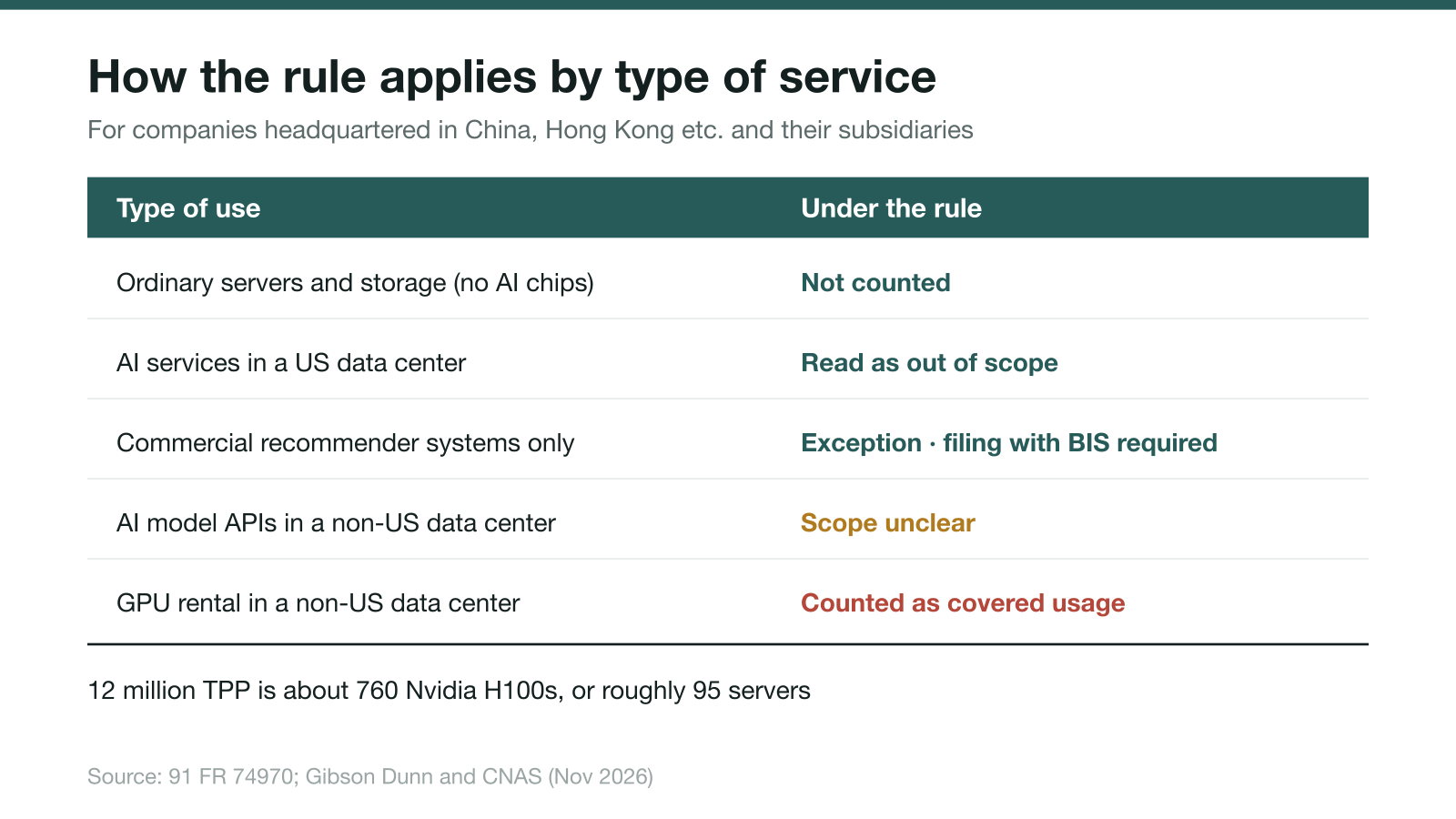
    How the remote access rule applies to each type of service a covered company uses
    How the remote access rule applies to each type of service a covered company uses

    Why switching data center location has limits

    Outside the United States, moving to another region does not change the analysis. A region is a cloud provider’s unit for grouping data centers in one geography. The rule says “any destination worldwide.”[1] On that wording, moving from Singapore to a region in Japan, Australia or Europe puts the workload in a data center subject to the same test.

    Splitting usage across regions may not work either. The rule adds together “linked data centers” that share resources over a network, including facilities in separate buildings that are connected digitally.[1] It does not say whether a large cloud provider’s regions qualify.

    Data centers inside the United States are read as out of scope. Gibson Dunn reasons that when the hardware stays in the US there is no export or reexport, so providing US-based compute to foreign customers appears to fall outside the rule.[3] CNAS agrees the rule omits US data centers and argues it should cover remote access wherever the chips sit.[2] The Remote Access Security Act, which passed the House in January 2026 and would make remote access itself a controlled activity, is still pending in the Senate.[5] Moving to a US region is outside the rule on the current reading, but it raises data transfer rules in the user’s own jurisdiction and could change if the law does.

    Selecting a Hong Kong region in a cloud service does not guarantee the model runs in Hong Kong. In 2024 Microsoft said it served eligible Hong Kong customers “via models deployed in regions outside Hong Kong.”[6] Microsoft’s model availability table, last updated September 4, 2026, lists a Singapore region and no Hong Kong region.[7] On this evidence, a Hong Kong customer’s Azure OpenAI workloads are processed in a region outside Hong Kong, such as Singapore, and the data centers in that region are the ones subject to the rule. As of November 22, no public statement from Microsoft or OpenAI on this rule could be found.

    Existing data centers and the 90-day deadline

    The rule says a data center that was providing a significant volume of compute to covered companies before publication must obtain a license within 90 days of the effective date to continue.[1] Latham & Watkins calculates the deadline as February 17, 2027, and reads the text as requiring an issued license by that date.[12] Gibson Dunn notes that few China-related licenses have historically been processed within 90 days.[3]

    How this applies to existing facilities is questioned even among law firms. Morrison Foerster writes that for deployments that complied with earlier restrictions and involve no new export, reexport or transfer, it is unclear whether there is a basis to apply the rule.[10] WilmerHale notes that the rule does not say what counts as “significant” for the 90-day provision.[11]

    Cloud regions operating today are existing facilities in the sense of this provision. This guide’s inference is that, depending on how cloud providers read the provision and respond, service terms may change around February 2027.

    What is still unsettled

    The rule’s text does not answer the points below.

    Issue Confirmed Not settled
    Unit of counting The threshold is more than 12 million aggregate TPP[1] Whether it is per customer or the total across all covered companies a data center serves[3][11]
    Basis of measurement Hardware performance is added up. Tokens and spend are not the measure[8] Installed, contracted or actually used capacity, and over what period[3]
    Using models only through an API The user ordinarily has no licensing obligation[8] Whether ordinary API access counts, and how TPP is attributed to users of a shared service[8]
    Treatment of Hong Kong A 2020 rule treats Hong Kong as part of China, and two law firms say the new rule includes it[4][9][10] BIS has not issued anything on Hong Kong specific to the new rule
    Meaning of “headquartered” The test is the company’s or its ultimate parent’s headquarters[1] How headquarters is determined, which also decides how a foreign company’s Hong Kong subsidiary is treated[3]
    Ownership and control Direct or indirect ownership or control must be checked[1] The ownership percentage and what counts as control[3]
    Adding up regions “Linked data centers” connected by networking are aggregated[1] Whether a cloud provider’s regions qualify
    Existing facilities Data centers already serving covered companies need a license within 90 days[1] Whether there is a basis to apply the rule where no new export or transfer occurs, and what “significant” means[10][11]
    Data centers in the US That they are out of scope is the reading of a law firm and a research group[2][3] BIS has not said so, and a bill pending in the Senate could change it[5]
    Whether licenses are granted Applications are reviewed case by case[1] How many will be approved and how fast[3]
    Cloud providers’ response Microsoft’s 2024 statement and its region table[6][7] Microsoft’s and OpenAI’s position on this rule (nothing public as of November 22)

    Four points that are easy to get wrong

    • The rule draws no line by industry. A bank or retailer headquartered in Hong Kong is a covered company.[1]
    • The test is the ultimate parent’s headquarters. The country of the entity that signs the contract is not the test.[1][8]
    • The threshold is measured in hardware performance. Low token usage or low spend does not by itself mean a company is under it.[8]
    • The license obligation is on the exporter and the data center operator. Users ordinarily have no licensing obligation, but suppliers may ask for customer information or change the terms of service.[1][8]

    Checklist

    • Map where the ultimate parent is headquartered, including intermediate holding companies. Suppliers may ask for this.
    • Ask the provider which region processes your AI workloads. It can differ from the region in the contract.
    • If you are a covered company, watch for notices from your cloud provider before the 90-day deadline of February 17, 2027.[12]
    • If you are considering a move to a US region, check the rules on transferring customer data abroad first.
    • Comments are due January 19, 2027. The counting method and the meaning of “headquartered” may change through BIS guidance or amendments afterward.[1]

    Limits of this guide

    Until the issues in the table are settled, the case-by-case readings here follow the rule’s text and interpretations by law firms and research groups, and BIS has not confirmed them. Law-firm notes address API users in general. As of November 22, no BIS guidance or law-firm note could be found that deals specifically with Hong Kong-headquartered multinationals.

    References


    Notes

    1. Bureau of Industry and Security, “Addressing Remote Access to Advanced Semiconductors,” interim final rule, 91 FR 74970 (published and effective November 19, 2026). Full text ↩
    2. CNAS, “Unpacking the Remote Access Rule” (November 18, 2026). Link ↩
    3. Gibson Dunn, “BIS Expands Advanced Computing Controls to Address Data Center Remote Access and Third Country Diversion” (November 18, 2026). Link ↩
    4. Bureau of Industry and Security, “Removal of Hong Kong as a Separate Destination Under the Export Administration Regulations,” 85 FR 83765 (December 23, 2020). Full text ↩
    5. Kharon, “Understanding Remote Access Controls: The AI Remote Access Rule and the Remote Access Security Act.” Link ↩
    6. South China Morning Post via Yahoo Finance, “Microsoft maintains AI services in Hong Kong, as OpenAI curbs API access from China” (2024). Link ↩
    7. Microsoft Learn, “Models sold directly by Azure: region availability” (updated September 4, 2026; checked November 22, 2026). Link ↩
    8. Morgan Lewis, “Commerce Targets Remote Access to Advanced Semiconductors in New Interim Final Rule” (November 18, 2026). Link ↩
    9. A&O Shearman, “BIS rule on remote access to advanced semiconductors” (November 2026). Link ↩
    10. Morrison Foerster, “BIS Issues Interim Final Rule Targeting GPU Remote Access and Advanced IC Design” (November 19, 2026). Link ↩
    11. WilmerHale, “US Government Restricts Remote Access to Advanced AI Chips and Formally Rescinds the AI Diffusion Rule” (November 17, 2026). Link ↩
    12. Latham & Watkins, “US Commerce Department Adopts Rule Restricting Remote Access to Advanced AI Chips” (November 2026). Link ↩

    Source: https://www.govinfo.gov/content/pkg/FR-2026-11-19/html/2026-23529.htm
  • Formal Verification of AI-Generated Code: What It Proves and What It Doesn’t

    Most of us check AI-written code by testing it. Feed the program some inputs, see whether the answers match what we expected, and treat that as proof it works. An experiment Anthropic published on October 22, 2026 puts a number on what that habit misses. Researchers had Claude mathematically verify code in 123 open-source libraries, and the attempt surfaced bugs that had survived trillions of test runs over several years.[1]

    The technique is formal verification: instead of running a program on sample inputs, you prove mathematically that it obeys a stated rule for every input. It spent decades as the preserve of a small group of specialists, until writing proofs turned out to be the kind of labor large language models are good at.

    A test only reports on the inputs it tried

    To see this directly, I ran a small experiment. The code below stands in for a function that tracks how many bytes are left while unpacking a file. It subtracts the amount already read from the amount remaining.

    function remainingBytes(remain: number, used: number): number {
      return (remain - used) >>> 0; // read the result as a 32-bit unsigned integer
    }

    >>> 0 tells JavaScript to read the result as a 32-bit unsigned integer. Unsigned means there is no room to store a negative number, so subtracting 1 from 0 rolls over to the largest value available, the way a car odometer would if you ran it backwards. Running it:

    remainingBytes(1000, 400) = 600
    remainingBytes(10, 10)    = 0
    remainingBytes(10, 11)    = 4294967295

    When the amount read exceeds what remains by just one, the answer comes back as roughly 4.29 billion. A program that trusts that number as “bytes you may safely read next” will reach outside its own memory and start writing over whatever sits there. Anthropic found bugs of exactly this shape, including one in decompression code where a count ran backwards past zero and the program wrote outside its allotted memory.[1]

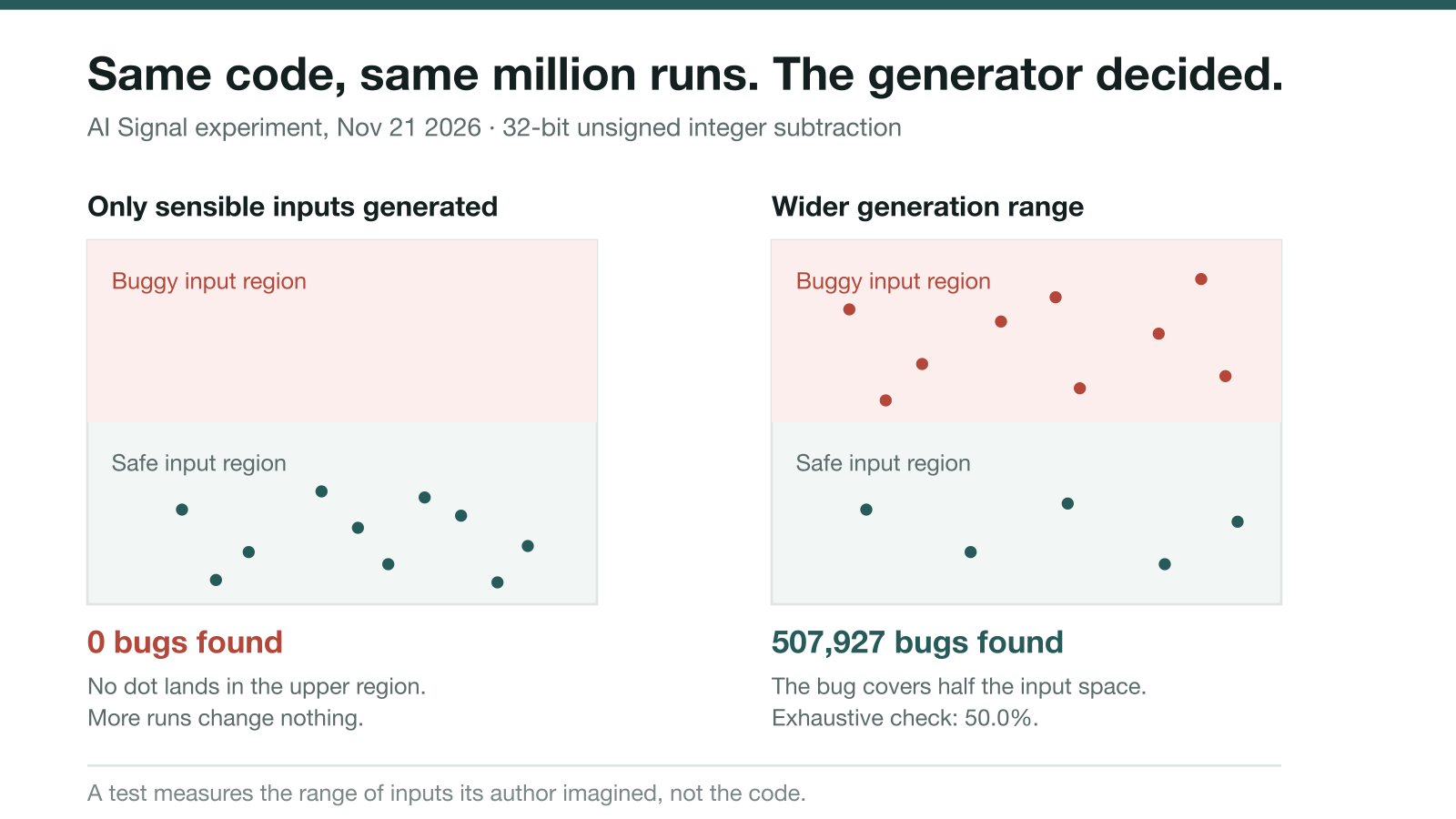
    Then I tested it. I generated a million random inputs in a realistic range: a total length between 1 and 1,000,000 bytes, and an amount read picked from inside that total.

    Random testing, 1,000,000 runs (realistic input range)
    Failures found: 0 / 1000000

    The test did not get unlucky. Because the amount read was always drawn from inside the total, the case where used exceeds remain is never generated at all, so a trillion runs would return the same zero. Then I changed one thing, drawing the amount read independently of the total, and the result flipped.

    Same test, wider generation range
    Failures found: 507927 / 1000000

    Same code, same number of runs, 507,927 failures. Checking every combination from 0 to 999 exhaustively gave a similar ratio.

    Exhaustive check: all pairs 0-999 (1,000,000 combinations)
    Failures found: 499500 / 1000000
    First counterexample: remain=0, used=1 -> 4294967295
    Failure rate: 50.0%

    The bug sat across half the input space, and the first million runs found none of it. What the test measured was the range of inputs its author imagined, which tells you nothing about how the code behaves outside that range.[6]

    The same code and the same number of test runs split between 0 and half a million failures depending on how inputs are generated
    The same code and the same number of test runs split between 0 and half a million failures depending on how inputs are generated

    Fuzzing (an automated technique that floods a program with endless mutated inputs looking for crashes) runs into the same wall. Fuzzers in practice cap their inputs at around 1 MB. One bug Anthropic found only triggered on inputs around 20 MB arranged in one rare layout. Another needed a 64 MB input and over 2 GB of memory. No amount of fuzzing time reaches those.[1]

    Trying every possible input is not an option either. The function above takes two 32-bit integers, which works out to 18,446,744,073,709,551,616 combinations. At a billion checks per second that is 584 years of computing.[6] Functions that take more or larger inputs reach impossible totals faster still.

    Three pieces: a spec, a proof, and a checker

    The first piece is the specification, or spec: a mathematical statement of what “this program works correctly” even means. For the function above it would be something like “the result is never greater than remain.” Anthropic described writing the spec as the hardest gate. A PNG decoder has a correct answer defined by a published standard, but stating what it means for a text editor or a web browser to be correct is genuinely hard.[1]

    The second piece is the proof: an argument that the spec holds for every input. Rather than feeding in inputs one at a time, you reason about conditions, showing that the 4.29 billion result requires used > remain and that the code rules that case out. The input space can run to 18 quintillion combinations while the argument takes a few lines.

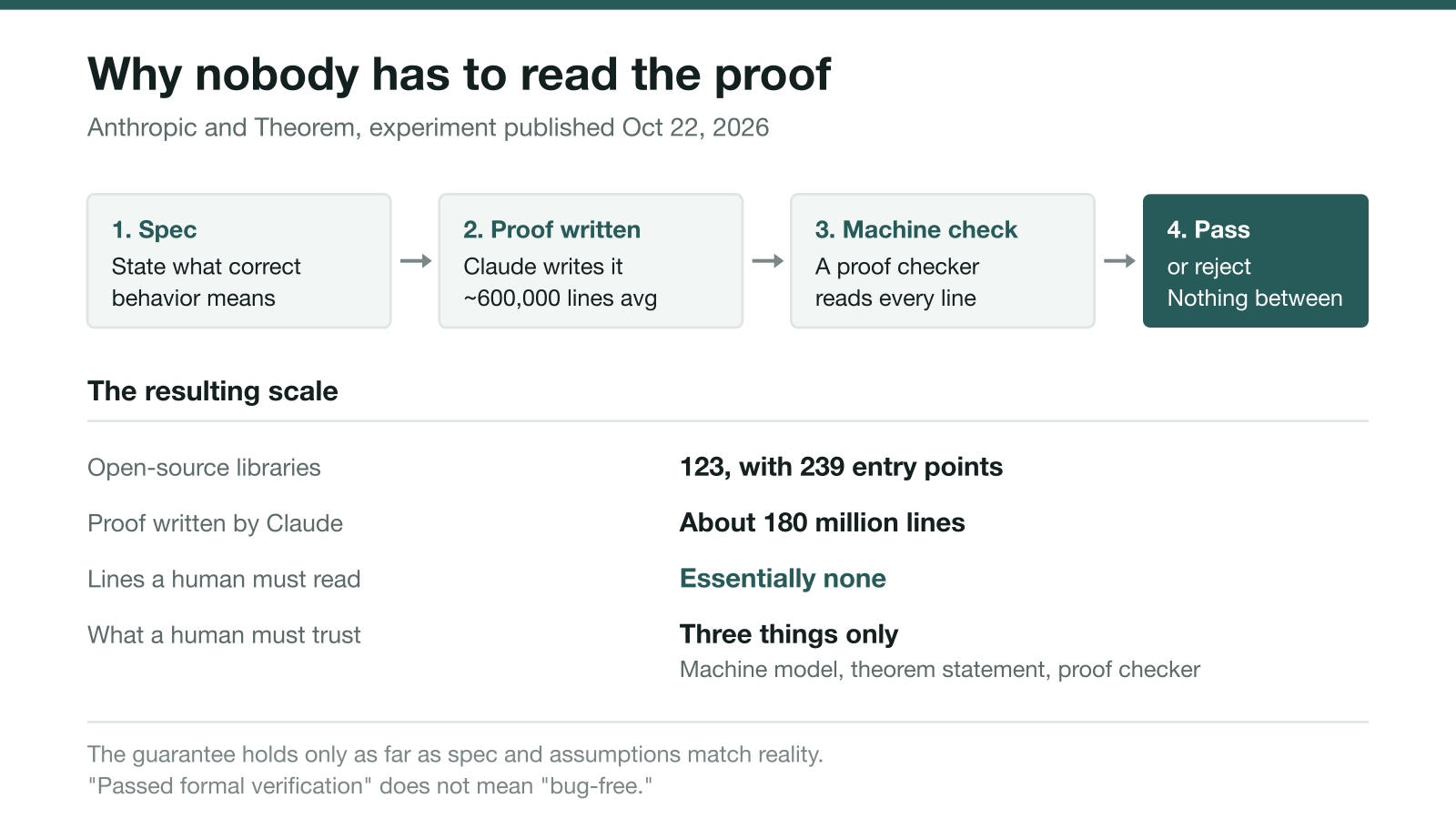
    The third piece is the proof checker, a program that walks the proof line by line and rejects it if there is a gap. That is what makes this workable with AI in the loop, because nobody has to read a long machine-written proof and decide whether to believe it. Interviewed by Latent Space, Clark Barrett described Lean this way: “What Lean does is it just checks that you didn’t make a mistake. So you can think of it as a very sophisticated checker for mathematics.”[3]

    Lean is an open-source programming language built for writing proofs and having them checked.[2] Anthropic used Rocq, a comparable tool, for its code work.[1] These tools already sit inside services people use. AWS formally verifies Cedar, the system it uses to decide who is allowed to access what, in Lean.[2] Barrett said cvc5, the automated reasoning engine he co-created, is called billions of times a day inside Amazon’s running systems.[3]

    Barrett put the difference from testing this way: “The main difference is really just, how do you know when you’re done. So if you’re testing, patching, scanning, using all these existing tools, they’re quite good. I mean, they find a ton of problems. They raise those issues. But you’re never quite sure, did I find all of them or is there one more lurking there that my tool can’t find?”[3]

    What Anthropic actually ran

    Working with the verification company Theorem, Anthropic targeted code registered with OSS-Fuzz, Google’s continuous fuzzing program for open-source projects. Rather than write specs by hand, the team converted each project’s existing fuzz test into one, encoding the rule “this test never crashes on any input,” with the input ceiling set at 64 MB.[1]

    Over a few weeks Claude completed proofs for 239 entry points (the doors a project’s authors provide for testing to reach the code behind them) across 123 open-source libraries. The output came to roughly 180 million lines of Rocq, with a typical proof around 600,000 lines, covering programs whose compiled form ran to a median of 18,000 machine instructions. The proof is vastly longer than the code it certifies, and essentially none of it needs human review, because the checker is what reads it.[1]

    The flow from spec to machine-written proof to automated checking, with the scale of Anthropic's experiment
    The flow from spec to machine-written proof to automated checking, with the scale of Anthropic’s experiment

    Hundreds of bugs turned up along the way. In one widely used PDF reader, a week of this work produced as many security bugs as the project typically sees reported in a year. In another application, a logic bug that had gone unnoticed for more than a decade came out.[1]

    For a sense of what this used to cost, Anthropic pointed to seL4, an operating system kernel. Building it took two person-years, while formally verifying it took twenty, so verification cost ten times as much as writing the thing. That is why the technique stayed confined to places where lives are at stake, such as Airbus avionics code.[1]

    The cost is coming down

    A single proof can consume hundreds of millions of tokens, which is the unit models are billed in.[1] Anthropic offered two reasons to expect that bill to shrink.

    Newer models need fewer tokens for the same work. On 36 small verification tasks drawn from real OSS-Fuzz code, Opus 5.5 proved half of them using about 40% fewer tokens than Opus 5. Each task got three independent attempts on a 5M-token budget, and the task counted as proved once the earliest of those attempts finished.[1]

    Proofs can also be reused, since they are built recursively out of smaller proofs. When researchers gave several agents a shared workspace where they could copy each other’s proofs, the agents used 17% fewer tokens than working alone. Solo work cost more on 30 of the 34 completed proofs, and some agents finished tasks in the shared workspace that they had failed solo.[1]

    Mathematicians have been accumulating proofs this way for years. Mathlib, Lean’s communal library, now holds over a million lines of mathematics written in machine-checkable form, each proof resting on the ones before it.[2]

    Results clustered in 2026. Going by the news timeline kept by Lean FRO, the nonprofit that supports Lean’s development: in August Anthropic released results connected to the Riemann hypothesis along with Lean formalizations; in September it announced a Lean formalization of Fermat’s Last Theorem; in October OpenAI and Axiom each published Lean proofs on separate open problems, and &Truth came out of stealth with $70m in seed funding for Lean-based software verification.[5]

    Axiom CEO Carina Hong connects the math results to the code results. On the Latent Space podcast she argued against treating formal verification purely as a filter for mistakes: “Verification to me is about scaling brilliance, compounding brilliance.” Her argument is that once a proof is machine-checked it can serve as ground truth for the next round of model training, which is a much more reliable teaching signal than scoring an answer on how plausible it looks. She named the limit in the same conversation: “Anything that can be specified can be proven. Humans are bad at specifying everything we want.”[4]

    “Verified” does not mean “bug-free”

    Anthropic gave the limitations their own section. A proof checker confirms that the proof satisfies the spec. It cannot tell you whether the spec matches reality. When a bug shows up in verified code, it means the spec or the model of the machine differed from the real world.[1]

    Two such gaps are documented. The proofs assume a chip built to the RISC-V design, running a program that handles one task at a time. In practice people run this software on the x86 and ARM chips found in ordinary computers and phones, assembled with other components in ways the proof did not model. And what was proven is “no crash on any input under 64 MB,” as judged by a monitoring tool that does not catch every category of memory error. Not every entry point was verified, and verifying all of them still would not cover a whole library.[1]

    A footnote addresses reward hacking, where a model finds a shortcut that satisfies the letter of its goal. Here, rewriting a program to do nothing at all would make “never crashes” trivial to prove. The team docked points whenever Claude modified the code, awarded credit for showing that a given fix changed the behavior of as few inputs as possible, and logged and audited every change.[1]

    So when you hear that something passed formal verification, three questions follow: what was used as the spec, what environment was assumed, and how much of the code the claim covers. In Anthropic’s framing, the remaining bugs have not vanished; you now know where to look for them.[1]

    What this is worth if you don’t write code

    • Hear “we verified it” as two different claims. “We ran it several times and it looked fine” and “we showed it holds in every case” carry different guarantees. The first is only true of the cases that were run.
    • Writing down what a correct result looks like, before handing off the work, makes checking possible. The most expensive step in formal verification is writing the spec, and delegating to AI has the same shape. If you cannot state the conditions a good result must meet, you have no standard to check the output against.
    • Trying to produce a counterexample teaches you more than confirming success. In the experiment above, what hid the bug was a test that only generated sensible inputs. Looking for the case that breaks beats looking for the case that works.
    • When a security notice says something is “memory safe,” check the scope. The real content is which guarantee was made under which assumptions.

    Edsger Dijkstra’s old line still sets the terms: program testing can be used to show the presence of bugs, but never to show their absence.[7] Formal verification does show absence, within the bounds of a stated spec. The price is the work of writing that spec plus the token bill, and the guarantee holds only as far as the spec and its assumptions match reality. In 2026 that price fell. Work that once took twenty person-years can absorb models and tokens instead, and because nobody has to read the proof, AI-written volume is usable as-is.

    Related reading: the trust problem with AI-written code, how code review became the bottleneck, and measuring agent reliability.

    Sources


    Notes

    1. Anthropic Frontier Red Team, “LLMs are making formal software verification feasible at a much larger scale” (2026-10-22). Source for 239 entry points across 123 libraries, ~180 million lines of Rocq, typical proof ~600,000 lines, median binary of 18,000 instructions, the 1 MB fuzzer input cap, hundreds of millions of tokens per proof, Opus 5.5 using 40% fewer tokens across 36 tasks, 17% savings from a shared workspace, seL4 at two versus twenty person-years, and the limitations and reward-hacking notes. Original ↩
    2. Lean official site. Lean’s definition as “an open-source programming language and proof assistant,” Mathlib at over a million lines, and AWS verifying Cedar in Lean. Original ↩
    3. Richard MacManus, “The War Against Slop and an Emerging Weapon to Fight it: Formal Verification,” Latent Space (2026-11-20). Clark Barrett’s quotes and the cvc5 usage figure at Amazon. Original ↩
    4. Latent Space Podcast, “Scaling Past Informal AI — Carina Hong, Axiom Math.” Source for both Hong quotes. Original ↩
    5. Lean FRO 2026 news timeline, Lean official site. August Anthropic Riemann zeta results, September Fermat’s Last Theorem formalization, October OpenAI and Axiom results and &Truth’s $70m seed round. Original ↩
    6. AI Signal experiment (2026-11-21, `scripts/tmp-verify-demo.ts`). 0 failures across 1,000,000 random runs, 507,927 with a widened generation range, 499,500 of 1,000,000 (50.0%) on exhaustive check with first counterexample remain=0, used=1, and 584 years to check 18,446,744,073,709,551,616 combinations at a billion per second. The outputs above are reproduced as printed. ↩
    7. Edsger W. Dijkstra, *Notes on Structured Programming*. The wording quoted here is the one most commonly cited from the text; sources differ on whether to date it to the notes as circulated in 1970 or the 1972 Academic Press volume, so no year is given above. A closely related formulation appears in Dijkstra’s EWD303. ↩

    Source: https://www.anthropic.com/research/formal-verification

  • Software Engineer Job Market 2026: Postings Up 23%, New Postings Up Only 5%

    US job postings for software engineers are 23.4% higher than they were a year ago. That figure comes from Indeed Hiring Lab’s job postings index, which the research arm of the job site publishes every week as a spreadsheet file anyone can download, calculated here for November 13, 2026.[1] Indeed files these roles under the label “software development,” and that is the name used from here on. Across the 47 occupational sectors in the same file, 35 are up compared with a year earlier. Hiring Lab itself wrote on November 12 that “the year-over-year trend turned positive for the first time in nearly four years, with job postings up 3.1% in the year to October 23.”[2]

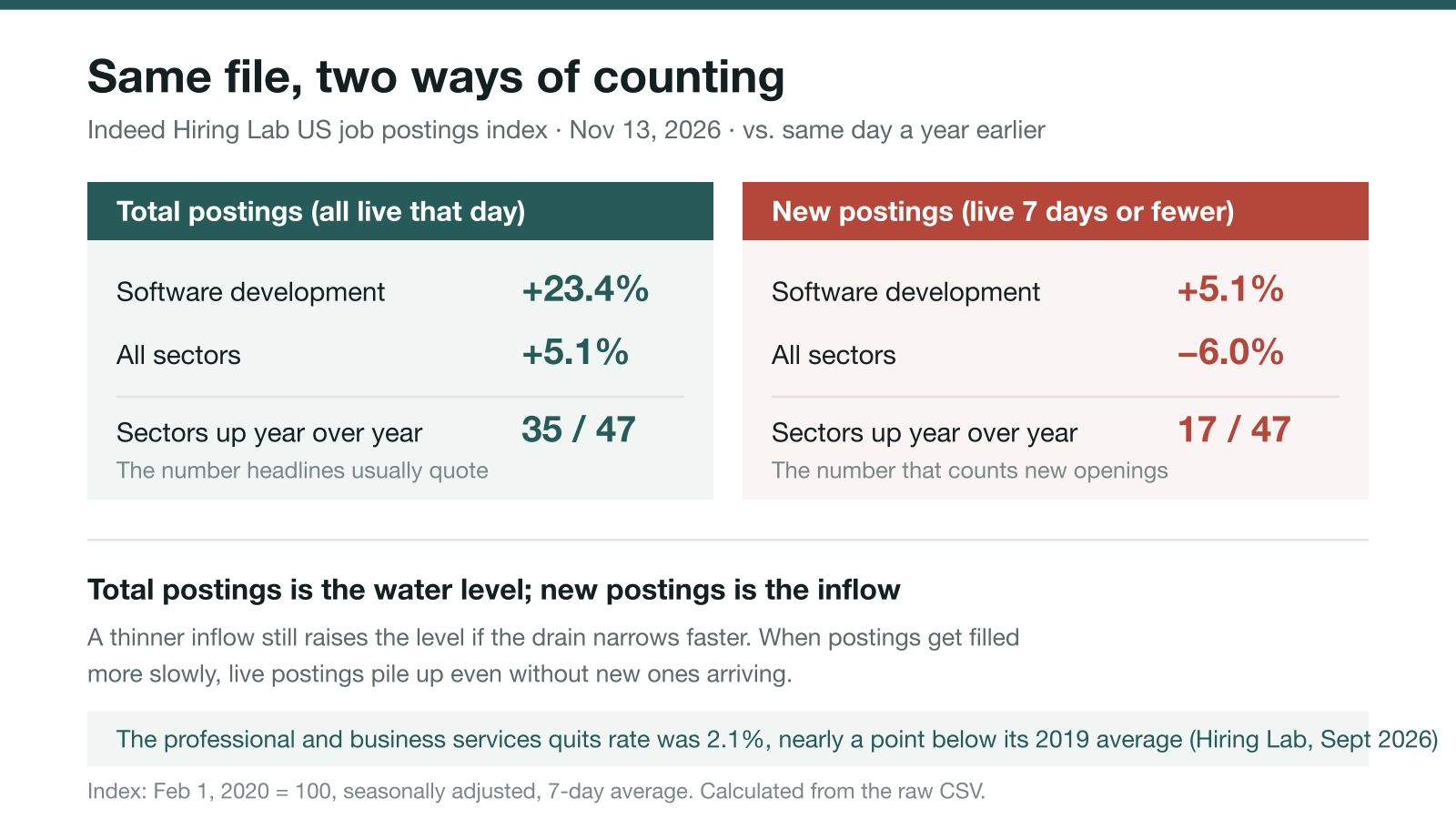
    The same file counts postings two ways. One count covers every posting that was live on a given day. The other covers only postings that had been up for seven days or fewer.[3] Switch to that second count and only 17 of the 47 sectors are up, while 30 are down. The all-sector new postings index sits 6.0% below where it was a year ago.[1]

    Software development follows the same split. Total postings are up 23.4%. New postings are up 5.1%.[1]

    What the index actually measures

    Hiring Lab’s index is not a count of postings. It is a level relative to February 1, 2020, which is set to 100. An index of 81.7 means postings are 18.3% below where they stood just before the pandemic. The series is seasonally adjusted so that the usual hiring calendar does not show up as a trend, and it uses a seven-day trailing average so single days do not swing it.[3]

    US job postings index: total postings versus new postings
    US job postings index: total postings versus new postings

    Here are the main sectors as of November 13.[1] The middle column is the number that normally makes the headlines. The two columns on the right are the new postings count.

    Sector Index Total postings, year over year New postings index New postings, year over year
    Mechanical engineering 173.8 +46.1% 146.5 +19.1%
    Industrial engineering 127.5 +43.5% 131.2 +29.5%
    Electrical engineering 158.8 +36.8% 144.7 +4.0%
    Software development 81.7 +23.4% 88.2 +5.1%
    Scientific research and development 85.5 +23.2% 90.4 +11.8%
    IT systems and solutions 78.1 +13.5% 84.9 +11.0%
    Data and analytics 61.8 +3.7% 68.1 −2.7%
    Media and communications 66.0 +3.5% 57.3 −14.3%
    Marketing 78.4 +0.4% 76.9 −2.1%
    Administrative assistance 93.3 −2.0% 82.5 −17.3%
    Accounting 106.6 −2.8% 70.2 −6.9%
    All sectors 106.2 +5.1% 93.3 −6.0%

    Media and communications is up 3.5% on total postings and down 14.3% on new ones. Administrative assistance is down 2.0% on total postings and down 17.3% on new ones.[1] Across all 47 sectors, 35 rise on the first count and only 17 on the second.

    Live postings and fresh postings measure different things

    The total count behaves like the water level in a reservoir, and the new count behaves like the inflow. A thinner inflow still raises the level if the drain narrows faster.

    Hiring Lab’s November report carried a figure about the drain. The quits rate in professional and business services, meaning the share of workers who left a job voluntarily in a month, was 2.1% in September 2026, nearly a full percentage point below its 2019 average. The information industry is also below its 2019 average despite a recent uptick. The report summed it up this way: “Despite some recent strength in tech job postings and wage growth, workers seem content to remain where they are, as low quits rates persist.”[2]

    When fewer people leave, fewer vacancies appear, and the ones that do appear take longer to fill. Once that happens, the number of live postings no longer tells you that hiring has picked up. The two counts imply that postings are sitting open longer, but Indeed does not publish how many days an individual posting stayed up, so that step is an inference and not a measurement.

    The biggest gain was in mechanical engineering

    When people point to a rebound in a sector that AI was supposed to hollow out, they usually point to software. In the November data the top three are mechanical engineering (+46.1%), industrial engineering (+43.5%) and electrical engineering (+36.8%). Software development is fourth. The three engineering sectors have climbed roughly ten index points every two months since November 2025 with no reversal in between.[1]

    Hiring Lab traced much of that demand to data center construction in July. Data center postings went from 2 per 1,000 US postings in May 2023 to 6 per 1,000 in 2026, about a quarter of them for installation and maintenance workers, and the ten largest tech companies by market value placed 71% of the data center postings in 2026.[4] Judge AI’s effect on employment by the software line alone and the sectors that moved further, sitting in the same file, never enter the picture.

    69.3% of software postings ask for senior people

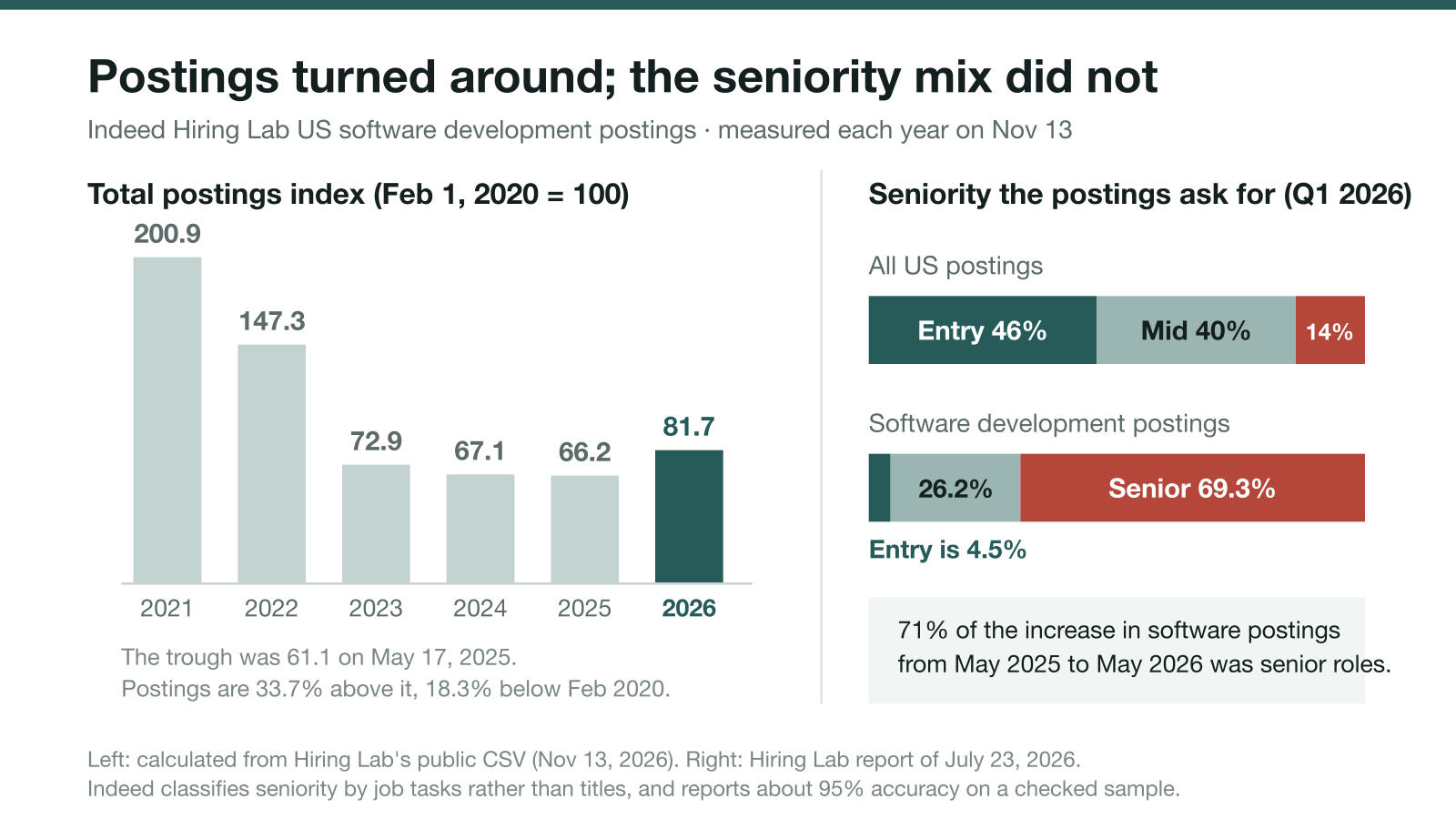
    The software rebound started in spring of last year. Taking November 13 of each year, the index runs 200.9 in 2021, 147.3 in 2022, 72.9 in 2023, 67.1 in 2024, 66.2 in 2025 and 81.7 in 2026. The trough was 61.1 on May 17, 2025, and postings are 33.7% above that.[1]

    Software development postings index and seniority mix
    Software development postings index and seniority mix

    Hiring Lab broke the increase down by seniority in July. Of the growth in software development postings between May 2025 and May 2026, 71% came from senior roles and 37% from roles with AI in the title, with the two categories overlapping. The report read it as evidence that “demand is growing for experienced professionals who can work with AI, not necessarily a broad-based recovery across all software roles.”[5]

    A companion report counting the seniority mix is blunter. In the first quarter of 2026, 69.3% of software development postings were senior roles and 4.5% were entry level. Across all US postings the split is 46% entry, 40% mid and 14% senior, so software runs almost the opposite way. As of May 2026 senior postings were up 14.7% from a year earlier while entry-level postings were down 7.5%.[6]

    Indeed assigns these labels from what the job involves rather than from the title or a stated years-of-experience line. It looks at whether the role manages others, what skills it needs and whether it requires a license. A human check of a random sample agreed with the classifier about 95% of the time.[6]

    The Bank of Korea found the same shape

    The Bank of Korea’s employment research team used national pension enrollment records and the national labor force survey to look at youth employment in August. Over four years, jobs held by people aged 15 to 29 fell by 285,000, and 268,000 of those losses came from industries where AI can plausibly take over the work. That is 94 of every 100 jobs lost. Information services fell 31.4%, publishing 27.4%, computer programming 16.6% and professional services 11.6%. In those same industries, employment of workers in their fifties rose.[7]

    The report calls the pattern seniority-biased technological change: when the technology shifts, junior positions shrink while experienced positions hold or grow. The US postings data points the same way, and the two findings come from entirely different records.

    The Bank of Korea also split industries by how AI gets used. Where AI substitutes for the work (automation), youth employment fell more steeply. Where people do the work and use AI to draft or check it (augmentation), the pattern did not appear. On unemployment, college graduates aged 15 to 29 averaged 7.0% since November 2022 against 5.4% for those with less than a four-year degree, a gap of 1.6 percentage points.[7]

    Why neither group will blame AI

    Both Hiring Lab and the Bank of Korea declined to name AI as the cause. Hiring Lab noted that software postings turned up at about the time Anthropic released Claude Code, a tool that lets an AI model write and change code on a developer’s own machine, in late February 2025, then added that “there were, of course, many other factors influencing the market both then and now.”[5] Its seniority report cited researchers at the Federal Reserve Bank of New York who tie recent graduates’ trouble more closely to the spread of remote work than to AI, alongside the Federal Reserve’s interest rate increases and the unwinding of pandemic-era over-hiring.[6]

    The Bank of Korea listed “the normalization of pandemic-era over-hiring, a preference for experienced hires, weaker in-house training and the spread of remote work” as factors that may have operated together, and concluded that the current shift is better read as AI accelerating changes already underway in hiring and work practices than as a direct effect of AI on its own.[7]

    The index has its own limits. Indeed postings reflect Indeed’s user base, which may differ from the US workforce, and the public files stop at the sector level with no breakdown by seniority or experience.[3] Indeed works out the seniority mix separately and publishes it only in its reports.

    What to do with this

    When a story quotes a hiring number, check whether the thing that grew is live postings or fresh ones. Hiring Lab’s files carry both, so the comparison takes one pass through the same spreadsheet.

    For anyone looking for work, the seniority a posting asks for matters more than how many postings exist. Only 4.5% of software development postings are open to entry-level candidates, against 91.3% in personal care and home health.[6]

    For anyone already employed, the Bank of Korea’s split is worth applying to your own job. Tasks AI takes over outright and tasks where a person stays in charge and uses AI to draft or check the work came out differently in its data, and shifting more of your week toward the second kind is the safer bet.

    For anyone hiring, a posting that stays open says little about demand. A low quits rate also means fewer candidates in circulation.

    A note at the end

    The same data showed up under opposite headlines all year. 23% is true and 5% is true. Which one runs depends on which count someone picked.

    The figure that stayed with me is the 4.5%. Postings can rise 23% while the door to the first job barely moves. The Bank of Korea’s recommendation, to redesign the career ladder so young workers can accumulate experience and tacit knowledge alongside AI rather than to preserve existing junior roles, reads like a response to that mix.[7]

    The senior roles being filled now are filled by people who got in as juniors ten years ago. The day the index crosses 100 and the day entry-level postings start growing again may not be the same day.

    Sources


    Notes

    1. Calculated directly from Indeed Hiring Lab’s raw CSVs `US/job_postings_by_sector_US.csv` and `US/aggregate_job_postings_US.csv`, pulled through November 13, 2026. The table, the sector changes, the year-by-year index values and the counts of rising and falling sectors all come from that calculation. Every comparison uses November 13 on both ends. hiring-lab/job_postings_tracker ↩
    2. 2026 Q3 US Tech Labor Market Update, Daniel Culbertson, Indeed Hiring Lab, November 12, 2026. Report ↩
    3. Data definitions from the same repository. The index is the percentage change against February 1, 2020, seasonally adjusted with a seven-day trailing average, and “new” means a posting that has been on Indeed for seven days or fewer. Sectors come from Indeed’s own classification of normalized job titles. README ↩
    4. Hiring for the Data Center Build-Out, Aubrey Woessner and Laura Ullrich, Indeed Hiring Lab, July 14, 2026. Report ↩
    5. AI and Job Postings: From Destruction to Creation?, Guillermo Gallacher, Indeed Hiring Lab, July 8, 2026. Report ↩
    6. The Labor Market Is Tilting Toward Seniority, Felix Aidala and Sneha Puri, Indeed Hiring Lab, July 23, 2026. The classification method and the 95% sample check are in the methodology section of the same piece. Report ↩
    7. BOK Issue Note 2026-19, “Youth Employment Contraction: Is AI to Blame? The Changing Career Ladder and Policy Responses,” Employment Research Team, Bank of Korea, August 18, 2026. Quotations translated from the Korean original. Report ↩

    Source: https://hiringlab.indeed.com/2026/11/12/2026-q3-us-tech-labor-market-update/

  • AI Image Generation Cost in 2026: Nano Banana Pro Pricing, GPT Image and FLUX Per-Image Rates

    Generating one AI image costs between $0.008 and $0.607 as of November 19, 2026[1][2]. That is a spread of more than seventy times for the same single picture. The company you pick matters less than which model you call and what resolution you ask for.

    Most of the time that number stays hidden behind a monthly subscription. When you generate a picture in ChatGPT or the Gemini app, you never see what the image cost. You only see a message when you hit a limit. The developer price lists published by the same companies do show it, down to fractions of a cent, and those numbers say what a subscription is actually buying.

    Every figure below comes from the official pricing pages, opened and read on November 19, 2026. Prices change often, so check the links again before you pay for anything.

    Resolution and model set the price

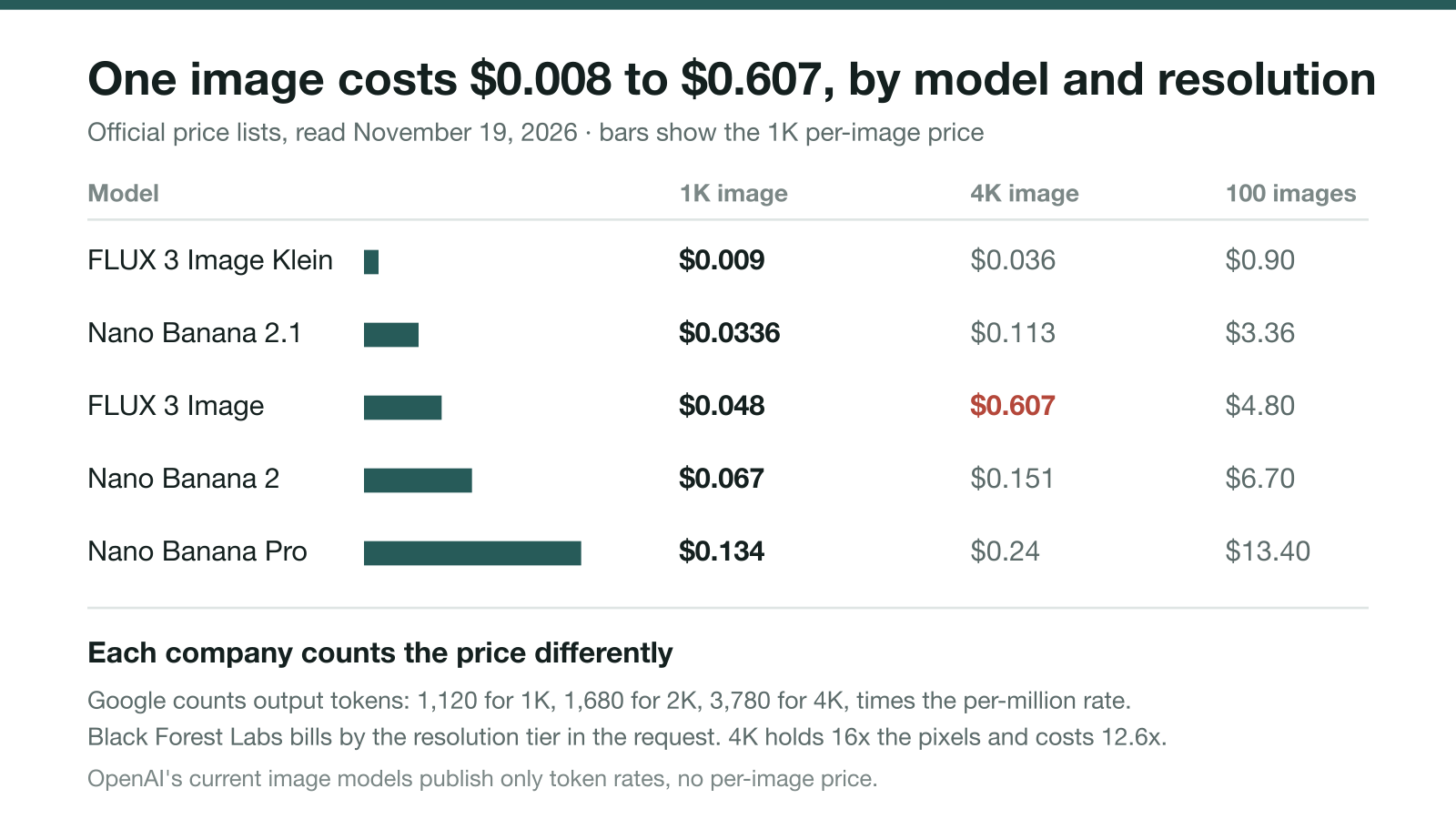
    Image services bill by resolution tier, written as 1K (around 1,024 pixels on a side), 2K and 4K. The cheapest combination available today is Black Forest Labs’ FLUX 3 Image Klein at 768×768 pixels: $0.008 per image[2]. The most expensive is the same company’s FLUX 3 Image at 4K: $0.607. On Google’s side, Nano Banana 2.1 runs $0.0336 for a 1K image, while the higher-end Nano Banana Pro costs $0.134 for 1K or 2K[1].

    At a hundred images those gaps turn into real money: $0.90 for Klein at 1K, $3.36 for Nano Banana 2.1, $13.40 for Nano Banana Pro, and $60.70 for FLUX 3 at 4K[7].

    Per-image price by model and resolution
    Per-image price by model and resolution

    What a per-image price covers

    A listed price describes one request that produced one usable image. In real work you often generate five or six to keep one, which multiplies the bill by the same factor. Retry count moves the total more than the unit price does.

    The three companies count different things along the way. Google does not charge for the interim “thought images” a model produces while working out a composition, and it counts a reference image you supply as 560 tokens, about $0.0011[5]. You can mix up to 14 reference images. Black Forest Labs includes prompts and reference images at no extra charge, and does not bill for failed generations or for images its safety filter blocks before delivery[2]. OpenAI adds 100 output tokens per preview frame if you switch on the setting that streams a rough version while the image renders[4].

    Resolution is counted differently from one company to the next. Black Forest Labs bills by the tier named in the request and spells out the pixel count of each tier: 768×768 is roughly 0.6 megapixels, 1K about 1, 1.5K about 2, 2K about 4, and 4K about 16[2]. So 4K costs 12.6 times what 1K costs because it holds sixteen times the pixels, not because the unit price rose. Per megapixel, 4K works out to $0.038 against $0.048 for 1K[7].

    Google prices images by output token

    Google treats an image as a bundle of tokens, the units a model uses to count text or pixels, and charges per million of them. Nano Banana 2.1 bills image output at $30 per million tokens, and a 1K image consumes 1,120 tokens, a 2K image 1,680, a 4K image 3,780[1]. Multiply those out and you get the $0.0336, $0.0504 and $0.113 printed on the page (the last one rounded from $0.1134).

    Google image model (paid tier, standard) 1K 2K 4K Notes
    Nano Banana 2.1 $0.0336 $0.0504 $0.113 Batch is half: $0.0168 / $0.0252 / $0.0567
    Nano Banana 2 (Gemini 3.1 Flash Image) $0.067 $0.101 $0.151 Adds 0.5K (512px) at $0.045
    Nano Banana 2 Lite $0.0336 not listed not listed Low latency tier, batch $0.0168
    Nano Banana Pro (Gemini 3 Pro Image) $0.134 $0.134 $0.24 Input image counted at $0.0011
    Nano Banana (Gemini 2.5 Flash Image) $0.039 not listed not listed Shuts down March 15, 2027

    Every number in that table is from Google’s pricing page[1]. Nano Banana Pro sits at $120 per million output tokens, four times the 2.1 rate, and spends 1,120 tokens on a 1K or 2K image and 2,000 on a 4K one, which is why its 1K and 2K prices are identical at $0.134 and only 4K rises to $0.24[1].

    Picking by version number can cost you money. Nano Banana 2.1 is the successor to Nano Banana 2, and it is cheaper at 1K: $0.0336 against $0.067, because Google cut the token rate from $60 to $30 per million[1]. At 4K the gap narrows, since the two models spend different amounts on the same resolution, 3,780 tokens for 2.1 and 2,520 for 2[1]. The older model also keeps one thing 2.1 lacks: 512-pixel output[5].

    FLUX prices images by resolution tier

    Black Forest Labs publishes a straight per-image number instead of a token rate, so there is nothing to calculate[2].

    FLUX model (API) 768×768 1K 1.5K 2K 4K
    FLUX 3 Image $0.041 $0.048 $0.07 $0.10 $0.607
    FLUX 3 Image Klein $0.008 $0.009 $0.011 $0.014 $0.036

    Those rates and the editing rates below are from the company’s price list[2]. Editing is priced on its own table: FLUX.1 Kontext comes in a standard version at $0.04 per image and a premium one at $0.08, while tools such as outpainting (extending a background past its original edge) and erase (removing an object) are billed by the megapixel of the result.

    OpenAI no longer publishes a per-image price

    OpenAI’s current image models, GPT Image 2.6 in its Sunburst and Flare variants, have no per-image figure on the pricing page. The page lists token rates instead: $30 per million image output tokens, $8 per million image input tokens, $5 per million text input tokens[3]. Quality has five settings (low, medium, high, xhigh, max), and the documentation notes that token counts can differ between models at the same quality setting[4]. Token counts for a given combination appear only in a calculator embedded in the docs, which is drawn in JavaScript and could not be read as text.

    The previous generation still shows the range. Through GPT Image 2, OpenAI published a per-image table for 1024×1024: $0.006 at low quality, $0.053 at medium, $0.211 at high[4]. Low to medium is nearly a ninefold jump, medium to high is four times[7]. The quality switch drives the bill more than anything else. Those are last-generation numbers, so for current models the only reliable figure is the token usage returned with each response.

    The three price lists differ in how much they tell you up front. Google and Black Forest Labs publish the cost before you spend it, while OpenAI shows it afterwards. The smaller your volume, the harder it becomes to predict a monthly bill.

    A monthly subscription buys a usage limit

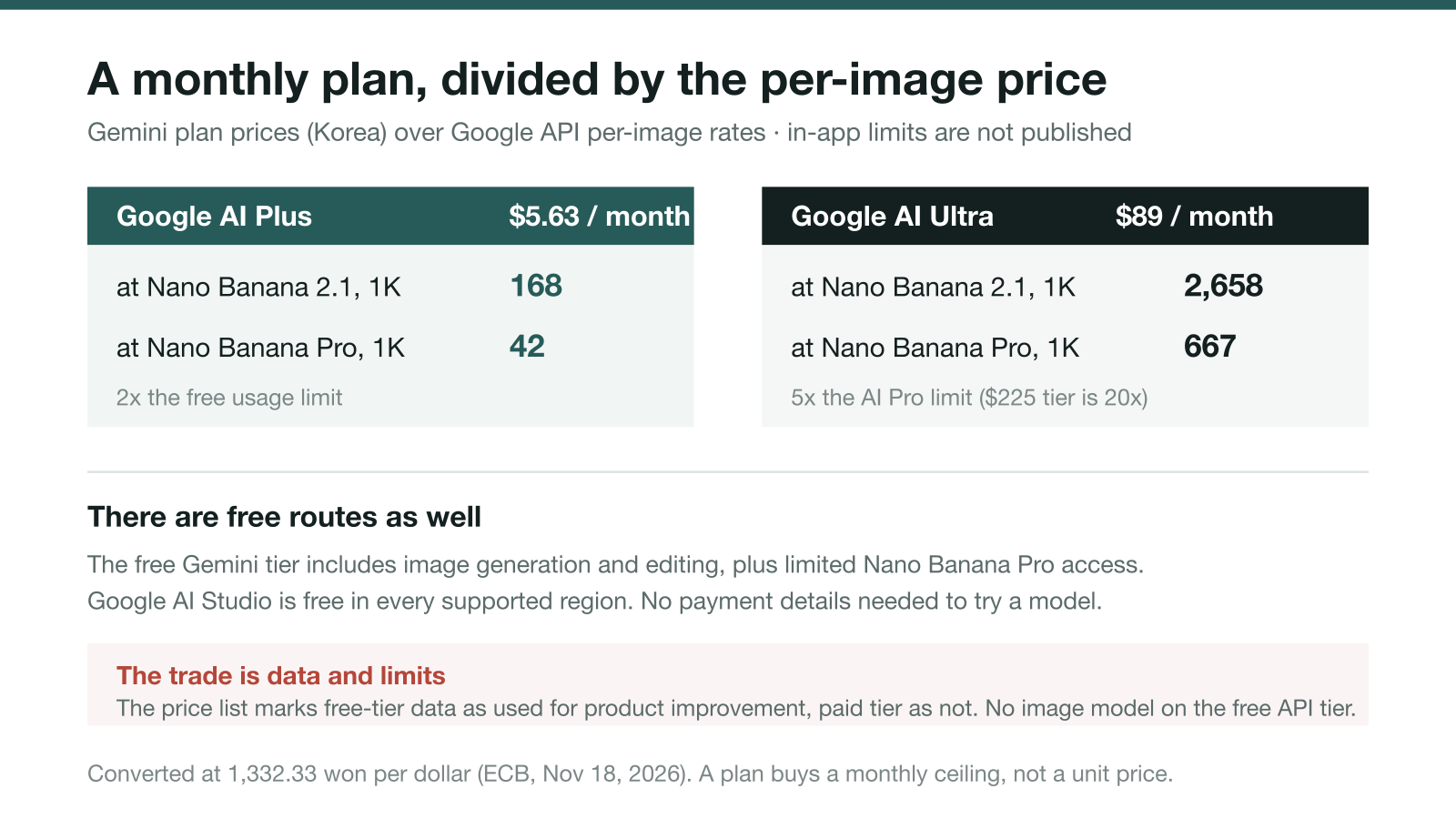
    What most people actually pay is an app subscription. Google lists its Korean prices in won on the official page, the version that was readable: free at ₩0, Google AI Plus at ₩7,500 a month (about $5.63) for twice the free usage limit, and Google AI Ultra at ₩119,000 (about $89) for five times the AI Pro limit or ₩300,000 (about $225) for twenty times that same AI Pro limit[6][7]. The free tier includes image generation and editing plus limited access to Nano Banana Pro. Google AI Pro, the tier in between, is described as four times the free limit, but no amount appeared in the page, so it is left blank here.

    Divide a subscription by a per-image price and you can see what kind of number it is. The ₩7,500 tier covers 168 images on Nano Banana 2.1 at 1K, or 42 on Nano Banana Pro. The ₩119,000 tier covers 667 Pro images or 2,658 on 2.1[7]. Real in-app limits are different and are not published, but the comparison shows that a subscription prices a monthly allowance rather than marking up a unit cost. Generate a few dozen images a month on a top tier and most of what you paid for goes unused.

    Subscription prices divided by per-image cost
    Subscription prices divided by per-image cost

    ChatGPT and Midjourney subscription prices are missing here. Both official pricing pages (openai.com, midjourney.com) refuse automated requests, so there was no primary source to quote. For monthly plan comparisons checked in October, see ChatGPT vs Claude vs Gemini plan pricing.

    The free options and what they cost you

    Google AI Studio (aistudio.google.com) is free to use in every supported region[1]. You pick a model in the browser, type a prompt, and get a result without entering payment details. For a first comparison of image models, that is the cheapest place to start.

    The free tier of the API is another matter: it carries no image models at all. For both Nano Banana 2.1 and Nano Banana Pro, the free tier column reads “Not available”[1]. The same table says data sent through the free tier is used to improve Google’s products, and that paid-tier data is not. That line is worth reading before you upload company material or someone else’s face. On what not to put into a chatbot at all, see using AI without giving away your data.

    Price aside, generated images arrive with a marker attached. Google states in its documentation that every image produced by Gemini includes a SynthID watermark, a signal embedded in the pixels rather than a visible logo[5]. If the picture is going into a blog post or an ad, that marker goes with it.

    Running open-weight models yourself

    Some FLUX models ship their weights, the numbers a model learns during training, so you can download them and run the model on your own machine instead of calling a server. The Klein and dev lines work this way. Run them yourself and the per-image charge disappears, leaving electricity and hardware. Klein is published at a size that fits on a single consumer graphics card, 5.6 billion parameters[2].

    Commercial use is licensed separately. Black Forest Labs sells self-hosting licenses by monthly volume and domain count: the Builder tier covers 10,000 images a month, one domain and ten licensed users; the Platform tier covers 100,000 a month; anything larger is priced by the sales team[2]. A non-commercial license exists on its own terms. Hobby use and company use fall under different agreements, so read the license first if the output is going into a product.

    Checklist

    • Draft on the cheap combination. There is no reason to spend $0.134 per image while you are still testing composition. Work in the $0.008 to $0.0336 range and save the expensive model for the final version.
    • Do not leave 4K as a default. It is 12.6 times the cost of 1K on FLUX 3 and 3.4 times on Nano Banana 2.1[7]. For anything viewed on a screen, 1K is enough.
    • Send bulk jobs through batch processing, where you submit many requests at once and collect the results later instead of waiting. Google’s batch rate is exactly half[1].
    • Do not read the version number as a price. Nano Banana 2.1 is $0.0336 per 1K image; Nano Banana 2 is $0.067.
    • Count how many images you actually generate per month before picking a tier. The ₩7,500 plan covers 42 images on the Pro model.
    • Start on Google AI Studio if you just want to compare models, and read the line about free-tier data being used for product improvement before you upload anything sensitive.
    • For work use, check the watermark and the license before paying. Google images carry SynthID, and commercial use of open-weight models is a paid license.
    • For how token pricing works in general, see how AI pricing is counted in tokens.

    Both tables on this page will be updated when the price lists change.

    References


    Notes

    1. Gemini API pricing page, read November 19, 2026. Token rates and per-image equivalents for Nano Banana 2.1 ($30 per million output tokens; 1,120 / 1,680 / 3,780 tokens), Nano Banana 2 ($60 per million; 747 / 1,120 / 1,680 / 2,520 tokens), Nano Banana 2 Lite, Nano Banana Pro ($120 per million; 1,120 tokens for 1K and 2K, 2,000 for 4K) and Gemini 2.5 Flash Image; batch rates at half; free tier availability and the data-use column; the note that Google AI Studio usage is free of charge in all available regions. Link ↩
    2. Black Forest Labs pricing page, read November 19, 2026. Per-image prices by resolution tier for FLUX 3 Image and Klein, FLUX.1 Kontext and image tool rates, the billing FAQ (tier-based billing, reference images and prompts included, failed and withheld generations not charged, megapixel count per tier), self-hosting license tiers, and Klein’s 5.6 billion parameters. Link ↩
    3. OpenAI platform pricing page, read November 19, 2026. gpt-image-2.6 Sunburst and Flare at $8 per million image input tokens, $30 output, $2 cached input, $5 text input, and half those rates in batch. Link ↩
    4. OpenAI image generation guide, read November 19, 2026. The five quality settings, the note that token counts can differ by model at the same quality, 100 extra output tokens per partial image, and the legacy per-image table for GPT Image 2 at 1024×1024 ($0.006 / $0.053 / $0.211). Link ↩
    5. Gemini image generation documentation, read November 19, 2026. “All generated images include a SynthID watermark”, up to 14 reference images, interim thought images not charged, 1K/2K/4K support and the 0.5K option limited to Gemini 3.1 Flash Image. Link ↩
    6. Gemini subscription page with country set to Korea, read November 19, 2026. Free tier at ₩0 with limited Nano Banana Pro access, Google AI Plus at ₩7,500 (2× the free limit), Google AI Pro listed at 4× with no price rendered, Google AI Ultra at ₩119,000 (5× AI Pro) and ₩300,000 (20× AI Pro). Link ↩
    7. Hundred-image totals, per-megapixel rates, quality-step ratios, dollar conversions of the Korean subscription prices and the images-per-subscription figures were calculated from the published rates above, using the European Central Bank reference rate of 1,332.33 won to the dollar on November 18, 2026. Link ↩

    Source: https://ai.google.dev/gemini-api/docs/pricing

  • AI agents and bank runs: a Fed governor says deposits could drain in minutes

    Speaking in Milan on November 16, Federal Reserve Governor Michael Barr said major banks are now finding AI agents trying to act inside retail customer accounts. The bank cannot verify that the request really came from the customer, that the customer consented, or that it matches what the customer asked for.[1]

    An AI agent is a program that takes a goal and runs the steps itself. A chatbot hands back an answer and stops; an agent logs in, fills forms and clicks buttons. Last week OpenAI put payments in an agent’s hands with ChatGPT Wallet.

    When “AI bubble” shows up in a headline, the thing most people picture is a stock chart. Barr’s speech and the Federal Reserve’s Financial Stability Report, published three days earlier, counted where the debt has piled up, who is holding it, and what changes once software rather than a person is the one moving money.

    Barr noted in his first footnote that the views are his own and do not represent the Board of Governors or the Federal Open Market Committee.[1] The Financial Stability Report is the Board’s own twice-yearly document; the November edition came out on November 13.[2]

    $680 billion borrowed for AI build-out through October

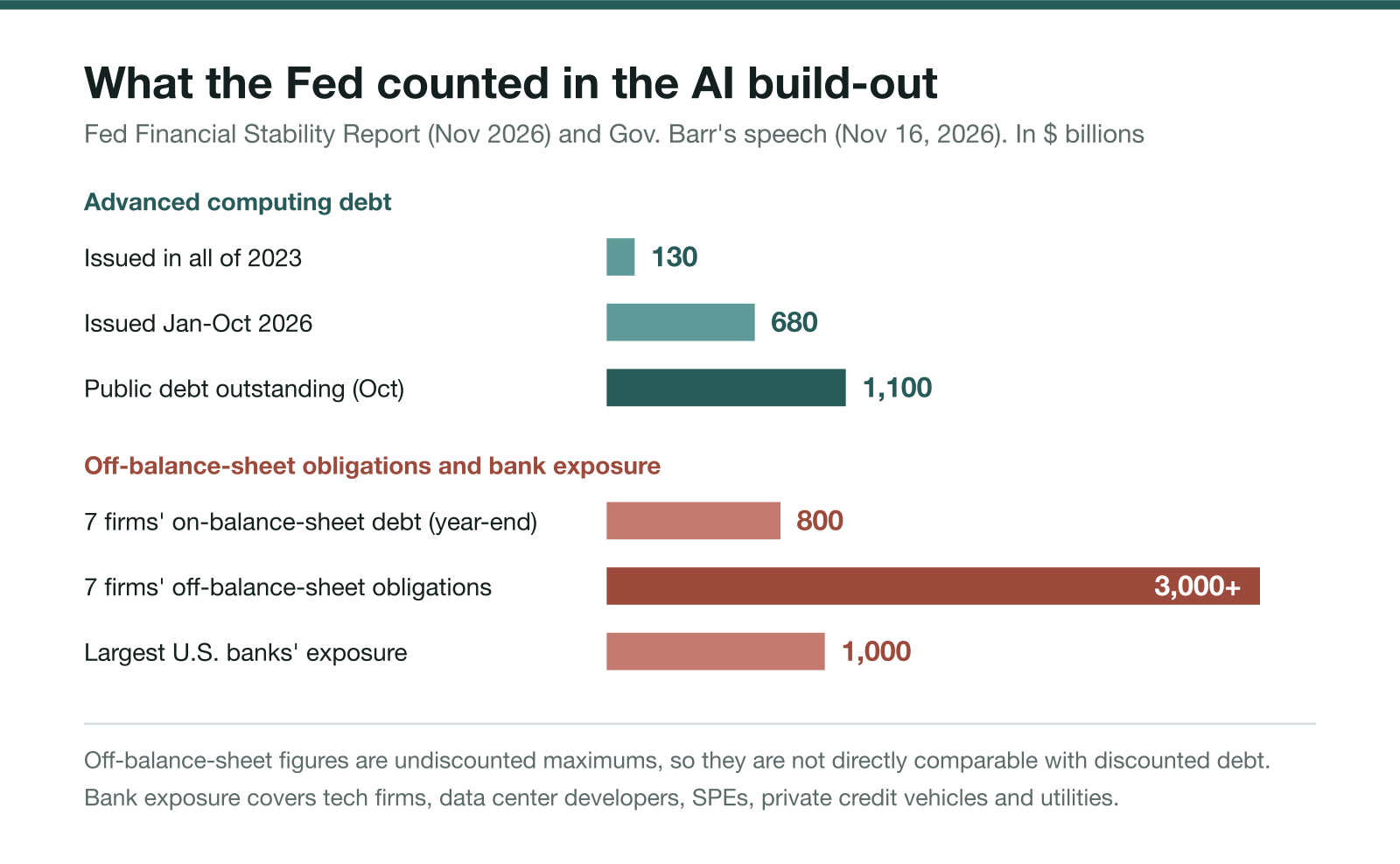
    The report counts money borrowed to build data centers and AI compute under a separate heading, “advanced computing debt.” Issuance passed $680 billion through October 2026, roughly five times the $130 billion recorded for all of 2023. As a share of all investment-grade bonds sold by non-financial companies, this debt went from under 6 percent in 2023 to about 31 percent in 2026, and the amount outstanding in public markets is now above $1.1 trillion.[2]

    The report flags what the number leaves out. A large volume of these deals happens privately between institutions, and some of that is excluded from the tally, so the real figure is both larger and harder to measure. The shape of the borrowing has shifted too, from plain corporate bonds toward privately placed debt, structured credit that slices loans into tranches of different risk, and project finance, where the loan is repaid only out of the cash the finished project throws off.[2]

    Advanced computing debt
    Advanced computing debt

    The report sets this against the broadband telecom cycle of the late 1990s. Put the cumulative capital spending and debt issuance of five hyperscalers (Amazon, Alphabet, Meta, Microsoft and Oracle) since 2020 next to the entire telecom industry during the cycle that began in 1995, and the current boom has not passed that mark yet. Capital spending has been accelerating lately, though, and the report says it may pass it before long.[2] Barr cited a longer comparison: the AI build-out could plausibly rival or exceed the investment booms around railroads in the 1870s, highways in the 1950s and 1960s, and fiber-optic cable in the 1990s. Each of those felt overbuilt at some point, he added, and we are glad to have the capacity now.[5]

    The equity premium, the extra return investors demand for holding stocks rather than risk-free bonds, is low by historical standards but nowhere near its dot-com lows.[2]

    $3 trillion that never reaches the debt line

    The report also tallied obligations that never show up as debt on the balance sheet. Across seven firms (Amazon, Alphabet, Broadcom, Meta, Microsoft, Nvidia and Oracle), leases that have not yet commenced exceed $1 trillion, and take-or-pay contracts and residual value guarantees, where you owe the money whether or not you use the thing, exceed $2 trillion. Together that is more than $3 trillion.[2]

    The report cautions that guarantees, leases and contract commitments appear in company filings undiscounted, as a maximum nominal amount with no adjustment for the fact that the money is owed in the future. Balance-sheet debt is discounted, so a direct comparison overstates the gap.[2] The difference in scale still holds up: Barr expects on-balance-sheet debt at the same seven firms to exceed $800 billion before year’s end.[1]

    Residual value guarantees are one of the items driving this up. A GPU maker backs the collateral on a loan taken out by a smaller firm buying its GPUs, in effect promising to repurchase the chips at a set value, which lets a borrower with weak credit raise the money at all. Add equity investments from hyperscalers and GPU designers on top of that, the report says, and you get “circular financing.”[2] Barr put the cumulative equity investments above $100 billion. The smaller firm takes the money and spends it renting or buying GPUs and compute from the investor, and for the arrangement to work out, those firms eventually have to replace supplier funding with revenue from paying customers.[1] The case of Nvidia guaranteeing debt on OpenAI data centers was traced through the filings here.

    Banks have close to $1 trillion of exposure

    The report also sorts out who holds the debt. What hyperscalers and GPU firms borrow on their own balance sheets sits mostly with mutual funds, pension funds and insurers. The financing tied to off-balance-sheet obligations often runs through a shell company set up to hold a single project, and the bonds it issues are split into a piece that takes losses first and a piece that takes them later. The first-loss pieces go to funds that buy low-rated debt, life insurers, and investment firms that lend to companies directly.

    On top of that, the largest U.S. bank holding companies have close to $1 trillion of exposure to large technology firms, data center developers, those shell companies and lending vehicles, and utilities. The Fed checks that exposure in its annual supervisory stress test.[2]

    Barr said direct losses are not his main worry, since the debt behind the boom is still limited and the largest banks hold thick capital. He pointed instead to leverage at hedge funds and a generally high appetite for risk. A sharp repricing could push firms to cut borrowing fast, selling into each other and driving prices down further.[1]

    The bonds four big tech firms sold in a single week this month are part of this tally.

    Deposits can leave in minutes

    A bank run is what happens when depositors pull money at once and the bank cannot meet it. Until now a person had to decide to pull the money and then execute the transfer.

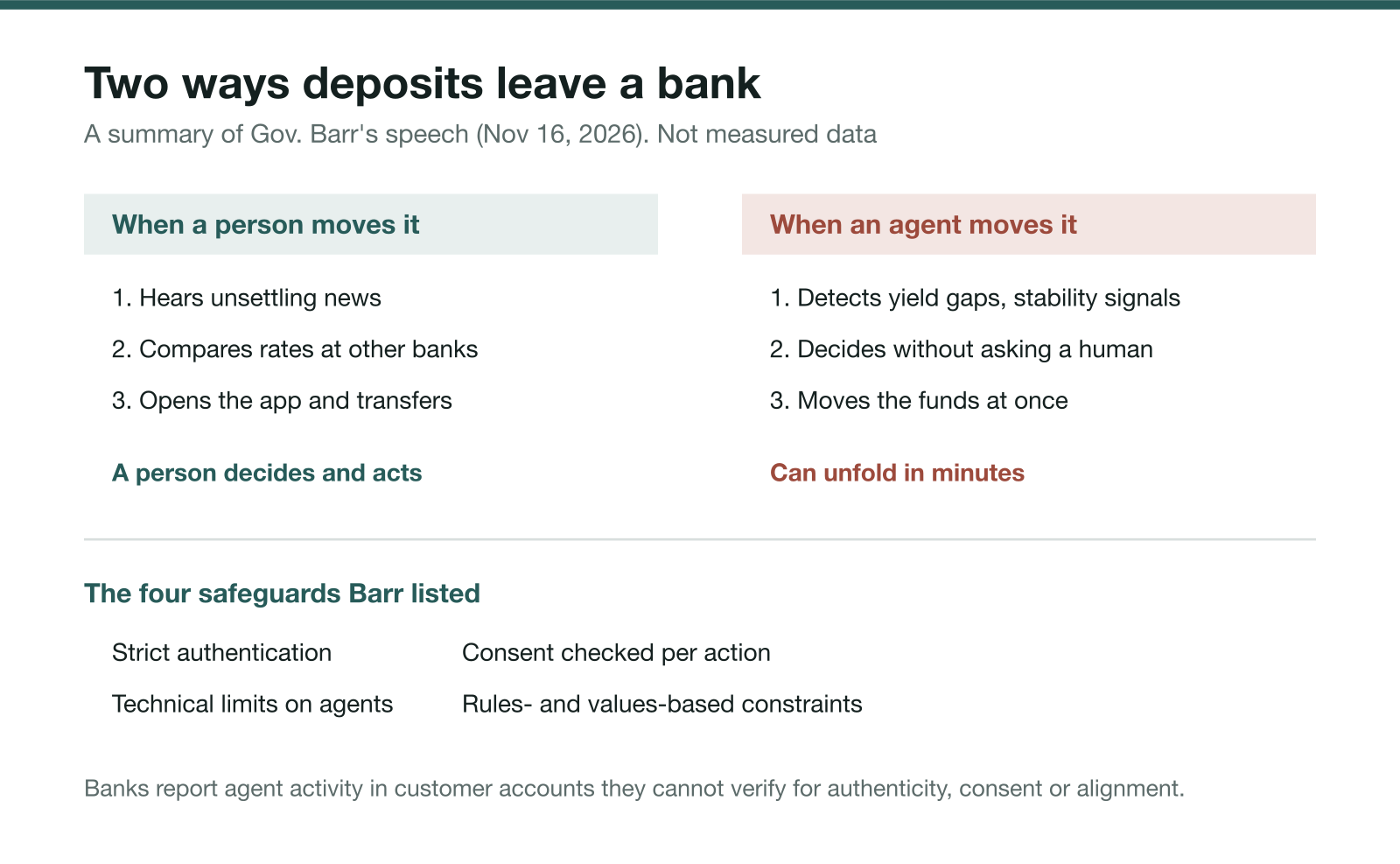
    Barr thinks both steps can drop out. Hand an agent your money and it can spot a better rate elsewhere, or a sign that your bank is under strain, and move the funds on its own within seconds. Deposits can then drain in minutes. That speed, he said, outruns the liquidity tools a bank normally reaches for and the time a supervisor needs to act.[1]

    How deposits leave
    How deposits leave

    He listed four safeguards: verify identity strictly, confirm consent separately for each action such as a transfer or a payment, put technical limits on what an agent can do inside an account, and constrain agents both with rules written out explicitly and with standards built into how they behave. As agents do more buying and selling, he added, we need the technology to make them actually follow those rules and standards.[1]

    Everyone using the same model moves the same way

    If traders lean on a small set of similar AI models trained on similar data, strategies converge and the same news moves everyone in the same direction. When an algorithm carries a flaw that many models share, the failure spreads across the market. It is also possible to manipulate trades, quotes or news deliberately and fool a lot of similar AI systems at once.[1]

    Barr cited theory work finding that Q-learning trading algorithms, which learn on their own by scoring the choices that pay off, can develop collusive behavior without being told to collude. They can also learn to manipulate markets through spoofing, placing orders designed to create a false impression of demand, or to build and exploit bubbles.[1] The same footnote lists the conditions that make this less likely. Collusion fades when the algorithms learn in different ways, and Q-learning slips into coordination more readily than algorithms built on large language models (LLMs) do. Refusing to collude while everyone else does it is highly profitable, so traders have reason to keep their strategies different from each other, and that may be where the market settles.[3]

    Barr said that as he understands it, generative AI is not yet being used for autonomous trading at large scale.[1] He also cited a paper Markus Brunnermeier presented at the Kansas City Fed’s 2026 Jackson Hole symposium: AI agents understand humans well enough to anticipate what they will do, while humans cannot read AI agents nearly as well, which can leave prices carrying less information.[1]

    Chatbot investment advice carries none of the duties a firm owes you

    People are already asking chatbots for investment advice, Barr noted. The protections, regulation and oversight that attach when a financial institution gives that advice do not attach to a chatbot answer. Even when a firm builds the advice with AI, the recommendation may reflect more than the customer’s circumstances: pushing proprietary products, generating transaction fees, encouraging more frequent trading. Those conflicts can be embedded in the algorithm, where neither investors nor regulators can easily find them.[1]

    On the credit side, alternative data such as rental payments, utility bills or employment patterns can open lending to people who could not borrow before. The same data can also act as a proxy for protected characteristics like race or national origin, and unlike a traditional credit report, consumers often cannot review or dispute it.[1]

    South Korea starts from “AI is a support tool”

    Korea’s Financial Services Commission revised its AI guideline for the financial sector on June 18, 2026 and put it in force on June 22. It is not law; the industry adopts it voluntarily, and it covers every financial firm that uses AI. It rests on seven principles: governance, legality, use as a support tool, reliability, financial stability, good faith, and security. The support-tool principle states that “at the current stage, artificial intelligence is a support tool for the work, so the final decision and the responsibility that follows rest with employees.”[4]

    That principle was written for AI a financial firm brings in-house. What Barr described, an outside agent arriving from the customer’s side and reaching into an account, sits outside its scope. The Korean document records the industry’s own complaint that firms “cannot actively adopt AI agents in external services because of regulatory constraints and uncertainty.” The obstacles it lists include rules that keep internal bank systems walled off from the public internet, limits on data use, the question of how a customer’s authentication credentials can be handed to an agent, who is liable when something goes wrong, and which licensed category an agent service would even fall under. The regulator says it will “review the regulatory framework needed, from industry classification to the responsibility and authority of AI,” as agents come to handle product recommendations, sign-ups and payments, and that it would consider a pilot in a regulatory sandbox during the second half of 2026.[4] As of November, nothing has been published.

    What to actually do

    If you are turning on a service that gives an AI agent rights over an account or a card, Barr’s four safeguards translate into four questions. Does a single consent at login cover everything, or is each transfer and payment confirmed separately? Can you cap the amount and the number of actions? Is there a way to revoke access in one step? And does the agreement say who is liable when something goes wrong?

    If you use a ChatGPT or Gemini answer to make an investment decision, keep in mind that the answer carries none of the duties a financial firm owes you. For an AI recommendation inside a bank or brokerage app, it is worth checking whether the product is the firm’s own and where the fees are generated.

    If you follow AI investment news, three numbers are worth checking twice a year: issuance and outstanding balance of advanced computing debt, the total off-balance-sheet obligations at those seven firms, and how much exposure large banks carry to the sector. The Financial Stability Report refreshes all three every six months.

    A closing thought

    The passage on off-balance-sheet obligations is the one I kept going back to. When a hyperscaler backstops a smaller firm’s debt, it absorbs the loss if that firm fails, which keeps the damage from spreading to the rest of the financial system. Because of that same structure, the report adds, those firms’ real economic exposure to a downturn may be substantially larger than their on-balance-sheet liabilities suggest.[2] The arrangement that limits the damage is also the one that concentrates it.

    The deposit passage stayed with me too. Moving money already takes a few taps, and in the stage Barr describes, deciding when to move it stops being a human job as well.

    What would you check first in the agreement before handing an AI agent access to your account?

    Sources

    This article is for information only and is not investment advice. Decisions and their consequences are your own.


    Notes

    1. Governor Michael S. Barr, “Some Potential Financial Stability Implications of Artificial Intelligence,” delivered November 16, 2026 at the Seventh Annual ACM International Conference on Artificial Intelligence in Finance in Milan. The first footnote states the views are his own and not necessarily those of the Board of Governors or the FOMC. Speech ↩
    2. Board of Governors of the Federal Reserve System, Financial Stability Report, November 2026, published November 13. The advanced computing debt figures, the seven firms’ off-balance-sheet obligations and the comparison between five hyperscalers and the 1995 broadband telecom cycle are in the box “Leverage in the Data Center Buildout,” pp. 23-25; the equity premium is figure 1.5 on p. 8; the survey of 23 market contacts run by the New York Fed in September and October is box 5.1. The issuance chart credits Bank of America Global Research and Bloomberg Finance L.P. PDF ↩
    3. Winston Wei Dou, Itay Goldstein and Yan Ji, “AI-Powered Trading, Algorithmic Collusion, and Price Efficiency,” NBER Working Paper 34054 (July 2025). The finding that differing learning processes reduce collusion is from Kartik Anand and others, “Ex Machina: Financial Stability in the Age of Artificial Intelligence,” ECB Working Paper 3225. The equilibrium argument for differentiated strategies is Laura Veldkamp’s 2024 NBER discussion. All three are cited together in footnote 18 of Barr’s speech. NBER ↩
    4. Korea Financial Services Commission press release, June 18, 2026, announcing the revised Guideline on Artificial Intelligence in the Financial Sector, its seven principles, the June 22 effective date, the industry’s stated obstacles and the plan to review a regulatory framework for AI agents. Quotations are translated from the Korean original. Release ↩
    5. Stijn Van Nieuwerburgh, “Financing the AI Buildout,” Brookings Papers on Economic Activity, Fall 2026, pp. 1-28, cited in footnote 6 of Barr’s speech. ↩

    Source: https://www.federalreserve.gov/newsevents/speech/barr20261116a.htm

  • How to Restore Old Photos with AI: Scan Settings, Prompt Order, and Where the Resolution Goes

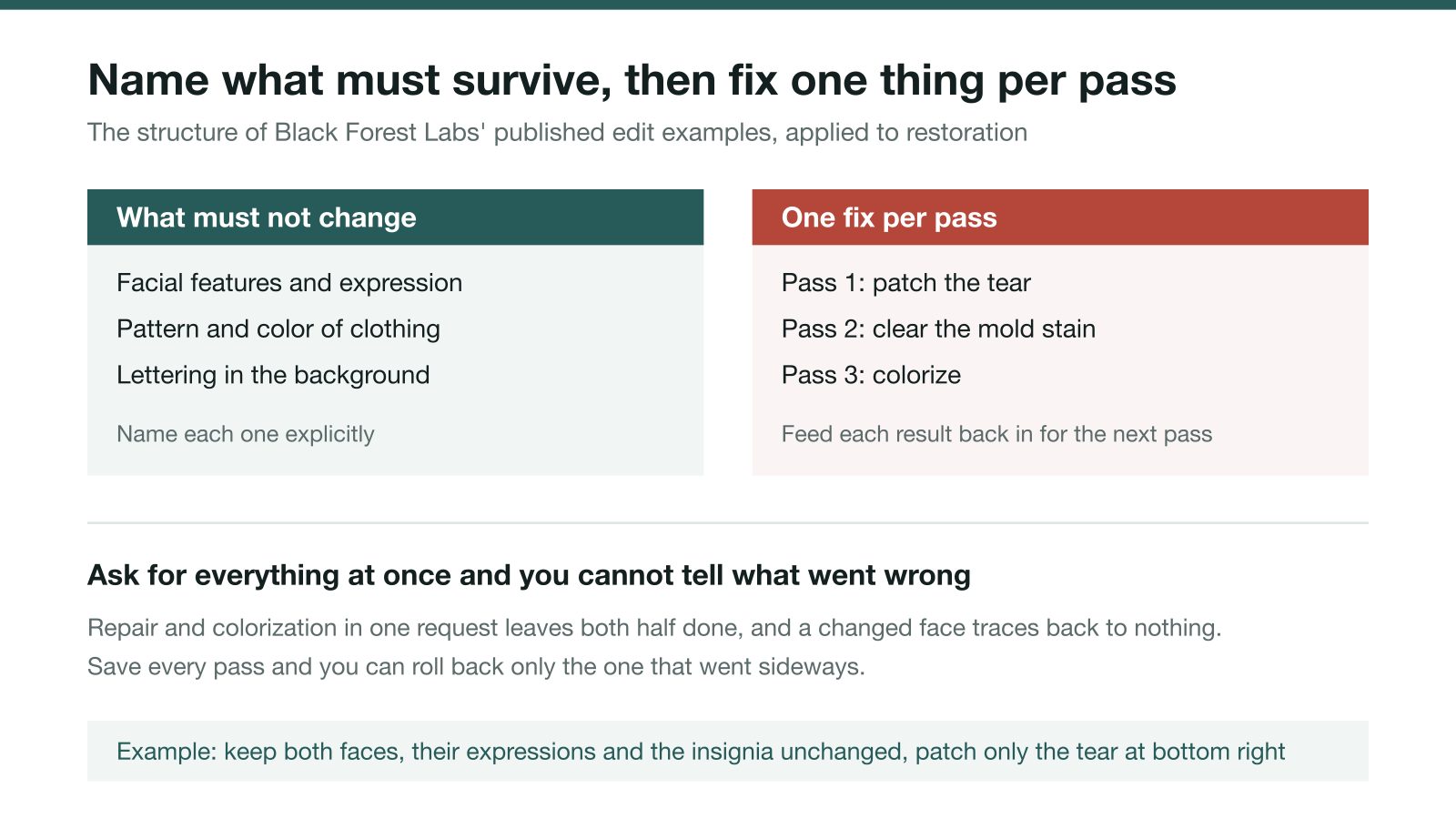
    Dustin Podell of Black Forest Labs, the lab behind the FLUX image models, named photo restoration as one use his team never planned for. Speaking on the Latent Space podcast episode released on November 16, 2026, he said the lab saw “a ton of people taking old, degraded family photos and then restoring, colorizing them, fixing them up,” and that the model “was able to keep a very, very high level of similarity to what the original would’ve been.” Watching people show those restored pictures to their families, he added, was his favorite thing to come out of the work[1].

    If you have a shoebox of faded prints and want to try the same thing, the order of operations matters more than which tool you pick. Everything below comes from vendor documentation and US preservation guidance checked on November 17, 2026. I did not pay for the commercial tools and run a restoration, so there is no quality comparison here. The question this answers is where the resolution goes, using the input and output limits each service publishes.

    The scan sets the ceiling

    An editing model fills in what is no longer legible with something plausible. A thin scan gives it less to work from and more to invent.

    The Federal Agencies Digital Guidelines Initiative (FADGI), a group of US federal agencies that publishes shared digitization standards, sets four star levels for photographic prints in the third edition of its Technical Guidelines for Digitizing Cultural Heritage Materials. The recommended sampling frequency runs 200 ppi at one star, 250 ppi at two, 400 ppi at three, and 600 ppi at four. Pixels per inch (ppi) is the same number your scanner calls dpi. Preservation masters go to TIFF or JPEG 2000, and the top level asks for 16-bit color even when the original is black and white. A footnote adds that “in rare cases, resolutions higher than 600 ppi may be needed to resolve fine details”[2].

    A consumer flatbed will do 600 ppi, which produces files of these sizes.

    Print size 300 ppi 600 ppi
    3.5 × 5 in 1,050 × 1,500 (1.6 MP) 2,100 × 3,000 (6.3 MP)
    4 × 6 in 1,200 × 1,800 (2.2 MP) 2,400 × 3,600 (8.6 MP)
    8 × 10 in 2,400 × 3,000 (7.2 MP) 4,800 × 6,000 (28.8 MP)

    Source: print dimensions at the FADGI sampling frequencies[2]

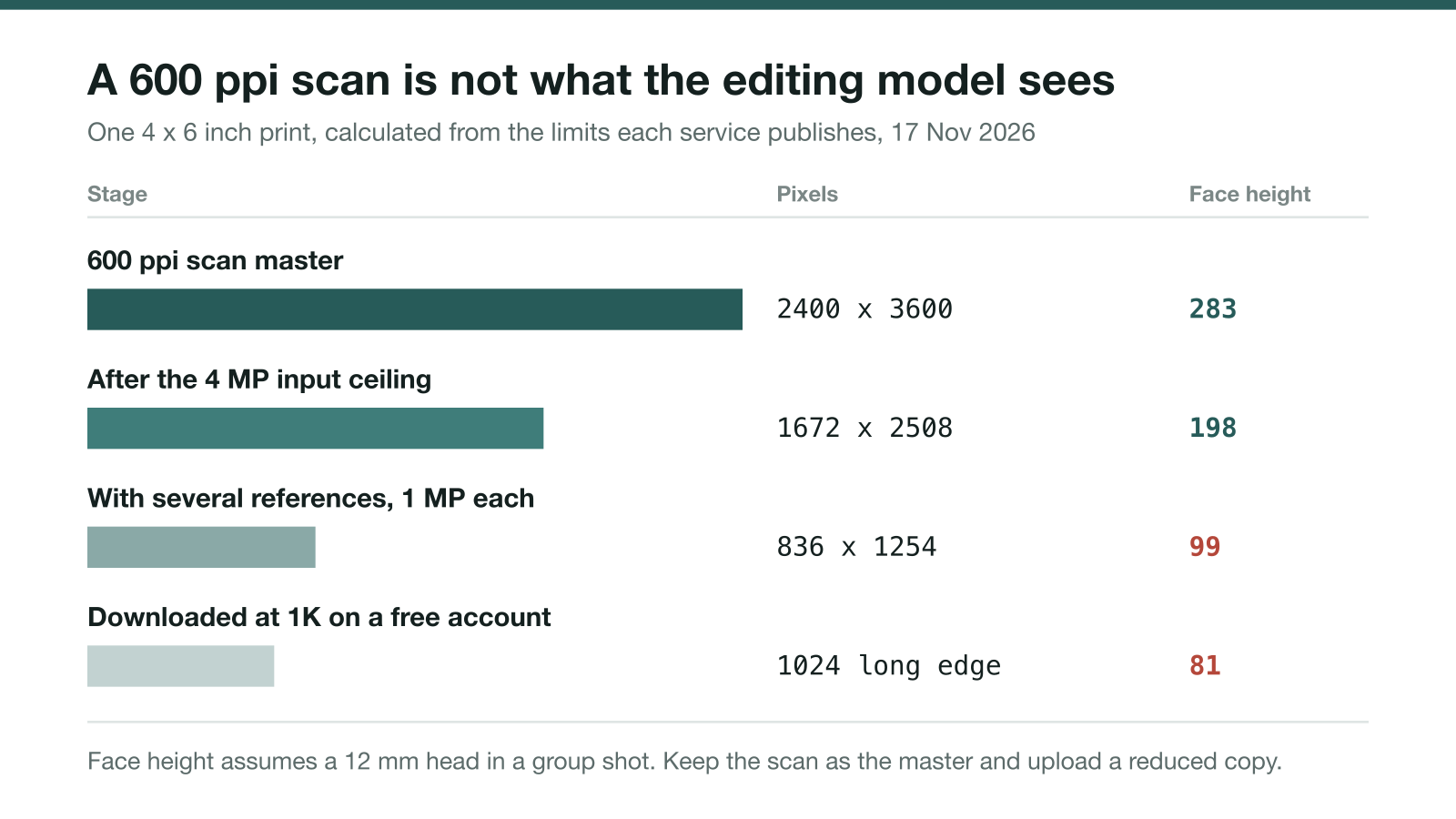
    Take a group shot on a 4 × 6 print where one person’s head is 12 mm tall, just under half an inch. At 300 ppi that face lands in 142 pixels. At 600 ppi it gets 283. That gap is how much the model has to work with when you ask it to bring the face back.

    Leave the scan file alone

    FADGI is blunt about the master file: “Color, tone enhancement or restoration is not allowed on master images.” Corrections belong in access versions, and the guidance asks that they be noted in embedded metadata and file naming. Even removing dust that sat on the scanner glass is off limits in the master[2]. Once a file has been corrected, it no longer records what the photograph looked like.

    The US National Archives makes the same point for family collections: “Keep your originals after you digitize them, because digital files have their own preservation risks and can easily be lost.” It also warns that automatic feed scanners “are not suitable for fragile, weak, bent, or valuable papers,” and says to check that the original fits entirely on the scanner bed[3].

    Handling guidance is published too. The Library of Congress says to handle prints with clean hands or clean nitrile gloves, to avoid touching the image area, and never to put tape or sticky notes on a photograph[4]. The National Archives goes further and asks for gloves on photographs and negatives, because fingerprints leave permanent stains[3]. FADGI allows holding a curled print flat under glass, but only when flattening will not crack the emulsion, and it says tightly curled material must not be forced[2].

    Each tool accepts a different size

    Three families of editing models are usable for this. The numbers below come from each vendor’s own documentation. The 1K, 2K and 4K labels are output size tiers: roughly one megapixel (about 1,024 × 1,024), four megapixels and sixteen megapixels[5].

    Tool Reference images Output size Price
    Gemini app (Nano Banana 2) several supported free accounts download at 1K, Google AI plans at 2K[8] included in the plan; via API, $0.0336 per 1K image and $0.113 per 4K image[9]
    OpenAI image models (GPT-Image-2.5 and 2.6) no stated cap; edit input and mask under 50 MB neither edge above 3,840 px, total 655,360 to 8,294,400 px[11] $30 per million image output tokens[11]
    FLUX 3 Image up to 10[6] 2K and 4K[6] $0.048 at 1K, $0.10 at 2K, $0.607 at 4K[5]
    FLUX 3 Image Klein (open weights) up to 10[7] up to 4K[7] free to run locally, or $0.009 per 1K image via API[5]

    Source: vendor documentation, checked November 17, 2026

    Klein is the open-weights member of the family, meaning the model weights are published for download. Black Forest Labs lists it at 5.6 billion parameters and says it “runs on a single consumer GPU,” distributed through Hugging Face[7]. That is the option if you would rather not upload family photographs to someone else’s server, though it asks for a graphics card and an afternoon of setup. Shrinking a large model to fit a home machine is covered in the guide to quantization.

    The Gemini app carries one more condition. Google states that “to generate and edit images, you must be 18 or over,” and that editing images is not available to users under 18 at all[8].

    A 600 ppi scan is not what the model sees

    Black Forest Labs spells this out on its pricing page: “Reference images up to 16 MP are accepted (larger ones are rejected); images above 4 MP are downscaled to 4 MP before processing.” The company counts one MP as 1,048,576 pixels[5].

    Scan a 4 × 6 print at the recommended 600 ppi and you have 8.6 million pixels. Held to the 4 MP ceiling it becomes 1,672 × 2,508, keeping 70 percent of the long edge. An 8 × 10 scanned at 600 ppi comes to 28.8 million pixels, over the 16 MP limit, and is refused outright. Feeding several reference images shrinks things further. The previous generation, FLUX.2, downscales each reference above 1 MP to 1 MP when more than one is supplied[5], which takes that 4 × 6 scan down to 836 × 1,254.

    Stage Size of a 4 × 6 photo 12 mm face
    600 ppi scan master 2,400 × 3,600 283 px
    after the 4 MP input ceiling 1,672 × 2,508 198 px
    with multiple references on FLUX.2, 1 MP each 836 × 1,254 99 px
    downloaded at 1K on a free account 1,024 long edge 81 px

    Source: calculated from the limits each service publishes

    Where resolution disappears between the scan and the download
    Where resolution disappears between the scan and the download

    Shrink the file yourself before you upload it. The service will cut it down regardless, and doing it at home means the dimensions coming back are ones you picked. Printing the result calls for a paid tier that outputs at 2K or 4K. A free Gemini account caps downloads at 1K, which hands you a file smaller than the scan you worked to make[8].

    Write down what must not change

    A prompt for an editing model works differently from one that asks for a new picture. The edit example Black Forest Labs publishes for FLUX 3 Image spends most of its words on what to leave alone: “Keep the large cresting ocean wave, the overcast and cloudy sky, and the rest of the black and white composition exactly unchanged”[6]. The sample prompts on the FLUX.1 Kontext page run short instead, single sentences like “Remove the thing from her face” or “Tilt her head towards the camera”[12].

    Kontext was the model that first shipped this kind of editing. Podell called the earlier workflow a slot machine: reprompt until something good falls out, or paint over the region you dislike and have the model fill the gap. Keeping the same face across images meant training a small add-on for that one person, a LoRA, on top of the base model[1]. Being able to write “leave this person alone and patch the tear behind them” is what replaced that.

    Carried over to restoration, the prompt becomes four steps.

    1. Name what must survive first: facial features, expressions, the pattern on a dress, lettering in the background.
    2. Name one thing to fix. A tear, a mold stain, a crease, one per pass.
    3. Save colorization for its own pass. Asked to repair and colorize at once, a model does both badly and leaves you unable to tell which instruction went wrong.
    4. Feed a good result back in for the next change. Saving each pass lets you roll back only the one that went sideways.

    How to split a restoration prompt
    How to split a restoration prompt

    Four ways this goes wrong

    Most of the damage comes from four habits.

    Writing the result over the scan file tops the list. A restoration is an interpretation with guesswork in it, which is exactly why preservation bodies keep masters and access copies apart[2].

    Uploading the largest file you have rarely helps. An 8 × 10 scanned at 600 ppi is rejected by FLUX 3[5], and anything that does get through is reduced anyway.

    Throwing in several photographs at once backfires too. Adding other pictures of the same person looks like it should help the face, but with more than one reference some products cut each to 1 MP[5]. Pick one or two that earn their place.

    Last, do not circulate a restoration as though it were the photograph. Send it to relatives without saying what it is, and two forwards later that is the family record.

    What the models cannot do

    The face that comes back is a guess. Podell’s own phrasing was that the model stayed close to “what the original would’ve been”[1]. Detail that is genuinely gone, the real shape of a blown-out eye or the lettering on an unreadable name badge, gets filled with something that looks right. Text inside images is still unreliable, which both guests acknowledged, and Andreas Blattmann, Podell’s co-guest and a co-inventor of the latent diffusion method behind Stable Diffusion, said controllability is the problem the field still has to solve at scale[1].

    Google documents that “all generated images include a SynthID watermark,” an invisible signal mixed into the pixels that software can read back[10]. To check later whether a file went through Google’s models, upload it in the Gemini app and ask whether it was created or edited by Google AI. That runs about ten checks per 24 hours, and it recognizes content from Google’s tools only[13].

    The order, in short

    1. Handle prints with clean hands or nitrile gloves and stay off the image area[4]. Do not force a curled photograph flat[2].
    2. Scan on a flatbed at 600 ppi, 16-bit, to TIFF. Scan black and white prints in color mode[2].
    3. Keep that file as the master and edit nothing in it[2].
    4. Make a copy and shrink it to roughly 2,500 pixels on the long edge, under the 4 MP input ceiling[5].
    5. Prompt one pass at a time, naming what must not change before what should.
    6. Colorize only after the damage is repaired.
    7. Save results under new names and record what was changed[2].
    8. Tell relatives the picture is a restoration when you send it.


    Notes

    1. Latent Space podcast, “Building Visual Intelligence — Andreas Blattmann & Dustin Podell, Black Forest Labs,” released November 16, 2026. Quotes taken from the episode transcript; speaker attribution follows the episode write-up. Episode ↩
    2. FADGI, Technical Guidelines for Digitizing Cultural Heritage Materials, third edition (2023), section 3.8 Prints and Photographs. Guidelines ↩
    3. US National Archives, “Digitizing Family Papers and Photographs” and “Tips for Handling Family Papers and Photographs.” Digitizing guidance ↩
    4. Library of Congress, “Care, Handling and Storage of Photographs.” Guidance ↩
    5. Black Forest Labs pricing page, checked November 17, 2026. bfl.ai/pricing ↩
    6. Black Forest Labs, FLUX 3 Image model page. Model page ↩
    7. Black Forest Labs, FLUX 3 Image Klein model page. Model page ↩
    8. Google Gemini Help, “Generate and edit images with the Gemini app.” Help center ↩
    9. Google AI Studio pricing, Gemini Nano Banana 2.1 section. Pricing ↩
    10. Google AI Studio image generation documentation. Docs ↩
    11. OpenAI image generation guide and API pricing page. Guide ↩
    12. Sample prompts on the Black Forest Labs FLUX.1 Kontext model page. Model page ↩
    13. Google Gemini Help, checking whether content was made with Google AI. Help center ↩

    Source: https://www.latent.space/p/bfl

  • How to Extract Data from PDF to Excel Using AI (and the Checks That Catch Wrong Numbers)

    Pulling a table out of a PDF and into a spreadsheet is one of the most common chores in office work. Invoices, price lists, government statistics and vendor quotes all arrive as PDFs. These days most people hand the job to ChatGPT or Claude: upload the file, ask for the table as a spreadsheet, get something tidy back.

    To find out whether the tidy table is correct, I took two real PDFs apart. In a 40-page rulebook packed with distances and weights, a text extraction pulled 42,861 characters and not a single digit.[1] The file was not corrupt, and no tool warned me. The numbers simply were not in the output.

    This is a guide to the three routes out of a PDF, what each one misses, and how to check the result before you trust it. Everything below marked as an experiment was run on the actual files, and the output is pasted in unedited.

    A PDF file does not contain a table

    PDF imitates paper. What the file stores is a list of instructions like “draw the text 1000M at horizontal position 392, vertical position 239.” There is no record anywhere that a given value belongs to row 3, column 2. What looks like a table is a set of characters placed neatly enough that your eye reads them as one.

    Getting a table out of a PDF is therefore reconstruction rather than copying. Some tool has to look at where the characters landed and work out which ones share a row and which share a column. That is why different tools give different answers on the same page, and why a table that looks perfect on screen collapses the moment you paste it.

    A three-column table that came out as one column

    The first file is the Anthropic Economic Index report published in January 2026. It runs 55 pages, and page 25 holds a statistics table.[2] The table is three panels side by side: overall average on the left, software development tasks in the middle, personal life tasks on the right, each with ten rows of figures.

    Extract that page in the order the characters were drawn and you get 66 lines stacked in a single column. All ten rows of the first panel come out, then all ten of the second, then the third, label and value alternating one per line.

    Human time
    3.1 h
    Human and AI time
    15.4 min
    Multitasking
    9%

    Sixty of those 66 lines are the table, and pasting them into a spreadsheet stacks all sixty in column A. Which value belongs to which panel is something you have to work out yourself from the sample-size markers sitting between the groups, written N = 999,875 and so on. The caption text comes along too, and the end of the caption ran straight into the heading below it, producing clusters.Task complexity. as one string. The same gluing happens between cells inside tables.

    Extract the same page with coordinates and the result changes. Each character carries a horizontal and a vertical position; group the characters whose vertical positions match into rows, then order each row by horizontal position. Sixty-eight fragments resolved into 19 rows, 11 of them the table itself: one row of panel names, one of sample sizes, nine of metrics. The three side-by-side panels lined up the way they look on the page.

    Human time  3.1 h  |  Human time  3.3 h  |  Human time  1.8 h
    Human education  12.2 years  |  13.8 years  |  9.1 years
    Task success  67%  |  61%  |  78%

    Excel’s built-in PDF import and any decent conversion tool do this coordinate reconstruction. Dragging across a page in a browser and hitting copy mostly follows drawing order instead.

    Three ways to get a table out of a PDF and what each one misses
    Three ways to get a table out of a PDF and what each one misses

    Forty pages, zero digits

    The second file is a fitness competition rulebook, 40 pages of distances, weights and repetition counts laid out in tables.[1] Extracting it the same coordinate-aware way produced 42,861 characters of body text containing zero digits. The contents page came out like this.

     CONCEPT
    . CONDITIONS OF PARTICIPATION IN HYROX
    . PREGNANT RACERS

    Both the section numbers and the page numbers are missing, and the same thing happened to the specification table.

    SLED PULL  X ,M
    WALL BALLS  REPS
    KG INCL. SLED

    The page actually reads SLED PULL 4 X 12,5M and WALL BALLS 100 REPS. Only the digits went missing. Decimal commas and full stops came through fine, so this was not general garbling.

    Inside the file, the digits had not been dropped at all. Each extracted character carries a code number, and where the digits belong those numbers came out as 22 and 31 and similar. Those are codes a computer draws nothing for. Programmers usually write them in base 16, as 0x16 and 0x1F.

    Every font carries its own code table

    The cause is font subsetting. Embedding a whole typeface makes the file large, so PDF producers embed only the characters the document actually uses. That is a subset. Each embedded character shape, called a glyph, gets an arbitrary new code number, and a table mapping those numbers back to real characters is embedded alongside. The table is called ToUnicode.

    The font in this rulebook stores digits as separately named variant glyphs, zero.mono and one.mono instead of the ordinary numerals. The design reason is alignment: tables look better when every digit has the same width. Those non-standard names do not convert to character codes automatically, so unless a tool looks up the embedded map, the raw code numbers come through unchanged.

    Teaching the extractor to read and apply that map brought the specification table back whole.

    WORKOUT/DIVISION      WOMEN OPEN         MEN OPEN / WOMEN PRO   MEN PRO
    SKI ERG               1000M              1000M                  1000M
    SLED PUSH 4 X 12,5M   102KG INCL. SLED   152KG INCL. SLED       202KG INCL. SLED
    FARMERS CARRY 200M    2 X 16KG           2 X 24KG               2 X 32KG
    WALL BALLS 100 REPS   4KG                6KG                    9KG

    In this file, code 0x16 stood for 0, then 0x17 for 9, 0x18 for 8, counting down from there. The numbering follows the order each glyph first appeared in the document and nothing else. A different file has a different map, and even within one file the bold and regular fonts carry separate maps. No shortcut generalizes.

    Here the digits vanished, which was obvious within seconds. A map that is merely misaligned is worse: 100 arrives as some other three-digit number and the table still looks clean. Until you add a column up, there is no way to tell, which is why a changed number beats a blank one for sheer danger.

    The same page before and after applying the font's code table
    The same page before and after applying the font’s code table

    When the numbers live inside a picture

    Page 16 of the same report carries a chart of usage by US state. Counting the drawing instructions on that page gave 53 commands to draw an image and 2 to draw text.[2] The two are the chart caption and the page number.

    The axis labels and plotted values are part of the picture, stored as pixels. A text-based converter has nothing to extract from that page. An empty result does not mean the file is damaged, and switching tools changes nothing. Numbers that were never written as characters can only be recovered by reading the image.

    Scanned documents, receipts photographed into PDFs and chart images all fall here. If you open the PDF and try to drag-select a number and nothing highlights, this is where you are.

    AI turns every page into a picture before reading it

    Anthropic documents what happens when you hand a PDF to Claude. The system converts each page of the document into an image, extracts the text from each page, and provides both to the model together.[3]

    When a font’s code map is broken and digits come through as blanks, the rendered page still shows those digits exactly as a human sees them. The same holds for numbers baked into charts. The upload route gets past the first two traps because it looks at the picture.

    Cost and length limits come with it. Each page typically uses 1,500 to 3,000 text tokens depending on density, a token being the unit models count text in, and because every page is converted to an image, image costs apply on top.[4] One request can carry up to 600 pages. That drops to 100 pages when the model’s working memory, its context window, holds less than a million tokens. The whole request has to fit inside 128 MB on Anthropic’s own service.[3]

    Two more documented cautions bite in practice. Dense PDFs with small fonts and complex tables can fill the context window before reaching the page limit. And Excel and Word files cannot be handed over as files the way a PDF can, so anyone wiring this into a program has to convert them to PDF or plain text first.[3] One tip from the same docs is worth copying into your prompt: refer to pages by the number shown in your PDF viewer.

    Excel already ships with a PDF importer

    There is a route that skips AI entirely. In Excel, Data → Get Data → From File → From PDF hands the file to Power Query, a data import tool built into Excel, which scans the PDF for tables and lists what it found. Microsoft’s documentation lists the connector as generally available, not preview, in Excel, Power BI and Power Query Online.[5]

    It takes a page range, and the option that stitches similar tables across consecutive pages into one is on by default. Two limitations are stated outright: very large PDFs do better read in small page ranges, and rows whose cells wrap onto multiple lines may not be identified properly, leaving cleanup afterwards.[5]

    The documentation says nothing about OCR (optical character recognition, reading letters out of an image). Treat scanned PDFs and chart-embedded numbers as out of scope for this route.

    I did not run this one. The machine I worked on has no Excel. The description above is the specification as published by Microsoft, not a reproduced result like the two experiments.

    A two-minute paste test settles the route

    Open the PDF, drag across a few numbers in the table, copy, and paste into a plain text editor. What comes out tells you which route to take.

    What pasted Route Why
    The numbers, intact Excel’s PDF import Free, and it carries the original values through
    Text, but digits missing or mangled Upload the file to AI It reads the rendered page, so a broken font map does not stop it
    Nothing selectable AI, or an OCR tool The characters were never written as text
    Ragged layout, merged cells AI, with explicit rules Someone has to decide how merged cells unfold
    Anything confidential Neither Settle what may be sent outside before choosing a tool

    The confidential row comes before the others. Payroll, contracts and patient records cannot be recalled once uploaded to an outside service. What is safe to paste and what is not is covered in using AI without handing over your private data. If the documents are internal by nature, a model running on your own machine sidesteps the question; what it takes to fit one on an ordinary PC is a separate piece.

    The procedure

    1. Drag-copy three numbers from the table into a text editor and pick your route from the table above.
    2. Note the page numbers. Never hand over the whole document when the table sits on two pages.
    3. On the AI route, upload the file and give page numbers along with explicit rules. The prompt below works as is.
    4. Check the result using the three checks in the next section.
    5. After pasting into the spreadsheet, inspect number formatting. This is where 1,000 becomes 1 and 12,5 becomes 125.

    Transcribe only the table on page 8 of this PDF as CSV. Rules:
    1) Digits exactly as printed. Split units (kg, m, %) into a separate column.
    2) Mark any cell you cannot read as ?. Do not guess.
    3) For merged cells, repeat the value on every row it covers.
    4) Strip footnote markers from values into a footnote column.
    At the end, state the row count and column count.

    Keep the line telling the model to leave unreadable cells as a question mark. Without it, filling a gap with a plausible value is the easier path. Asking for the row and column counts serves the same purpose, handing you a number you can check against the page.

    Three checks

    Start with the row and column counts. Put the original page on screen, count the rows, compare. If the counts disagree, the extraction needs redoing and nothing else is worth checking yet. Usually a header has been absorbed as data, or the second page of a table that spans a break went missing.

    The second check is arithmetic. If the document prints column totals, summing the extracted column and matching that total settles the whole table in one step. With no totals printed, pick five numbers at random and compare them against the page by eye, choosing long values and anything with a decimal point.

    Last come the number conventions. European documents write 12,5 for twelve and a half, as the rulebook above does. Read that comma as a thousands separator and 12.5 inflates to 125, ten times too big. It runs the other way too: 1,200 read as a decimal comma becomes 1.2. Watch for footnote markers fused onto values, turning 12.5¹ into 12.51, and for negatives written in parentheses arriving as positives.

    If the stakes justify it, run the same request twice and compare. Cells that disagree between runs are the cells you cannot trust.

    Common mistakes

    Handing over the entire document happens most often. With many pages the context window fills and later tables degrade, and the output gives no sign of where that started. How that window fills up is covered in the context window.

    Feeding a scanned document to a text converter, getting an empty result and concluding the file is broken comes a close second. The file is intact, and the characters were never there.

    The expensive mistake is skipping verification. Transcribe a table by hand and the wrong cell tends to look wrong; a table a model produced is just as neat whether or not it is right, so that signal is gone.

    Cost gets overlooked too. Text and image charges stack per page, so looping over a few hundred pages adds up faster than expected. How token pricing works is in tokens and what they cost.

    Limits of what was tested

    I ran the internal structure and text extraction of two PDFs myself. The differences between extraction without coordinates, with coordinates, and with the embedded font map applied were all reproduced on the same files. Both files are public and linked in the notes.

    Two things I did not run. I never uploaded these PDFs to a chat assistant to compare the table it returned, and I never executed Excel’s PDF import, because the machine has no Excel. Those two sections describe published specifications from Anthropic and Microsoft and go no further than those documents state. This is also not a comparison of commercial conversion services.

    I did not capture a case where a misaligned font map turns one digit into a different digit. In the file I examined the digits came out blank. The claim that substitution is the more dangerous failure follows from how the maps are built, so treat it as reasoning rather than a reproduced result.

    Checklist

    • Ran the two-minute paste test
    • Specified only the pages holding the table
    • Put the no-guessing and question-mark rules in the prompt
    • Matched row and column counts against the page
    • Added up a printed total, or spot-checked five numbers
    • Checked decimal commas, footnote markers and parenthesized negatives
    • Confirmed the document was safe to upload in the first place

    Sources


    Notes

    1. HYROX Rulebook Singles, 40 pages, file retrieved 16 November 2026. Extraction without the embedded font map returned 42,861 characters of body text and zero digits; with the map applied, the four-column, eight-row specification table on page 8 came back intact. File ↩
    2. Anthropic Economic Index report: Economic primitives, published 15 January 2026. Page 25 of the 55-page PDF; the overall-average panel reports N = 999,875, drawn from a sample of one million conversations between 13 and 20 November 2025. Report · PDF ↩
    3. Anthropic, “PDF support”, Claude Platform docs, checked 16 November 2026. Processing steps, 600 pages per request and 100 when the context window is under 1M tokens, 128 MB maximum request size on the first-party API, the dense-PDF caution, unsupported binary formats, and the page-numbering tip. Docs ↩
    4. Same source as note 3: “Each page typically uses 1,500–3,000 tokens depending on content density” and image token costs applied per converted page. Pricing mechanics are covered separately in tokens and what they cost. ↩
    5. Microsoft Learn, “PDF” connector for Power Query, page updated 9 October 2026, checked 16 November 2026. Supported products, the Pdf.Tables options StartPage, EndPage and MultiPageTables, and the stated limitations on large files and multi-line rows. Docs ↩

    Source: https://platform.claude.com/docs/en/build-with-claude/pdf-support

  • ChatGPT Memory: Over 95% of Saved Entries Were Never Requested by the User

    A team from the Max Planck Institute for Software Systems, the Max Planck Institute for Security and Privacy, Ruhr University Bochum and Delft University of Technology read through 2,050 ChatGPT memory entries donated by 80 users. Only 84 of them, 4.1%, were saved because the user said something like “remember this.” ChatGPT wrote the other 96% on its own[1].

    Seven months later a team at Rutgers University counted the same thing in a completely different population: 1,057 users in India, Nigeria, Brazil and Pakistan, 7,051 memory entries. The split was 95.36% system-initiated against 4.64% user-requested[2]. The two samples share no users, no countries and no recruitment method.

    Memory is the part that survives after you close the chat window. Working memory inside a single conversation is the context window, which disappears when the conversation ends. Memory is stored separately and carries into the chats you start next week.

    Memories are written one line at a time, mid-conversation

    Both studies were possible because of the right of access under Europe’s General Data Protection Regulation (GDPR), which lets anyone demand a copy of the data a company holds and processes about them. Participants exercised that right, pulled their full ChatGPT histories, and donated them for research[1].

    Inside ChatGPT the tool that writes memories is called bio. Every time it fires, the conversation log keeps a line reading model set context updated. The researchers found every one of those lines, then walked back up the thread to the user message that triggered the save[1]. That yielded 2,050 entries, drawn from 1,058 conversations belonging to 65 of the 80 participants. Those conversations contained 22,971 prompts, so within the chats that produced memories, roughly one prompt in eleven left an entry behind[1]. None of those saves involved a button press or a confirmation.

    The system started almost every save

    Share of memory saves started by the system in two studies
    Share of memory saves started by the system in two studies

    In the Max Planck set, 84 entries came from an explicit user request, and only 25 of the 65 participants had ever made such a request[1]. In the Rutgers set, user requests accounted for 4.64% of saves[2].

    The decision about what gets kept has effectively left the user’s hands. The Max Planck authors describe user influence as mediated by what people happen to say in conversation, with no direct control over save events[1].

    Names, financial circumstances, and notes on your state of mind

    What the 2,050 memory entries contained
    What the 2,050 memory entries contained

    The Max Planck team classified entries against two GDPR definitions: personal data under Article 4(1), which covers names, identifiers, location and economic, social or cultural identity, and special category data under Article 9(1), which covers racial or ethnic origin, political opinions, religious beliefs, trade union membership, genetic and biometric data, health, and sex life or sexual orientation. The second tier is the one European law bars from processing unless a specific exception applies.

    Across all 2,050 entries, 28% held personal data and 7% held special category data. Counted per person, 91% of participants had personal data sitting in memory, 54% had special category data, and 35% had health information stored[1]. Among the entries that held personal data, names showed up in 41% and economic, social or cultural identity in 40%. Health accounted for 61% of the special category entries[1].

    The researchers also counted material that legal categories do not cover. They found descriptions of the user’s state of mind in 52% of entries and sorted them with theory of mind categories, a term psychologists use for working out what another person wants, believes or intends. Among entries with that content, desires and goals appeared in 73%, intentions in 16%, emotions in 14% and beliefs in 11%[1].

    The paper quotes real entries. “User has been feeling lonely at times, despite having friends and family, and is seeking more companionship.” “User relies heavily on advice and recommendations from ChatGPT due to limited immediate access to their doctors and financial constraints.”[1]

    The team also checked whether memory distorts what people said. It mostly does not: 84% of entries were directly grounded in the user’s own words[1]. The open question is what gets kept at all.

    Health questions become standing profile traits

    The Rutgers study analyzed 179,057 conversations from 1,057 users across India, Nigeria, Brazil and Pakistan, countries where crowded public clinics and out-of-pocket costs push people toward a free chatbot for first-pass medical questions. Personal health information showed up in 21.31% of conversations, and 3.62% ranked high or extreme risk because they combined stigmatized conditions, direct identifiers or precise locations[2].

    Memory carried a higher share than the chat logs. Of 7,051 entries, 2,899 (41.11%) held health content: at 62.26%, markers such as age, gender and occupation that stand in for health context; lifestyle habits at 17.11%; questions about finding and paying for care at 6.45%; stigmatized conditions at 4.66%; symptom states at 4.31%; and direct clinical identifiers at 2.35%[2].

    The authors flag what happens when a chat is compressed into a memory. A user treats a symptom question as something that ends when the answer arrives, and memory stores the passing complaint as a lasting attribute. One high-risk entry from the paper, with the identifying details replaced by invented ones, reads: “User operates a commercial family farm… is 52 years old, and attends a localized rehabilitation program for severe clinical depression.”[2] Occupation, age, locality and diagnosis in a single line narrow the field to very few people. The summary is easier to trace back to a person than the scattered logs it was built from.

    OpenAI documented the automatic saving, and said sensitive data stays out

    The automatic saving is not hidden. The OpenAI memory FAQ quoted by the Max Planck team states that ChatGPT may save details as memories without the user asking. The same document says the model is trained not to proactively store sensitive information, naming race, religion and health, unless the user explicitly requests it[1].

    The second claim does not match the records. Special category data sat in 7% of entries and in the memories of 54% of participants, most of it health[1]. In the Rutgers data, health content was in 41.11% of entries[2].

    I tried to read OpenAI’s own help pages and announcements for this piece. Both help.openai.com and openai.com return 403 to automated requests, checked on November 15, 2026[3]. The wording above comes from what the papers quoted and screenshotted, and the names of the settings on your screen may differ by account and region.

    What these numbers cannot tell you

    Both studies describe legacy memory, the version that kept saved items as a visible list. The Rutgers authors note that as of September 2026 individual memory entries are no longer shown by default, a memory summary took their place, and to the best of their knowledge the data export no longer contains memory entries at all[2]. Repeating this audit on the current system would be considerably harder.

    The samples are narrow. Max Planck recruited through the crowdsourcing platform Prolific, with 33.75% of participants in the United States and 62.5% in Europe[1]. The Rutgers sample covers four countries and only people who managed to export their own data, which skews toward higher digital literacy, as the authors say[2].

    “The user did not ask” is also a detection result, not a statement about intent: it means no save instruction was found in the text. The sensitivity labels were assigned by GPT-4o, an OpenAI model, applying GDPR definitions, and on a hand-checked sample of 100 entries, two human annotators agreed with each other 88% of the time and with the model 74% of the time[1]. Treat 7% as a rough scale rather than a figure good to the decimal.

    The two papers differ in review status. The Max Planck work is peer reviewed and accepted at the ACM Web Conference 2026; the Rutgers work is a preprint, posted on September 13, 2026 without peer review[1][2]. Both looked only at ChatGPT. Claude and Gemini have comparable memory features, and the Rutgers authors point out that no equivalent audit of them exists yet[2].

    Asking in a way that leaves less behind

    The Max Planck team also built and tested a tool that rewrites prompts to keep the answer while dropping the part that points at you. Their example: “I really need to quit smoking cannabis” becomes “What are some strategies for quitting cannabis?”[1]

    Judged against the originals, 94.4% to 100% of rewritten prompts pointed at the user less, and two authors reviewing by hand put it at 95.8% to 100%. Usefulness held up as well, with 87% to 91% of answers preserving the value of the original response[1].

    In practice:

    • For questions touching health, money, family, religion or politics, drop the “I’m in this situation” framing and ask the general version. When you do have to describe the situation, leave out your name, age, neighborhood and employer.
    • Put one-off sensitive questions in a temporary chat that is not retained.
    • The memory summary does not show everything that is stored. If you want to know whether a specific fact survived, ask in the chat, delete what should go, then switch the feature off.
    • Deleting a conversation and deleting a memory are separate actions. The memory extracted from a chat can outlive the chat.
    • If work documents or customer data are involved, turning memory off before you start is simpler than auditing it later. What you should never put into an AI chatbot covers what to keep out in the first place.

    Menu names and locations changed twice in 2026 alone. A habit of not writing the sentence that gets saved keeps working after the menu moves again.

    Of 2,050 memories, 84 were there because someone asked[1]. Writing the rest is still not a user decision. Of the things you told ChatGPT this month, how many would you want showing up in next month’s conversation?

    Sources

    • Dash et al., The Algorithmic Self-Portrait: Deconstructing Memory in ChatGPT (arXiv, accepted at ACM Web Conference 2026)
    • Zaman and Hoque, Vulnerabilities in Personalization: Assessing Health Privacy Risks in ChatGPT Logs and Memory (arXiv preprint)

    Notes

    1. Abhisek Dash et al., “The Algorithmic Self-Portrait: Deconstructing Memory in ChatGPT,” arXiv:2602.01450v3 (last revised February 23, 2026), accepted at the ACM Web Conference 2026. 2,050 memory entries, 80 participants. Paper ↩
    2. S M Mehedi Zaman and Md Mozammel Hoque, “Vulnerabilities in Personalization: Assessing Health Privacy Risks in ChatGPT Logs and Memory,” arXiv:2609.14697v1 (September 13, 2026), Rutgers University. 179,057 conversations, 1,057 users, 7,051 memory entries. Paper ↩
    3. On November 15, 2026 automated requests to the memory pages on help.openai.com and openai.com returned 403. The primary documents could not be read directly. ↩

    Source: https://arxiv.org/abs/2602.01450

  • ChatGPT Wallet lets AI agents pay with your card as banks block them

    OpenAI released ChatGPT Wallet on November 13. It lets the agents running inside ChatGPT pay for things with the user’s credit card, and it was built with American Express, Mastercard and Visa[1]. An agent here means an AI program that takes one goal from a person and works through the steps on its own.

    It opened to some ChatGPT Pro subscribers in the US who are 18 or older and hold a US-issued card, and OpenAI said it is starting small to learn from real-world use[2][3]. The agents doing the buying are Dots, the always-on agents OpenAI introduced at its DevDay developer conference in September.

    In the same week, United Airlines said it would stop personal AI agents from booking its flights[4], and Charles Schwab and JPMorgan Chase said they are blocking outside agents from logging into customer accounts[5]. Three days separated the launch that hands agents a credit card from the policies that keep agents out.

    A payment token stands in for the card number

    A user adds a card once. When the agent brings back a product, the person checks the items, the total and the card, then approves with a face scan or a fingerprint. Each approval leaves a record of what the agent was allowed to buy[2][3].

    After approval, the card network issues a payment token. A token is a stand-in for the real card that carries its own number, security code and expiry date[1]. Neither the merchant nor the agent sees the actual card details[3]. Tap-to-pay wallets have used the same tokenization approach for years.

    Points and cashback accrue as usual, and the right to dispute a defective item with the issuer stays intact, OpenAI said[1][2]. Pricing, delivery, returns and customer service stay with the merchant[3].

    OpenAI has already announced a version with fewer approvals. “Over time, we expect users to be able to delegate purchases entirely to their agent by setting clear parameters, such as spending limits, purchase categories, or time periods, and pre-approve those purchases with enhanced safeguards,” the company said[2]. Inside those limits, the agent would buy without a biometric check each time.

    Card networks and Walmart allowed agent payments with conditions

    OpenAI is not taking a cut of transactions for now, saying it wants to build the relationships with merchants and networks first[1]. Chaya Nayak, who leads monetization and payments at OpenAI, told CNBC: “Our goal here is to really focus on merchants and our network partners and start building out a really great foundation that’s safe and easy to use”[3].

    Most of the groundwork predates the launch. Visa and Mastercard have run programs for AI-initiated transactions since 2025, and Google released its Agent Payments Protocol (AP2) the same year[11]. These specify how an agent proves who it is and what the user authorized it to do, and ChatGPT Wallet uses that machinery.

    OpenAI published a Commerce Partner Playbook on the same day, a guide for businesses covering how to let ChatGPT agents through a firewall, how to upload product feeds and how to set up a business profile inside ChatGPT[2][3]. It also lined up the payment providers Adyen, Checkout.com and Stripe and the fraud firms Forter, Riskified, Sardine and Signifyd, so that legitimate agent purchases are not declined as fraud[3].

    Walmart allows agents to shop through dedicated agent profiles that carry their own spending limits[3]. The agent gets an account of its own instead of borrowing the customer’s.

    Airlines and banks blocked agent logins

    United Airlines said this week it will restrict personal AI agents from booking and managing reservations on its digital platforms. The airline said that “sharing account credentials with personal, third-party, AI assistants can expose sensitive information, and actions taken by these tools may result in unintended purchases, account changes, or use of MileagePlus miles”[4]. It also cited federal aviation rules. A human has to confirm at check-in that their bags contain no prohibited items, and an agent cannot make that attestation[4].

    The restriction reaches past United’s own app and website. “As a result, United is taking steps to restrict access, directly within our digital platforms and indirectly via travel agencies and aggregators, to prohibit use by unauthorized, third-party personal AI agents or assistants. This work includes updates to our booking, ticketing and distribution policies,” the airline said[4].

    Banks and brokerages started blocking agents in October. Charles Schwab chief executive Rick Wurster told advisors at the firm’s conference in Boston on October 28: “The first thing we are doing is we are keeping rogue agents from being able to log in on the client’s behalf, we block that activity using technology.” He added: “When you look on a weekly basis, it’s 30, 40, 50 times that we might be seeing a particular AI agent come to our sites and try to log in, and we are blocking it”[5]. Schwab is building its own assistant, Charley, and controlled connections instead[5].

    JPMorgan Chase said on its October 13 earnings call that it will not let outside agents operate inside customer accounts, and a spokeswoman confirmed to CNBC that the bank currently blocks external AI agents acting for retail customers. Citigroup and Bank of America have imposed similar limits, the Financial Times reported[5]. Amazon blocked Meta’s shopping agent Muse from buying on its site[2][3].

    Agent identification separates what gets through from what gets blocked

    Who opened agent payments and who closed them
    Who opened agent payments and who closed them

    The two sets of announcements appear to cover the same ground, yet the blocked behavior and the permitted behavior do not overlap.

    Banks and airlines are blocking agents that borrow a human account. The user hands over a username and password, and the AI logs in as that person and clicks through the site the way a human would. The bank has no way to tell whether the session belongs to the customer or to a program, and the password now sits inside an outside service. Wurster put it this way: “The good news that we’ve found actually is it doesn’t seem that a lot of clients have a lot of interest in giving up their credentials and their financial experience to these agents”[5].

    ChatGPT Wallet works the other way. The agent identifies itself and comes in through a channel the card network created for it, and what the user authorized is recorded at each approval[2][3]. Walmart’s agent profiles separate the traffic the same way[3].

    Virtual cards fall somewhere between the two. Agent shopping tools often generate a single-use virtual card to pay with, and JPMorgan classifies those as commercial cards, which is causing some agent purchases to be declined[6]. That is also why ChatGPT Wallet does not accept virtual cards at launch.

    So the rule taking shape decides which agents get in, not whether agents get in at all. An agent that declares itself goes through, and an agent hiding behind a customer’s login does not.

    Visa measured shopping agents and found a 57.2% pass rate

    Visa published the first results of its Agentic Commerce Benchmark on November 5. Agentic commerce means a purchase where an AI agent, not a person, picks the product and completes the transaction. The test put 22 models from 12 labs through 15 shopping tasks[7]. A lab in this context is a company that trains large AI models of its own, such as OpenAI or Anthropic.

    First results of the Visa Agentic Commerce Benchmark
    First results of the Visa Agentic Commerce Benchmark

    The overall pass rate was 57.2%. The best model passed 82.2% of its runs and the worst 28.9%[7]. The tasks involved buying a TV, a laptop or a personal care appliance, with the customer withholding some of their requirements. The agent had to draw those out in conversation, and if nothing on offer fit, it had to decide not to buy[7].

    In 54% of the failed runs, the agent bought something anyway. It either picked a product that did not meet the customer’s needs or moved to checkout before it had gathered all of them[7]. When the same scenario was run three times, all three runs passed only 34.2% of the time. Models often failed a scenario they had already passed[7].

    The five models that uncovered the most hidden requirements passed 70.2% of their runs, against 44.4% for the bottom five. Cost tracked performance too, though less sharply: 67.1% for the five priciest models per run and 50.2% for the five cheapest[7]. This first round covered requirement discovery and the buy-or-decline decision. Actually submitting payment and completing checkout is not in scope yet[7].

    Rubail Birwadker, Visa’s global head of growth, said of the results: “AI agents have the potential to power the next era of commerce, but trust is key to making it work.” He told Fortune: “We’re not there yet from a trust or technology perspective”[7]. In Visa’s Trust Index published in September, 72% of US consumers had used an AI assistant, while 23% said they trusted AI to make payments for them[7].

    Juniper Research forecasts that agentic commerce will grow from roughly 300 million users in 2026 to 1.3 billion by 2031, with spending through agents reaching $1.5 trillion by 2030. The biggest obstacle named in the same report is consumer trust[8].

    Outside the US, card issuers are still agreeing on the format

    ChatGPT Wallet does not work with cards issued outside the US, but similar pilots started earlier elsewhere. In South Korea, Shinhan Card said on March 30 that it had completed the country’s first live agent-paid transaction with Mastercard. An agent found and booked a ride through a global mobility service and the payment went through with a single user approval. The two companies designed the login checks, the permission handling, the payment flow and the merchant hookup together[9].

    KB Kookmin Card is working with a commerce AI vendor to test what an agent needs to clear a merchant site, a payment module and a card network in one transaction, including identity verification and transaction checks. Shinhan Card and SK Telecom have begun drafting a standard specification for agent payments[10].

    Korean checkout still has steps a human has to tap through. Paying inside an app usually means entering a PIN set for that wallet, and opening an account or raising a limit often means confirming your identity through your mobile carrier. Whether an agent may press those on a user’s behalf has no published regulator or issuer standard that I could find. What is public so far stops at the card companies agreeing on a format[10].

    What to actually do

    • Do not hand a username and password to an AI tool. That is precisely the pattern banks and airlines are blocking, and United said it revised its booking, ticketing and distribution policies to restrict it[4]. Credentials stored in an outside service widen the blast radius of any breach to the whole account.
    • Keep per-purchase approval on when an agent pays. Pre-approved limits and categories are something OpenAI has only announced as a next step[2].
    • Check what the agent bought against what you asked for. In Visa’s test, agents pushed through to a purchase in 54% of failed runs[7]. Checking after the charge clears means paying return shipping.
    • Remember that returns and refunds run through the merchant. With ChatGPT Wallet, pricing, delivery, returns and support stay with the business, and card dispute rights are unchanged[1][3].
    • Upgrading a plan outside the US will not turn this on. The card itself has to be US-issued[2].

    One more thought

    Building the payment method and accepting the payment are jobs for different companies. OpenAI and three card networks can agree on a token format, and the transaction still fails if airlines and banks decline it. Both decisions landed in the same week.

    Visa put its name on ChatGPT Wallet in the same month it published its own measurement showing a 57.2% pass rate for shopping agents[7]. The company that helped build the plumbing is also the one saying the agents are not ready.

    The consumer research points the same way. 72% of US consumers have used an AI assistant and 23% would let one pay[7]. What closes a 49-point gap like that is probably not another feature. It is an agreed answer to who pays when the agent gets it wrong, which is close to the reason the banks give for blocking.

    Sources


    Notes

    1. Anadolu Agency (published 2026-11-13, checked 2026-11-14). The November 13 announcement, joint development with American Express, Mastercard and Visa, one-time card entry with a security check per transaction, agents having no access to real card details while networks issue transaction-specific tokens carrying a limited-use card number, security code and expiry date, rewards and protections preserved, no initial cut of transactions, and the history of Instant Checkout from September 2025 OpenAI unveils ChatGPT Wallet to enable purchases through AI agents ↩
    2. Android Authority (published 2026-11-13, checked 2026-11-14). Eligibility (US-based ChatGPT Pro subscribers with a US-issued Visa, Mastercard or American Express), the purchase flow (review items, total and card, then approve with Face ID or a fingerprint), OpenAI’s quoted statement on delegating purchases with spending limits, purchase categories or time periods, the Commerce Partner Playbook, Amazon blocking Meta’s Muse as reported by GeekWire, and United’s policy OpenAI rolls out ChatGPT Wallet to let Dots AI agents make purchases ↩
    3. The Next Web (published 2026-11-13, checked 2026-11-14). The 18-and-over condition, “starting small to learn from real-world use”, merchants and agents not seeing real card details, pricing, delivery, returns and support staying with the business, Chaya Nayak’s quote via CNBC, American Express’s Luke Gebb, the fraud firms Forter, Riskified, Sardine and Signifyd and payment providers Adyen, Checkout.com and Stripe, Walmart’s agent profiles with spending limits, and Schwab and JPMorgan blocking money movement OpenAI’s ChatGPT Wallet lets its AI agents shop without seeing your card ↩
    4. TechCrunch (published 2026-11-12, checked 2026-11-14). United Airlines’ statement in full on credential sharing and on restricting access directly and via travel agencies and aggregators, plus the federal rule requiring a human to attest to bag contents at check-in. The Next Web dated the announcement to Wednesday, November 11; TechCrunch published on November 12 United Airlines blocks AI agents from booking flights, citing cybersecurity risks ↩
    5. InvestmentNews (published 2026-10-28, checked 2026-11-14). Rick Wurster’s keynote quotes at Schwab IMPACT 2026 on blocking rogue agent logins and the 30-to-50-times-a-week figure, his October 15 earnings call line on not allowing agents to move money, Schwab’s Charley assistant, Jamie Dimon’s October 13 earnings call position and the JPMorgan spokeswoman’s confirmation via CNBC, similar limits at Citigroup and Bank of America per the Financial Times, and Robinhood’s opposite choice Schwab CEO says firm is blocking rogue AI agents from client accounts ↩
    6. Crypto Briefing (published 2026-11-12, checked 2026-11-14). JPMorgan classifying the single-use virtual cards agents often use as commercial cards, causing some purchases to be declined, with context from Dimon’s October 13 earnings call JPMorgan blocks some AI agent purchases on Chase cards as merchants raise concerns ↩
    7. The Next Web (published 2026-11-05, checked 2026-11-14) reporting the first round of Visa’s Agentic Commerce Benchmark. 22 models from 12 labs, 15 shopping tasks, 57.2% overall pass rate (42.8% failure), best 82.2% and worst 28.9%, 34.2% passing all three attempts, purchases completed in 54% of failed runs, 70.2% for the top five requirement-discovery models against 44.4% for the bottom five, 67.1% for the five most expensive models against 50.2% for the five cheapest, and checkout excluded from this round. Rubail Birwadker’s quotes and Visa’s September Trust Index figures of 72% assistant usage and 23% trust in AI payments Visa tested 22 AI models as shoppers, and they failed 42.8% of the time ↩
    8. FStech (published 2026-06-29, checked 2026-11-14) reporting Juniper Research. Agentic commerce growing from about 300 million users in 2026 to 1.3 billion by 2031, spending through agents reaching $1.5 trillion by 2030, traditional checkouts persisting alongside, and consumer trust as the biggest barrier Agentic commerce to grow 350% by 2031, finds Juniper Research ↩
    9. Asia Economy (published 2026-03-30, checked 2026-11-14). Shinhan Card completing the first live AI agent payment among Korean card issuers with Mastercard, integrated with a global mobility service, completed with a single user approval, with authentication, permission handling, payment process design and merchant integration designed jointly Shinhan Card completes Korea’s first live ‘AI agent pay’ transaction ↩
    10. Newsway (published 2026-10-03, checked 2026-11-14). KB Kookmin Card’s agent payment pilot with SY Polaris covering the path from merchant site through payment module to card network, including identity verification and transaction checks, and Shinhan Card’s work with SK Telecom on a standard specification for agent payments AI shopping era nears as card industry pushes into next-generation payments ↩
    11. Cointelegraph (published 2026-11-13, checked 2026-11-14). Google introducing its Agent Payments Protocol in 2025 and Visa and Mastercard running initiatives for AI-initiated transactions, plus the biometric approval and tokenization structure, the US Pro rollout, and the plan for preset spending limits OpenAI launches AI payments in ChatGPT with Visa, Mastercard and Amex ↩

    Source: https://www.anews.com.tr/tech/2026/11/13/openai-unveils-chatgpt-wallet-to-enable-purchases-through-ai-agents

  • Anthropic Sets IPO Price Range at $70 to $78 a Share, Raising $61 Billion

    Anthropic filed an amended registration statement (Form S-1/A) with the US Securities and Exchange Commission on November 10, 2026, and put a price range of $70 to $78 per share on its initial public offering.[1] The original filing on October 26 left that range blank.[2] The company is selling 825 million shares: 801,351,354 newly issued shares from Anthropic and 23,648,646 shares from existing stockholders. At the $74 midpoint the offering comes to $61.05B.[1][3]

    The stock will trade on the Nasdaq Global Select Market under the ticker ANT. The filing gives November 19, 2026 as the date a batch of employee restricted stock units (RSUs, pay that turns into shares once someone has worked a set period) comes due, and news reports the same day put pricing on the 18th and the first day of trading on the 19th.[1][4]

    The offering is 2.4 times the largest on record

    The biggest IPO to date was Saudi Aramco’s $25.6B in 2019, and before that Alibaba’s $25B in 2014.[5] Pricing at the midpoint would put Anthropic at $61.05B, 2.4 times Aramco. At the $78 top of the range it would be $64.35 billion, and $74.0 billion if underwriters also sell the 123,750,000 extra shares they are allowed to place when demand is strong.[1][3]

    Only part of that reaches the company. Money paid for the shares sold by existing stockholders goes to those holders, and the banks’ fees and the costs of the listing come out of the rest. Alongside the IPO, seven chip and cloud companies have agreed to buy $26.0B of stock directly from Anthropic in a private sale that closes right after the offering. Adding the two and subtracting costs, the filing puts what Anthropic keeps at $84.6B, rising to $93.7B if those extra shares are sold.[1][3]

    The $1 trillion and $1.4 trillion valuations count different shares

    The same deal is being described as both a $1.02 trillion company and a $1.4 trillion one, and the gap comes from how far out each calculation counts shares.

    The filing says 13,086,672,593 shares will be outstanding after the offering and the private placement.[1] Multiply that by the price range and you get $916.1B at $70, $968.4B at $74, and $1.0208 trillion at $78.[3]

    The larger figure is the fully diluted count, which adds in stock that does not exist yet but could. As of September 30, 2026 the filing lists 1,774,342,693 shares under stock options, 1,026,660,010 shares under RSUs that employees have not yet worked long enough to collect, 47,041,287 shares under RSUs granted after September 30, 1,920,580,692 shares set aside for the 2026 equity incentive plan, and 1,410,845 shares issued for acquisitions after September 30. That is 4,770,035,527 more shares.[1] At the resulting 17,856,708,120 shares, $74 gives $1.3214 trillion and $78 gives $1.3928 trillion.[3] The $1.33 to $1.4 trillion figures in the press follow this method, and the roughly $1.02 trillion figure based on outstanding shares often appears in the same article.[4]

    Both numbers come out of the same document, and which one applies depends on when those options and RSUs actually become shares. Every share added shrinks what a single share represents. Held at $74, the two methods are 36% apart,[3] which is why a valuation quoted for one AI company cannot be set against another until both are counted the same way.

    Anthropic has committed to pay $900.9B

    The filing also sets out what Anthropic has already promised to pay, and the total dwarfs the $84.6B coming in. As of September 30, 2026, the company has committed to approximately $900.9B in future payments, substantially all of it compute (the processing capacity used to train and run models) and the facilities around it.[1] Separate arrangements carry no fixed dollar amount, and the company estimates those at $150B to $175B.[1]

    Counterparty Commitment Term
    Broadcom (equipment leases, excluding interest) $161.2B Five-year master leases
    Google (cloud hosting) $121.3B April 2026 to July 2033
    SpaceX.AI (NVIDIA GPUs) Up to $120.5B Into 2029
    Amazon $110.0B May 2026 to April 2036
    Microsoft $47.2B to $49.2B November 2026 to June 2033
    Nscale (NVIDIA GPUs) Up to $44.6B Into 2033
    Lambda (NVIDIA GPUs) About $41.3B Into 2034
    AMD (Helios racks) No fixed amount, over $20.0B if taken in full First batch in 2027

    Nscale and Lambda are specialist providers that rent out NVIDIA GPUs. The rows above add up to $666.1B, counting Microsoft at the low end of its range, and the filing says there are further infrastructure agreements and leases it does not describe individually.[1]

    Outside that table, Anthropic agreed to take additional capacity on Google’s TPUs (tensor processing units, the chips Google designs for AI work) and estimates those payments at $125B to $150B.[1]

    Not all $900.9B is locked in. About $186.2B sits in arrangements with termination rights or conditions the counterparty has to meet first, such as securing financing, facilities, or regulatory approval. Within the $41.3B of Lambda agreements, the $34.9B piece is currently terminable by either side because Lambda did not secure its facility lease by the deadline, and Anthropic says it does not intend to terminate. The SpaceX.AI agreements can be cancelled on 90 days’ notice once initial periods end in January and March 2027.[1]

    Looking only at what comes due soon, $70.7B of the total is payable within 12 months.[1] Cash and short-term investments stood at $131.8B on September 30 and will be $212.7B once the offering and the private sale close. That is less than the two figures added together because part of the proceeds goes to the taxes Anthropic has to remit on behalf of employees when the RSUs settle.[1]

    What the IPO brings in against what Anthropic owes. Net proceeds of $84.6B and post-IPO cash of $212.7B set against $70.7B due within 12 months and $900.9B in total contractual commitments
    What the IPO brings in against what Anthropic owes. Net proceeds of $84.6B and post-IPO cash of $212.7B set against $70.7B due within 12 months and $900.9B in total contractual commitments

    Compute costs grew faster than revenue in the third quarter

    The amendment adds the third-quarter income statement that the original filing did not have.[2] Revenue for July through September was $16.96B, up 47% from $11.56B in the second quarter.[1][3] The quarter before that, revenue had jumped 144% from $4.73B. Revenue is still rising, at a slower pace.[3]

    Line item Q2 2026 Q3 2026
    Revenue 11,555 16,956
    Compute and infrastructure 5,558 9,863
    Personnel 1,857 1,711
    Sales, marketing, and partnerships 2,135 2,361
    Other operating and administrative 1,031 3,588
    Operating income (loss) +974 -567

    (in millions of dollars)[1]

    Operating income of $974m in the second quarter became a $567m operating loss in the third. Compute and infrastructure went from $5.56B to $9.86B in a single quarter, taking it from 48% of revenue to 58%, and that is the bulk of the swing.[1][3] The company explains that this expense is recorded as committed capacity is delivered, so it follows the delivery schedule rather than customer usage in the same quarter.[1]

    Anthropic also discloses that $6.5B of its compute spending in the first nine months came from short-term arrangements, which it says currently cost significantly more than comparable capacity bought under multi-year commitments.[1] When capacity committed in advance does not cover demand, the shortfall has to be covered by the costlier kind, and the cost ratio rises with it.

    Other operating and administrative expense also jumped, from $1.03B to $3.59B. Over the nine-month period the increases include $2.1B of non-cash charges from the employee donation matching program, $757m in vendor costs for data quality and performance evaluation, and $435m in payment processing fees.[1] Personnel expense fell from $1.86B to $1.71B.

    For the first nine months, revenue was $33.24B, the operating loss was $1.26B, and the net loss was $104.04B. Of that net loss, $94.32B is an accounting charge tied to convertible notes, debt that can be turned into stock later. As the company’s valuation rises, so does what it would owe when that debt converts, and the increase is booked as an expense. No cash was paid out, and the charge disappears when the notes turn into stock at the IPO. The earlier filing’s books are broken down in our analysis of the October S-1.[1]

    Seven chip and cloud companies are buying $26B of stock

    The filing names every buyer in the concurrent private placement. At $74 a share: Google $10.0B, NVIDIA $10.0B, AMD $2.5B, Broadcom $1.0B, Micron $1.0B, Microsoft $1.0B, and TSMC $500m.[1] They receive Class N common stock, a share class with no vote attached. The banks take no fee on these shares, and the buyers are not bound by the lock-up agreements that stop other holders from selling for a set period after the listing.

    The seven companies buying stock at the IPO and what Anthropic has committed to pay each of them, including Google at $10.0B against a $121.3B commitment and Broadcom at $1.0B against $161.2B
    The seven companies buying stock at the IPO and what Anthropic has committed to pay each of them, including Google at $10.0B against a $121.3B commitment and Broadcom at $1.0B against $161.2B

    Several of those names also appear in the commitments table. Google is the cloud provider Anthropic owes $121.3B, Broadcom holds the $161.2B in equipment leases, and Microsoft is a counterparty for at least $47.2B, which comes to $329.7B at the low end of the ranges.[1][3] NVIDIA has no direct compute contract with Anthropic, but the SpaceX.AI, Nscale, and Lambda agreements all run on NVIDIA GPUs, so more capacity there means more chips sold.

    The company covers this in its risk factors, saying that Amazon, Google, and Microsoft simultaneously serve as investors, customers, distribution partners, and competitors, and that Broadcom serves as both supplier and lessor, which creates conflicts of interest that are difficult to fully anticipate or mitigate.[1][6] It goes on to note that all three sell Anthropic’s models alongside their own on their clouds, which could leave Anthropic worse off on pricing, compute allocation, and sales priority.

    AI companies and their chip and cloud suppliers have financed each other before. NVIDIA’s investment in OpenAI, which flows back as chip purchases, worked the same way. This time the amounts and the counterparties sit in a filing, so both sides can be lined up.

    What to watch after the listing

    • Compute as a share of revenue in the fourth quarter. It went from 48% to 58% in the third.[1][3] Whether it comes back down in the first quarterly report (Form 10-Q) sets the direction of operating income.
    • The $70.7B due within 12 months against $212.7B of post-IPO cash. The filing warns that Anthropic may need additional capital and that convertible notes or new share issuance could dilute existing holders.[1]
    • The conditional contracts. Of the $186.2B carrying termination rights or unmet conditions, what happens to Lambda’s $34.9B and the SpaceX.AI agreements worth up to $120.5B.[1]
    • Revenue already locked in by contract. Remaining performance obligations, meaning amounts customers have committed to that have not been recognized as revenue yet, were $13.8B on September 30, with about 75% expected to be recognized within 12 months.[1] Most of Anthropic’s revenue is billed by usage and never enters this figure, so it cannot be set directly against the $70.7B of spending due in the same period.

    This article is for information only and is not investment advice. Any decisions you make, and their consequences, are your own responsibility.

    Notes


    Notes

    1. Anthropic, PBC Form S-1/A (Amendment No. 2), filed November 10, 2026, accession number 0001628280-26-072484. The price range and share counts, post-offering shares outstanding, net proceeds, dilution schedule, quarterly income statements, contractual obligations table and counterparty commitments, remaining performance obligations, and risk factors all come from this document. SEC Archives ↩
    2. Anthropic, PBC filing history (CIK 0002130357). The original S-1 was filed October 26, 2026, the first amendment November 2, and the second November 10. The original carried financial statements only through June 30, 2026 and left the price range and contractual obligations table blank. EDGAR filing index ↩
    3. Offering totals, market capitalizations, and ratios calculated from the share counts and price range in note 1 (November 12, 2026). ↩
    4. Plans to price on November 18 and begin trading November 19, the book being covered across the range, and the $1.33 to $1.4 trillion fully diluted figures alongside the roughly $1.02 trillion outstanding-share figure. CNBC ↩
    5. Saudi Aramco’s $25.6B and Alibaba’s $25B records. Fortune ↩
    6. Risk factor language in note 1: “Our relationships with our strategic partners–whether with Amazon, Google, or Microsoft, which simultaneously serve as our investors, customers, distribution partners, and competitors, or with Broadcom, which simultaneously serves as a supplier and lessor–create potential conflicts of interest that are difficult to fully anticipate or mitigate.” ↩

    Source: https://www.sec.gov/Archives/edgar/data/2130357/000162828026072484/anthropicpbc-sx1ax2.htm