12 min read
A rule from the US Commerce Department’s Bureau of Industry and Security (BIS), in effect since November 19, 2026, requires a license when data centers abroad provide remote use of advanced AI chips to companies headquartered in China and certain other countries. The rule places the license requirement on chip exporters and data center operators.[1] Law firms read it as ordinarily leaving the companies that use the service with no licensing obligation of their own.[8] The rule does not ask where the data center is. It asks where the user’s ultimate parent company is headquartered. As a result, Hong Kong-headquartered companies with no mainland business may see the terms of their cloud AI services change.
The case-by-case readings below follow the rule’s text and commentary from law firms and research groups. The rule is an interim final rule, which takes effect first and collects comments afterward, and much of it is unsettled. Nothing here is legal advice, and real transactions need professional review.
In Hong Kong, ordinary businesses are covered companies too
In mainland China, the rule appears mostly to affect the companies that build AI models. Its target is contracts to rent chips in data centers abroad for training, and the Center for a New American Security (CNAS) says the largest deals involving Chinese AI labs easily exceed the threshold.[2] According to 2024 reporting, OpenAI lists mainland China and Hong Kong as unsupported regions, which left ordinary mainland businesses with little formal access to US models running in data centers abroad.[6]
In Hong Kong, Microsoft said after OpenAI tightened its blocking in 2024 that it would keep providing OpenAI models to eligible enterprise customers through regions outside Hong Kong.[6] If that route is still open, banks, insurers and retailers in Hong Kong can use US models in overseas data centers for everyday work, and under this rule they are covered companies.
A mainland company’s overseas subsidiary that uses AI services in a local cloud is counted the same way, because the rule looks at the ultimate parent’s headquarters and not at where the using entity sits.[1]
Three questions that decide coverage
The first is who is using the compute. Covered companies are those headquartered in Macau or a Country Group D:5 destination, and those whose ultimate parent is headquartered there.[1] D:5 is the US list of arms-embargoed countries, which includes China, Russia, Iran and North Korea. Hong Kong is treated as part of China under US export regulations, as explained in the Hong Kong section below.
The second is what the workload runs on. The rule counts the processing power of advanced AI chips and the servers that contain them. US export regulations score a chip’s processing power as total processing performance (TPP), and chips scoring 4,800 or more are among those classified as advanced computing items.[1] The classification is aimed at AI accelerators, of which Nvidia GPUs are the best-known example. Ordinary servers outside that classification are not counted.
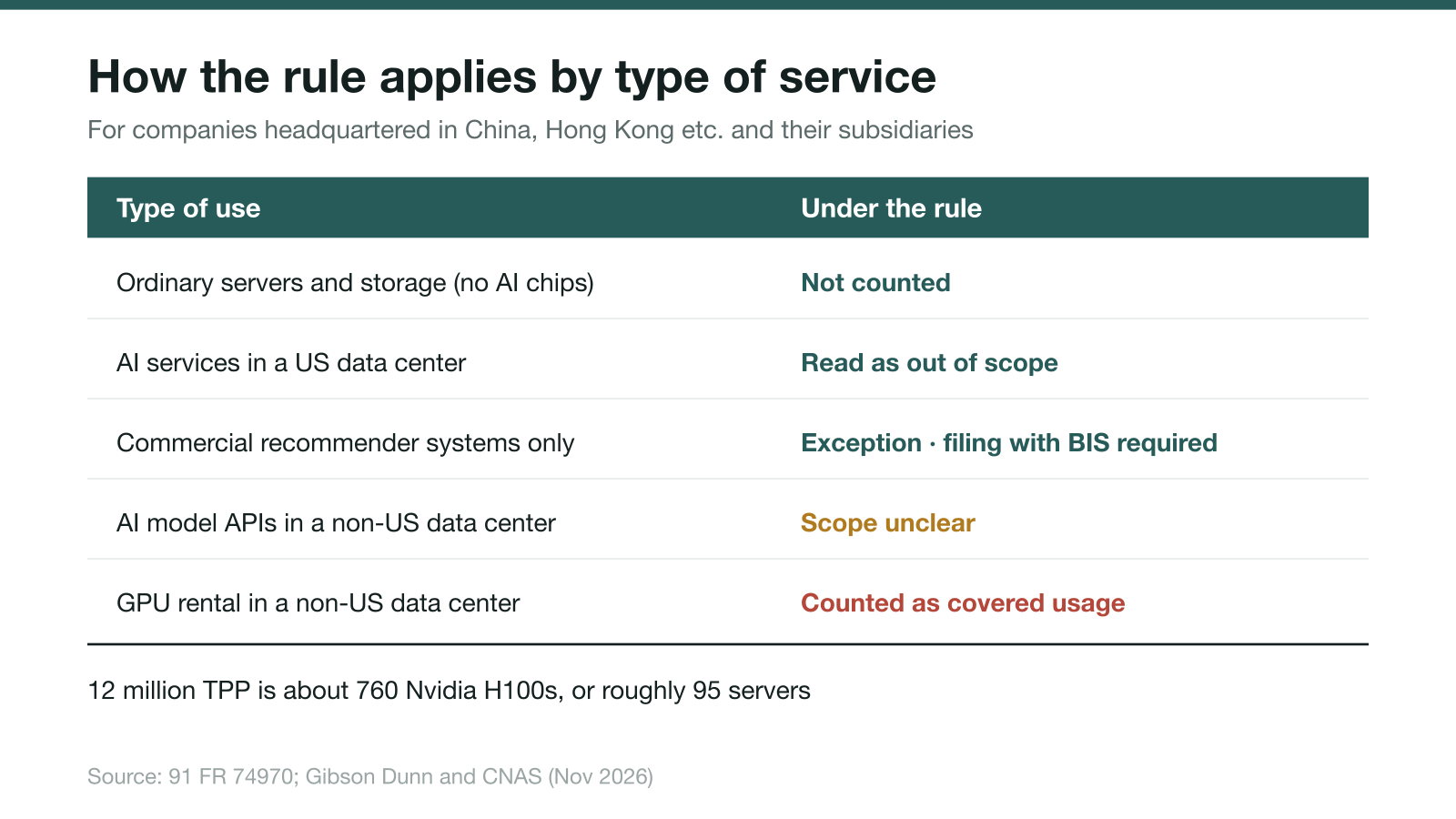
The third is how much. A license is needed when the TPP of the chips a data center provides to covered companies adds up to more than 12 million.[1] Whether the sum covers one customer or all covered companies is taken up below. The law firm Morgan Lewis calculates that this equals roughly 760 Nvidia H100 or H200 GPUs, or three of the latest GB300 racks (just over 200 GPUs). It also notes that the threshold measures hardware performance, not GPU-hours, tokens or spend.[8] Tokens are the unit AI services use to meter usage. In servers holding eight H100s each, 760 GPUs is 95 servers (760 divided by 8, this guide’s arithmetic).
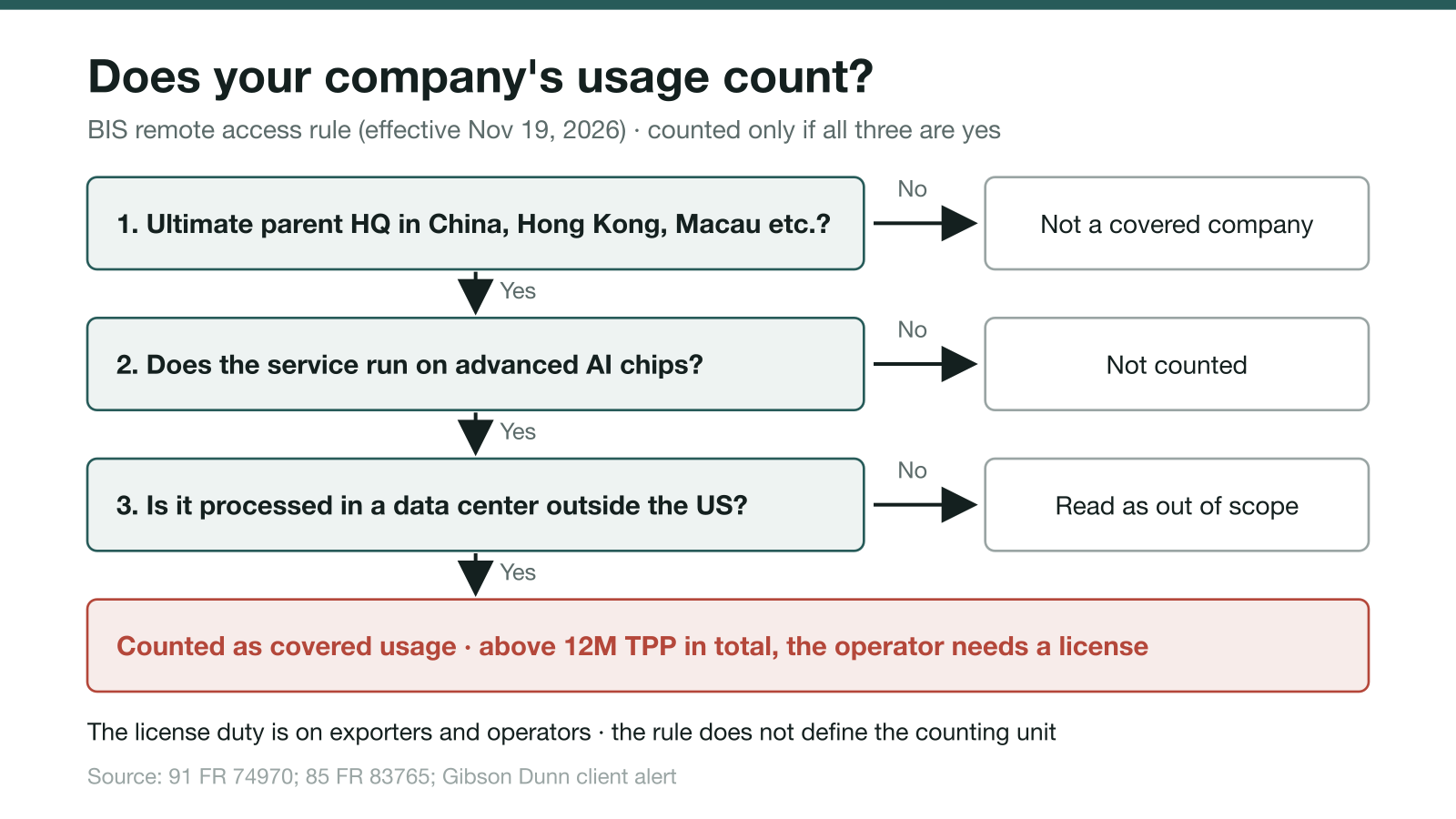
The license obligation falls on the exporter of the chips and the operator of the data center. US export rules treat a change in how chips abroad are used as needing authorization, in the same way as a shipment across a border, which is why the operator holding the chips is the one that needs the license.[1] Morgan Lewis explains that the rule regulates covered hardware and the persons who export or transfer it, and does not license cloud or AI services as such, while the commercial effect reaches every service that depends on that compute.[8]
Hong Kong companies
A company headquartered in Hong Kong is a covered company. US export regulations have treated Hong Kong as part of China since December 2020, when BIS removed it as a separate destination and stated that limitations applying to China’s country groups, D:5 among them, would also apply to transactions involving Hong Kong.[4] The new rule’s text does not mention Hong Kong by name. The law firms A&O Shearman and Morrison Foerster both state in their notes on this rule that China, for these purposes, includes Hong Kong.[9][10]
The rule draws no line by industry. The only use-based exception is for commercial recommender systems of the kind used by online retailers and social media, and generative AI that produces text or images is excluded from that exception.[1] A Hong Kong-headquartered bank, insurer or retailer is a covered company. Whether its ordinary API use is actually counted toward the threshold is unsettled, as discussed below.
| Case | Effect |
|---|---|
| A Hong Kong-headquartered company uses AI services in a data center abroad | Covered-company usage. Whether API use counts toward the threshold is unsettled |
| Its subsidiary in Singapore, Thailand or elsewhere uses them | Treated the same way, because the ultimate parent is in Hong Kong |
| The Hong Kong subsidiary of a company headquartered in the UK, the US or another country uses them | Not covered on the ultimate-parent test. Whether the Hong Kong entity itself could count as a headquarters is unsettled |
| The service runs in a data center inside the United States | Read as outside the rule |
| Ordinary servers, storage and similar cloud services | Not counted unless they run on advanced AI chips |
Because the test is the ultimate parent’s headquarters, contracting through a local subsidiary changes nothing. Morgan Lewis makes the same point: the trigger is where the customer or its ultimate parent is headquartered, not where a contracting entity is incorporated.[8] BIS says the diligence requirement is meant to prevent circumvention through corporate restructurings or spinoffs.[1] For a multinational headquartered in Hong Kong with subsidiaries across Southeast Asia, every subsidiary is treated as a covered company.
Whether a company with modest usage is actually caught depends on how the threshold is counted. Gibson Dunn and WilmerHale both note that the rule does not say whether 12 million is measured per customer or in total.[3][11] Gibson Dunn adds that it does not say whether the measure is installed, contracted or actually used capacity.[3] This guide’s inference is that if it is counted per customer, a company with small usage is under the threshold, and if it is counted across all covered customers, the data center operator must obtain a license or adjust what it provides to them, whatever any single customer uses.
Morgan Lewis addresses companies that use models through an API without renting GPUs. Sending a request to a model and getting an answer back is called inference. Morgan Lewis writes that a company that only consumes inference through an API ordinarily has no licensing obligation of its own, but should expect suppliers to pass down end-customer disclosure and usage restrictions. It also identifies what the rule leaves unanswered: whether ordinary API access for covered customers counts, and how aggregate TPP is attributed to users of a shared, token-metered service.[8] Because BIS describes its concern as compute for “training or running” advanced models, Morgan Lewis adds that inference capacity could also count.[8]
Why switching data center location has limits
Outside the United States, moving to another region does not change the analysis. A region is a cloud provider’s unit for grouping data centers in one geography. The rule says “any destination worldwide.”[1] On that wording, moving from Singapore to a region in Japan, Australia or Europe puts the workload in a data center subject to the same test.
Splitting usage across regions may not work either. The rule adds together “linked data centers” that share resources over a network, including facilities in separate buildings that are connected digitally.[1] It does not say whether a large cloud provider’s regions qualify.
Data centers inside the United States are read as out of scope. Gibson Dunn reasons that when the hardware stays in the US there is no export or reexport, so providing US-based compute to foreign customers appears to fall outside the rule.[3] CNAS agrees the rule omits US data centers and argues it should cover remote access wherever the chips sit.[2] The Remote Access Security Act, which passed the House in January 2026 and would make remote access itself a controlled activity, is still pending in the Senate.[5] Moving to a US region is outside the rule on the current reading, but it raises data transfer rules in the user’s own jurisdiction and could change if the law does.
Selecting a Hong Kong region in a cloud service does not guarantee the model runs in Hong Kong. In 2024 Microsoft said it served eligible Hong Kong customers “via models deployed in regions outside Hong Kong.”[6] Microsoft’s model availability table, last updated September 4, 2026, lists a Singapore region and no Hong Kong region.[7] On this evidence, a Hong Kong customer’s Azure OpenAI workloads are processed in a region outside Hong Kong, such as Singapore, and the data centers in that region are the ones subject to the rule. As of November 22, no public statement from Microsoft or OpenAI on this rule could be found.
Existing data centers and the 90-day deadline
The rule says a data center that was providing a significant volume of compute to covered companies before publication must obtain a license within 90 days of the effective date to continue.[1] Latham & Watkins calculates the deadline as February 17, 2027, and reads the text as requiring an issued license by that date.[12] Gibson Dunn notes that few China-related licenses have historically been processed within 90 days.[3]
How this applies to existing facilities is questioned even among law firms. Morrison Foerster writes that for deployments that complied with earlier restrictions and involve no new export, reexport or transfer, it is unclear whether there is a basis to apply the rule.[10] WilmerHale notes that the rule does not say what counts as “significant” for the 90-day provision.[11]
Cloud regions operating today are existing facilities in the sense of this provision. This guide’s inference is that, depending on how cloud providers read the provision and respond, service terms may change around February 2027.
What is still unsettled
The rule’s text does not answer the points below.
| Issue | Confirmed | Not settled |
|---|---|---|
| Unit of counting | The threshold is more than 12 million aggregate TPP[1] | Whether it is per customer or the total across all covered companies a data center serves[3][11] |
| Basis of measurement | Hardware performance is added up. Tokens and spend are not the measure[8] | Installed, contracted or actually used capacity, and over what period[3] |
| Using models only through an API | The user ordinarily has no licensing obligation[8] | Whether ordinary API access counts, and how TPP is attributed to users of a shared service[8] |
| Treatment of Hong Kong | A 2020 rule treats Hong Kong as part of China, and two law firms say the new rule includes it[4][9][10] | BIS has not issued anything on Hong Kong specific to the new rule |
| Meaning of “headquartered” | The test is the company’s or its ultimate parent’s headquarters[1] | How headquarters is determined, which also decides how a foreign company’s Hong Kong subsidiary is treated[3] |
| Ownership and control | Direct or indirect ownership or control must be checked[1] | The ownership percentage and what counts as control[3] |
| Adding up regions | “Linked data centers” connected by networking are aggregated[1] | Whether a cloud provider’s regions qualify |
| Existing facilities | Data centers already serving covered companies need a license within 90 days[1] | Whether there is a basis to apply the rule where no new export or transfer occurs, and what “significant” means[10][11] |
| Data centers in the US | That they are out of scope is the reading of a law firm and a research group[2][3] | BIS has not said so, and a bill pending in the Senate could change it[5] |
| Whether licenses are granted | Applications are reviewed case by case[1] | How many will be approved and how fast[3] |
| Cloud providers’ response | Microsoft’s 2024 statement and its region table[6][7] | Microsoft’s and OpenAI’s position on this rule (nothing public as of November 22) |
Four points that are easy to get wrong
- The rule draws no line by industry. A bank or retailer headquartered in Hong Kong is a covered company.[1]
- The test is the ultimate parent’s headquarters. The country of the entity that signs the contract is not the test.[1][8]
- The threshold is measured in hardware performance. Low token usage or low spend does not by itself mean a company is under it.[8]
- The license obligation is on the exporter and the data center operator. Users ordinarily have no licensing obligation, but suppliers may ask for customer information or change the terms of service.[1][8]
Checklist
- Map where the ultimate parent is headquartered, including intermediate holding companies. Suppliers may ask for this.
- Ask the provider which region processes your AI workloads. It can differ from the region in the contract.
- If you are a covered company, watch for notices from your cloud provider before the 90-day deadline of February 17, 2027.[12]
- If you are considering a move to a US region, check the rules on transferring customer data abroad first.
- Comments are due January 19, 2027. The counting method and the meaning of “headquartered” may change through BIS guidance or amendments afterward.[1]
Limits of this guide
Until the issues in the table are settled, the case-by-case readings here follow the rule’s text and interpretations by law firms and research groups, and BIS has not confirmed them. Law-firm notes address API users in general. As of November 22, no BIS guidance or law-firm note could be found that deals specifically with Hong Kong-headquartered multinationals.
References
Notes
- Bureau of Industry and Security, “Addressing Remote Access to Advanced Semiconductors,” interim final rule, 91 FR 74970 (published and effective November 19, 2026). Full text ↩
- CNAS, “Unpacking the Remote Access Rule” (November 18, 2026). Link ↩
- Gibson Dunn, “BIS Expands Advanced Computing Controls to Address Data Center Remote Access and Third Country Diversion” (November 18, 2026). Link ↩
- Bureau of Industry and Security, “Removal of Hong Kong as a Separate Destination Under the Export Administration Regulations,” 85 FR 83765 (December 23, 2020). Full text ↩
- Kharon, “Understanding Remote Access Controls: The AI Remote Access Rule and the Remote Access Security Act.” Link ↩
- South China Morning Post via Yahoo Finance, “Microsoft maintains AI services in Hong Kong, as OpenAI curbs API access from China” (2024). Link ↩
- Microsoft Learn, “Models sold directly by Azure: region availability” (updated September 4, 2026; checked November 22, 2026). Link ↩
- Morgan Lewis, “Commerce Targets Remote Access to Advanced Semiconductors in New Interim Final Rule” (November 18, 2026). Link ↩
- A&O Shearman, “BIS rule on remote access to advanced semiconductors” (November 2026). Link ↩
- Morrison Foerster, “BIS Issues Interim Final Rule Targeting GPU Remote Access and Advanced IC Design” (November 19, 2026). Link ↩
- WilmerHale, “US Government Restricts Remote Access to Advanced AI Chips and Formally Rescinds the AI Diffusion Rule” (November 17, 2026). Link ↩
- Latham & Watkins, “US Commerce Department Adopts Rule Restricting Remote Access to Advanced AI Chips” (November 2026). Link ↩
Source: https://www.govinfo.gov/content/pkg/FR-2026-11-19/html/2026-23529.htm