20 min read
GitHub is the site where developers share code, and a star there is a bookmark-style click. As of the evening of October 15, 2026, the repository morluto/rea has 259,029 stars. React (react/react), the web framework built by Meta, had 251,045 at the same moment, so a repository created this April has overtaken React in six months. Only 17 repositories on all of GitHub have more stars[1][2]. Stars are not users, but 250,000 of them arriving in 12 days is rare.
REA stands for Reverse Engineer Anything. It connects an AI coding agent such as Claude Code or Codex to tools for analyzing software that has no source code. It is a command-line tool, run by typing commands in a terminal, and it is also an MCP server. MCP, the Model Context Protocol, is a common standard that lets an AI model call another program’s functions as tools, and a server is the side that provides them. Below, the repository’s own records give the timeline from April to October 15, and a hands-on install, published reviews and research show what the tool does and how far it goes.
Created in April, downloaded a few dozen times a day until October
The repository was created on April 14, 2026. Its author is the GitHub account morluto, an individual account that joined in December 2020 and has 253 public repositories. The profile lists no employer or real name[3]. The first version of the npm package rea-agents (npm is the public registry where JavaScript programs are installed from) went up on July 12. Sixteen releases followed in July alone, then after 3.1.0 on August 9 there was no new version for almost two months[4][5]. From mid-September to October 2, daily downloads ran between 8 and 56, and October 2 saw 16[4].
From October 3: twelve releases in twelve days, and daily downloads from 16 to 100,000
With the 3.2.0 release on October 3, daily downloads jumped to 418, then 4,048 on the 5th, 9,000 on the 8th, 34,790 on the 10th and 103,109 on the 12th[4]. Twelve releases came out between October 3 and 14, and the major version number went from 3 to 6 along the way: 5.0.0 on the 7th, 6.0.0 on the 8th, 6.5.0 on the 14th[5].
By a daily tally from the API documentation company Apidog, the repository gained 1,373 stars on October 4, 5,602 on the 7th, 19,375 on the 9th, 26,572 on the 10th and 31,255 on the 11th, and it held the top spot on GitHub Trending for five of the seven days from October 6 to 12[6]. On October 10 it reached the developer forum Hacker News, where the thread collected 805 points and 337 comments[7]. It passed 115,000 stars on the 12th[6] and stood at 259,029 on the evening of the 15th, another 140,000 in three days[1]. The README, the introduction shown on a repository’s front page, carries a “250,000 GitHub stars, thank you” line and links to translations in 20 languages, Korean among them[8]. In Korea, a YouTube video appeared under the title “Is software finished? The insane open-source project that copies whole apps”[9], and the Japanese tech outlet GIGAZINE ran a piece on the 14th showing REA analyzing the Windows Calculator and the Chrome dinosaur game[10].

It bundles close to twenty existing tools for an AI to call
REA contains no new technique for turning machine code back into code. Software ships after compilation, the step that turns source code written by people into machine code the computer runs, and reversing that step (decompilation) is done by existing programs such as Ghidra, the free tool released by the US National Security Agency, IDA Pro and Hopper. REA puts those programs, along with JADX for Android apps, Binwalk for extracting firmware (the software built into devices), and mitmproxy and TShark for reading recorded internet traffic, behind a single MCP server, close to twenty tools in all, so an AI agent can call them with requests like “decompile this function” or “show me this app’s module structure”[8][6]. Desktop apps built with web technology (Electron apps), programs built on Microsoft’s .NET, websites, and executables written in the Go and Rust languages are read by REA’s own built-in analyzers without any external tool[8].
The repository pitches one use: see a feature you like in another app, understand how it works without the source, then build something similar in your own project. The user tells the agent something like “understand how search works in the Notes app, show me the evidence, and build a similar feature for my project”[8]. One official showcase reconstructs, as C code, the calculation the DOS game DX-Ball uses to pan sound left and right. The reconstruction gives the same result as the original for all 3,205 inputs tested and compiles to the same 63 bytes. Others trace how Notion’s copy function moves text and formatting to the clipboard, and confirm in code why 200 plus 10% equals 220 in the Windows Calculator[8][11].
The README also lists what the tool does not do. It does not claim to recover original source code or to clone an app automatically, analysis runs on the user’s own machine, and results come with evidence and with the “unknowns” marked[8].

Installed by hand: 155 commands, and native analysis needs an external engine
For this article I installed version 6.5.0 on a Mac (macOS 27.0.1, Node.js 26.0.0). The help output listed 155 commands. The readiness check (the doctor command) reported “not ready” because none of the native-binary engines Hopper, Ghidra and IDA, nor JADX for Android, was installed. Static analysis of JavaScript apps, which reads the files without running the app and which the README says needs no external engine, was available immediately[12].
I also pointed it at the Claude Desktop app installed on this Mac, but REA stopped at its file integrity check and produced no analysis, and the execution permissions of the test environment did not allow a retry on another app[12]. This article therefore contains no analysis result produced by REA itself, and the reviews below stand in for that part.
What people have actually taken apart with REA
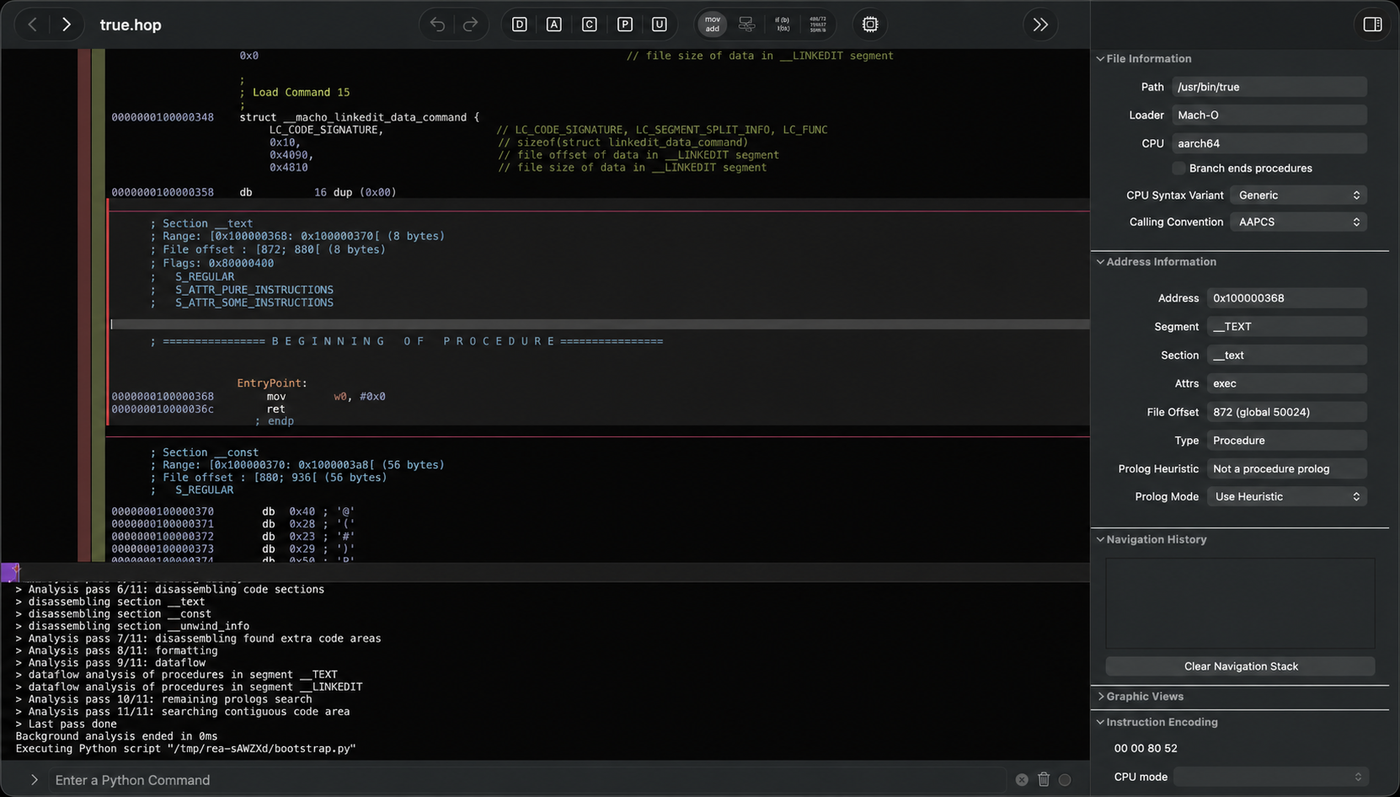
The five showcases on the official site each target a different kind of software, and each ends with a verification number[23]. The screenshot below, from the repository README, shows REA driving Hopper, a Mac reverse engineering tool, to read an executable.
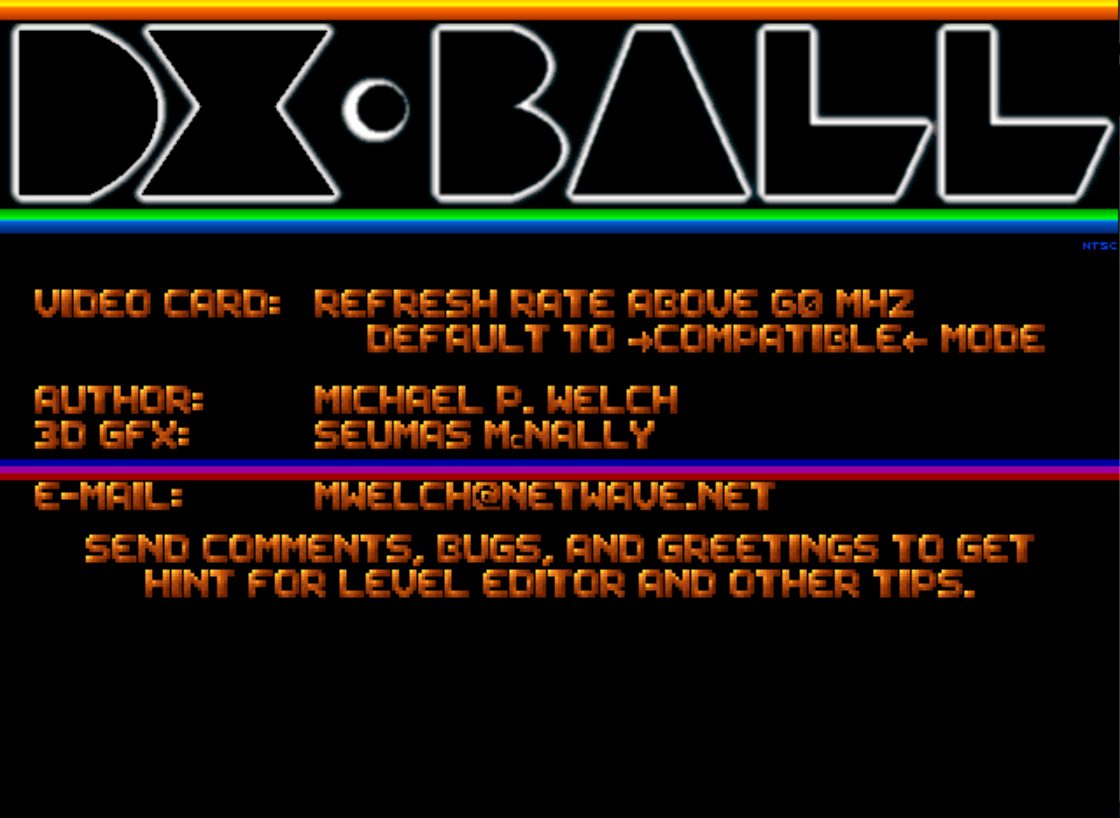
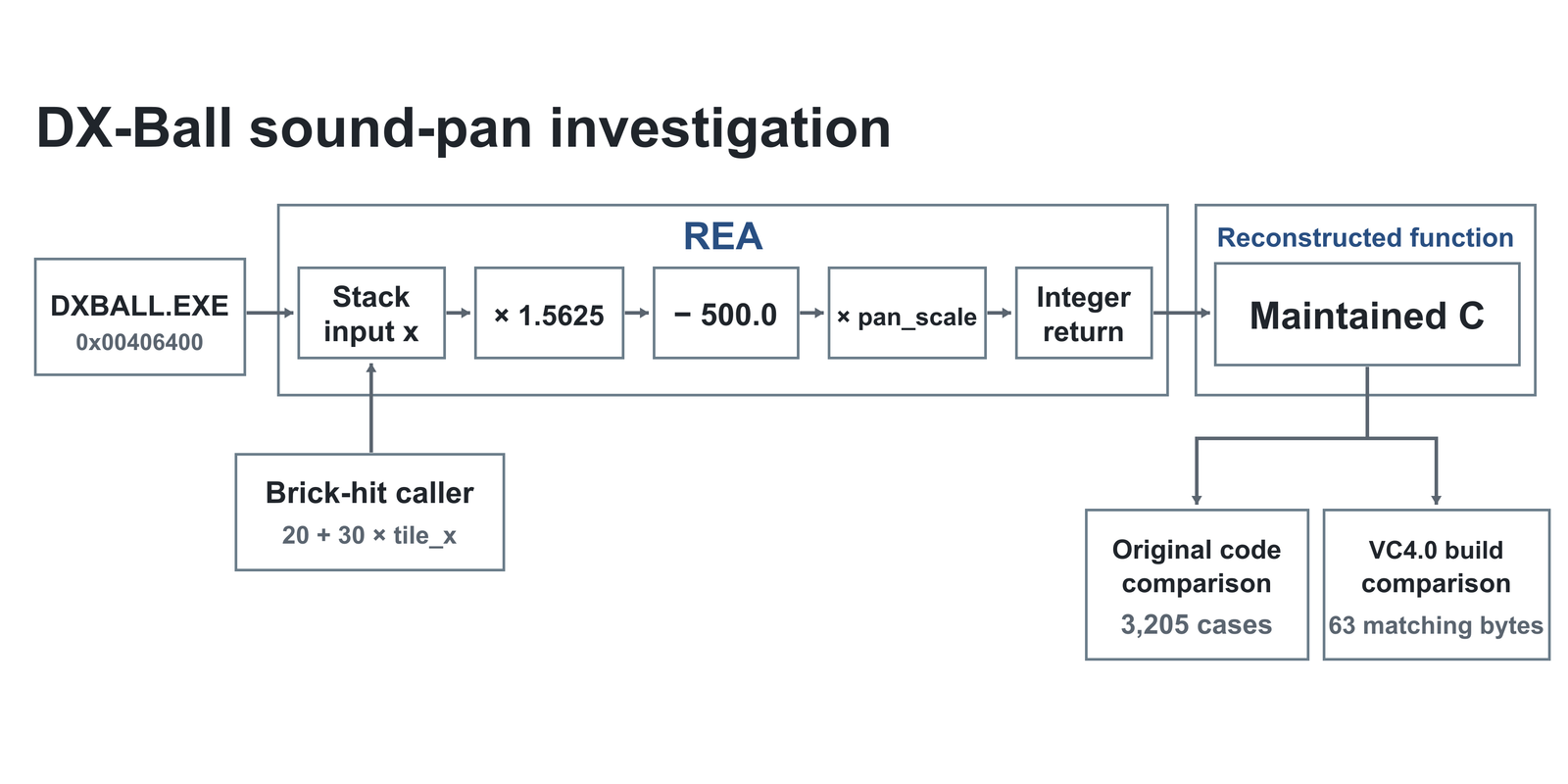
For DX-Ball, a 1996 Windows game shipped as a native executable, the question was why the sound of a brick breaking comes from the left or the right. The agent asked REA three things. First, the pseudocode of the sound function, which showed one integer input and floating-point math. Second, the brick-hit function that calls it, which showed the input is a screen coordinate computed as 20 + 30 × brick column. Third, the bytes at two memory addresses, which decoded to the constants 1.5625 and 500.0. The reconstructed C function multiplies the coordinate by 1.5625, subtracts 500 and multiplies by a scale factor. Across 3,205 comparisons (every screen coordinate from 0 to 640 times five scale factors) it matched the original, and compiling it with the period compiler, Visual C++ 4.0, produced the same 63 bytes. The project to rebuild the whole game in C stood at 55 functions and 45,380 comparisons as of October 7[24].
For Notion Desktop 7.6.1, an Electron app, the question was how Notion handles text and formatting when you copy. The app archive was unpacked and its minified JavaScript analyzed, locating the four points a copy request passes through, from the page to the preload script to the main process to the system clipboard, and the name of the channel connecting them. Notion puts text and HTML on the clipboard with a copy ID embedded as a comment in the HTML, keeps the structured block data inside the app, and restores it by that ID on paste. The findings were checked by executing the extracted modules[25].
For Touhou 4, a 1994 PC-98 DOS game with a 16-bit executable, the question was how the game aims a ring of 16 bullets at the player. In the 156 KB executable, REA located the bullet velocity-and-angle function and read out the calculation: a full turn is 256 units, so 16 bullets are spaced 16 units (22.5 degrees) apart, and the player’s direction is added. The reconstructed C++ compiled with the period compiler, Turbo C++ 4.0J, matched 2,139 bytes of the original[26].


The two game cases are pieces of larger projects to rebuild the whole game. The DX-Ball reconstruction repository documents its procedure: Codex drives Ghidra through REA to read one function at a time, compiles the result with the period compiler and compares it byte by byte with the original. The published worked example takes one function that appends an item to the projectile list all the way to a complete 146-byte match, and each instruction that differs becomes the target of the next REA query[32]. The person behind that repository (GitHub account N0zoM1z0) runs source reconstructions of more than ten Touhou games the same way. The furthest along, Touhou 8, has source for all 1,107 functions, 1,106 of them byte-exact (99.92%), and runs as a Linux port and as a browser port compiled to WebAssembly. Those Touhou repositories’ READMEs do not mention REA, though, describing only agents working against the project’s own verification gates, so the game reconstructions confirmed to use REA are DX-Ball and the Touhou 4 showcase[33]. Across AI game decompilation as a whole, REA is one connector among several. The largest case published this October, an unnamed first-person shooter with 99% of functions recovered to source and 83% byte-exact over about five months and an estimated 600 to 700 billion tokens, ran on Hex-Rays’ official IDA MCP and did not use REA[34].

For Aegis Authenticator 3.4.3, an Android app, the question was how the six-digit login code that changes every 30 seconds is produced. Reading the classes through the Android decompiler JADX showed the standard TOTP scheme: group time into 30-second blocks, hash the block with the account key (HMAC-SHA1), and pad the remainder after dividing by one million to six digits. A browser reimplementation passed 133 tests and the six reference values in the public standard, RFC 6238[27].
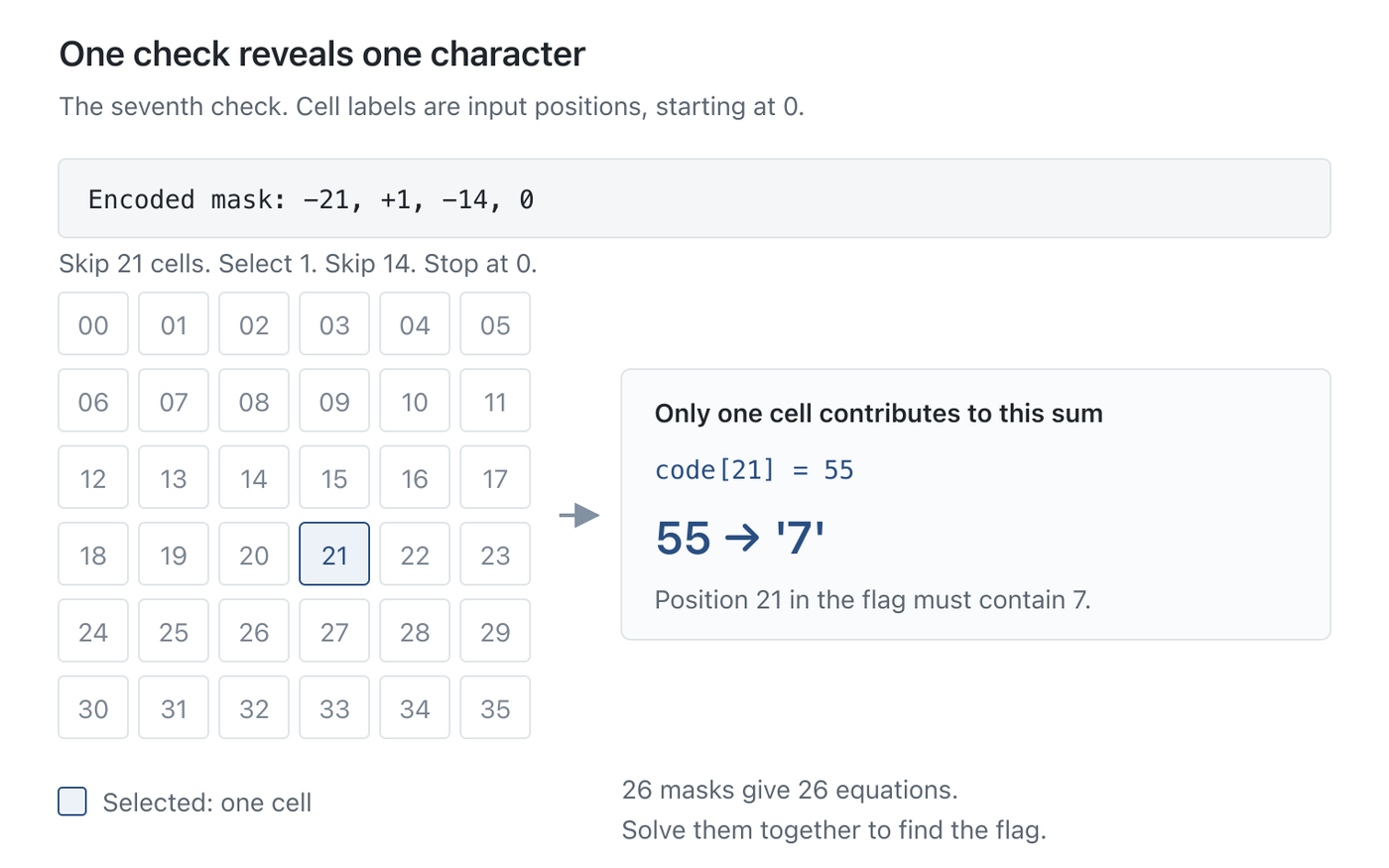
The fifth case is a 15 KB Linux executable from the Australian security contest DownUnderCTF, a program that prints “Correct!” when given the right string, the flag. REA found the checking functions with Ghidra and pulled 26 masks and target values from memory, revealing a structure that lays the input on a 6×6 grid and compares sums of the cells each mask selects. The 26 masks became 26 equations, the constraint solver Z3 solved them together, and running the original program on the result produced “Correct!”[28].
Community write-ups are narrower and their numbers smaller. A test that ran REA 6.0.0 on a public example Electron notes-exporter app took 1.3 seconds, correctly found the one channel connecting the export request on screen to the file writer, and rebuilt the CSV formatter to pass 14 tests, while 44 “unknown” entries remained in the full relationship graph[29]. In Korea, an operator of the GPTers community used REA on October 15 to inspect the deployed code of a live web service and found four problems (deployment records alone could not confirm what was in production, no list of files excluded from deployment, the screen access check trusted information stored in the browser, and no source maps to compare against the original). Giving the same task to an agent without REA produced the same number of correct findings in 129 seconds for $1.00, versus 380 seconds for $2.10 with REA, three times slower[30]. A Korean YouTube channel also posted a video titled “I tested REA, the ‘software is finished’ tool, myself”[31].
Taken together, these cases show what REA can do today: recover one function’s calculation from an executable, connect the communication path one feature takes through an Electron app, confirm whether an Android app’s algorithm is the standard one, turn a small binary’s checking logic into equations, and audit deployed web code for security gaps. Every one is a single feature with a verifiable number attached, and neither the official showcases nor the community write-ups contain a case of cloning a whole app.
The rough spots of a project that grew this fast
As of October 15 it has 219 contributors, 3,292 commits (recorded code changes), 1,618 issues (reports filed to flag a bug or problem) and 2,421 pull requests (proposed code changes) opened in total, and 925 issues still unresolved[14]. Apidog’s write-up lists the rough spots: even a small version change can break existing setups, REA has no sandbox to isolate the program under analysis so running untrusted files is dangerous, and on Linux the mitmproxy integration requires one exact version of its command-line edition, mitmdump 12.2.3[6].
The popularity also drew an imitator. On October 13 an issue on the repository reported that an organization called rea-tools was running a fake repository that copied the README and added a “Windows standalone executable” section. That file had been downloaded 172 times before Microsoft Defender and eight engines on VirusTotal, a site that scans a file with many antivirus engines, classified it as a trojan, and the top of the README now warns that a similar repository name or a copied README does not make a download official[13][8].
Reviews and research credit the reading and discount the cloning
Two published reviews give different pictures. A developer who fed REA his own Mac app (a tool for publishing articles to several sites) with no source got from installer to architecture diagram in three minutes, and REA correctly identified more than 20 classes (the building blocks of the code), a structure mixing Apple’s Swift language with web views, and a design that isolates copy and rendering work in a separate process. He added that what REA recovered was the structure of the current code, not the trial and error that led to it[15]. The other review cloned features such as Loom’s floating camera window and found that asking about one specific feature gave far better results than “clone this app”; its verdict, quoted by another blog, was that the output was solid but not dramatically better than an agent working from screenshots[16].
Research reports a similar range. A paper released in September 2026 gave 88 capture-the-flag security puzzles to nine of the most capable current AI models to measure where AI reverse-engineering agents fail, and found failures concentrated at the stage of understanding the program rather than running out of resources[17]. Another paper from April concluded that current agents still fail against obfuscation, code deliberately made hard to read, and against programs whose behavior depends on timing[18]. In this year’s experiment at NDSS, a security conference, comparing 24 experts and 24 novices, AI tools raised novice performance by 98% but left experts almost unchanged, and on vulnerability-finding tasks the AI’s hallucinations (plausible but wrong answers) made experts worse[19]. For what recovering a game without its source actually involves, see how AI decompiles old games and where it stops.
Where the law and the project draw the line
The project’s disclaimer says it will not help with circumventing DRM (digital rights management), building game cheats, bypassing authentication, copying proprietary software’s protected code and assets such as images and sounds, or evading AI providers’ usage policies. Commercial decompilers must be legally purchased, and cracked copies or shared license keys are not authorized[20]. In Korea, Article 101-4 of the Copyright Act permits program decompilation only within the scope needed for interoperability with other programs[21]. Understanding how a feature in someone else’s app works and writing your own version is a different act from taking that app’s code, images or sounds, and the Loom review warns against the latter in the same terms[16]. The rules laid out in the game decompilation article apply here unchanged.
What to do with this
- Install only from the two official channels: the npm package rea-agents and github.com/morluto/rea. Any other repository or site distributing a “Windows executable” is not official.
- Do not feed it untrusted files. REA does not isolate the target. Analyze executables of unknown origin in a separately isolated environment.
- Start with JavaScript apps or websites. They work without an external engine, and installing Ghidra extends the range to native executables.
- Narrow the question to one feature rather than a whole app. Both the reviews and the README say “how does this search work” beats “clone this app.”
- Open the evidence. REA attaches evidence and unknowns to each conclusion, and a conclusion without evidence is the agent’s own inference.
- Run it on your own company’s app. If a structure diagram comes out in three minutes with no source, a competitor can get the same diagram. Checking whether secret keys or important logic sit in the part of the app that runs on the user’s device is a practical use right now.
- The law allows decompilation for interoperability, and the project’s own stated scope is research, education, and software you are authorized to examine. If the tool is used to take someone else’s code and assets, the responsibility sits with the person using it.
Reflection
REA adds no new technology. Ghidra has been free since March 2019[22]. What has changed is that an agent now carries the years of skill it used to take to drive those tools, and 250,000 stars record how people received that change. Research and reviews still find the reading trustworthy and the rewriting in need of human verification. The repository’s next few months will show how far that boundary moves.
Notes
Notes
- GitHub API `repos/morluto/rea`, retrieved 2026-10-15. Created 2026-04-14, 259,029 stars, 65,149 forks, 866 watchers, 925 open issues, TypeScript, MIT license, homepage rea.tools. Repository ↩
- GitHub search API, retrieved at the same time on 2026-10-15. react/react at 251,045 stars; the query `stars:>259029` returns 17 repositories (first: codecrafters-io/build-your-own-x, 553,349). Search ↩
- GitHub API `users/morluto`, retrieved 2026-10-15. Joined 2020-12-22, 253 public repositories, 6,174 followers, no company or real name. Profile ↩
- npm registry for `rea-agents` (first publish 2026-07-12 as 0.2.1, 32 versions, latest 6.5.0 on 2026-10-14) and the npm downloads API, daily. 8–56 per day from September 13 to October 2 (18 on October 1, 16 on October 2), then 418 on October 3, 4,048 on the 5th, 9,000 on the 8th, 34,790 on the 10th, 103,109 on the 12th. Retrieved 2026-10-15. npm ↩
- GitHub releases API `repos/morluto/rea/releases`, retrieved 2026-10-15. Sixteen releases in July, from 1.1.0 on July 13 to 2.7.0 on July 28. 3.1.0 (2026-08-09) is followed by 3.2.0 (10-03); twelve releases between October 3 and 14: 3.2.0 and 3.2.1 (10-03), 4.0.0 and 4.0.1 (10-05), 4.1.0 (10-06), 5.0.0 (10-07), 6.0.0 (10-08), 6.1.0, 6.2.0 and 6.3.0 (10-09), 6.4.0 (10-11), 6.5.0 (10-14). Releases ↩
- “What Is REA (Reverse Engineer Anything)? The MCP Server That Hit 115K GitHub Stars in a Week,” Apidog (reposted on DEV Community), 2026-10-12. Daily star gains (10/4 1,373; 10/7 5,602; 10/9 19,375; 10/10 26,572; 10/11 31,255), #1 trending five of seven days 10/6–12, wrapped tools (Hopper, Ghidra, IDA, mitmproxy, JADX, Binwalk/Unblob, WABT), rough spots (breaking changes, not a sandbox, mitmdump pinned to 12.2.3). Link ↩
- Hacker News, “REA Reverse – Engineer Anything,” 2026-10-10, 805 points and 337 comments (Algolia HN search API, retrieved 2026-10-15). Link ↩
- morluto/rea README (main, checked 2026-10-15). Opening pitch (“See a feature in an app that you want in your own product? Ask your agent to investigate it with REA.”), official-source warning, external tools named in the target table (Hopper, Ghidra, IDA, Rizin, objdump, pwntools, GDB, pwndbg, WABT, JADX, JEB, Apktool, adb, Binwalk, Unblob, TShark, capinfos, sigrok-cli, mitmdump: 19), showcases (DX-Ball “passes 3,205 original-x86 cases and reproduces all 63 compiled function bytes,” Notion, TH04), FAQ (“REA analyzes targets locally”), “250,000 GitHub stars — thank you!”, links to 20 README translations. README ↩
- YouTube channel 성공지식백과, “소프트웨어는 끝났다? 앱 통째로 복사하는 미친 오픈소스.. ㄷㄷ” (title confirmed via YouTube oEmbed, 2026-10-15). Link ↩
- GIGAZINE, “質問するだけでAIコーディングエージェントが実行ファイル・ライブラリ・アプリなどをリバースエンジニアリングできる「REA」,” 2026-10-14. Windows Calculator 200 + 10% = 220 and the Chrome dinosaur game’s acceleration rule. Link ↩
- rea.tools official site (checked 2026-10-15). “Ask your coding agent about an app, a game or a website. REA gives it the tools to inspect the code behind the answer.”; showcases (Aegis authenticator, Notion, DX-Ball), Calculator and dinosaur guides. Link ↩
- Hands-on run, 2026-10-15. macOS 27.0.1, Node.js 26.0.0, `npx [email protected] –help` listing 155 commands. `doctor` returned `healthy: false` (hopper, ghidra, ida-registration and jadx all missing_analysis_engine). `analyze-javascript-application /Applications/Claude.app/Contents/Resources/app.asar –json` ended with `artifact_integrity_mismatch` (hash declared in the archive differed from the actual file) and no result. ↩
- morluto/rea issue #2424, “Warning: fake repo rea-tools/rea distributes a trojan ‘Windows exe’,” opened 2026-10-13 00:42 UTC, closed the same day at 19:23. rea-x64.7z, 82.6 MB, 172 downloads; Defender Trojan:Script/Wacatac.B!ml and Trojan:Win32/Wacatac.B!ml; VirusTotal 8/45; organization created 2026-10-10. Issue ↩
- GitHub API, retrieved 2026-10-15. 219 contributors (including anonymous), 3,292 commits, issue search `is:issue` 1,618 and `is:pr` 2,421, 925 open issues. ↩
- “REA Claims It Can ‘Reverse-Engineer Anything’ — and Pulled 120K Stars in a Week. So I Handed It My Own App,” DEV Community, 2026-10-14. Mac app FluxMark 1.3.5 (4.3 MB Mach-O), “3 min from installer to architecture diagram,” 20+ classes including CopyRenderSession, Swift/WebView hybrid, isolated copy and render session. Link ↩
- MindStudio, “Reverse Engineer Anything: The GitHub Repo That Clones App Features With AI,” 2026-10-14. Loom camera-bubble case, advice to ask about one feature, warning against copying code or assets. Link · The verdict “REA produced a solid result, but it wasn’t dramatically better than an agent working from screenshots” is MindStudio’s, as quoted by the AgentConn blog, 2026-10-14. Link ↩
- Hadjer Benkraouda et al., “Reveree: Diagnosing LLM Reverse-Engineering Agents,” arXiv:2609.01185, 2026-09-01. 88 picoCTF and NYU-CTF challenges, nine frontier models, four prompting strategies; failures concentrated at comprehension stages rather than resource limits. arXiv ↩
- Salem Radey, Jack West and Kassem Fawaz, “Challenges and Future Directions in Agentic Reverse Engineering Systems,” arXiv:2604.14317, 2026-04-15 (SAGAI 2026). “Cutting-edge systems still fail in complex RE scenarios that involve obfuscation, timing, and unique architecture.” arXiv ↩
- “Decompiling the Synergy: An Empirical Study of Human–LLM Teaming in Software Reverse Engineering,” NDSS 2026. 24 experts and 24 novices, 98% novice improvement, no change for experts, hallucination harm on vulnerability identification. Paper PDF ↩
- morluto/rea DISCLAIMER.md and the README license section (checked 2026-10-15). Unsupported uses (DRM, license-check and anti-cheat circumvention, game cheats, authentication bypass, copying proprietary software, evading AI providers’ policies, reselling accounts); permitted uses (“lawful research, education, interoperability, software preservation, and analysis of software you own or are authorized to examine”); “You must legally obtain and be authorized to use commercial tools.” DISCLAIMER ↩
- Copyright Act of Korea, Article 101-4 (decompilation of program code): permitted for a person with a legitimate right to use the program, within the scope necessary to obtain interoperability information that cannot easily be obtained otherwise. Korea Law Information Center ↩
- National Security Agency, Ghidra repository. The first public release, 9.0, dates from March 2019. GitHub ↩
- rea.tools showcase list (checked 2026-10-15): Aegis, DownUnderCTF, DX-Ball, Notion, TH04. All figures in this section are the project’s own material from docs/assets and website/public/assets/figures in the morluto/rea repository (MIT license). Showcases ↩
- rea.tools, “DX-Ball’s sound-pan calculation.” DXBALL.EXE 1.07, function 0x406400, caller 0x411f40 computing “20 + 30 × tile_x,” constants 1.5625 and 500.0, reconstructed `dxball_screen_pan`, 3,205 comparisons (x 0–640 × five pan scales), 63 matching bytes with VC4.0, project at 55 C functions and 45,380 comparisons (checkpoint 2026-10-07). Link · Reconstruction repository ↩
- rea.tools, “How Notion copies text and HTML.” Notion Desktop 7.6.1, REA 4.1.0, page API `clipboard.write` → preload `ipcRenderer.invoke` → main `ipcMain.handle` → system clipboard, channel `notion:clipboard:write`, copy ID in the HTML with block data kept locally, verified by executing extracted modules. Link ↩
- rea.tools, “How TH04 aims a ring of bullets.” MAIN.EXE 156,258 bytes, `bullet_velocity_and_angle_set()` at 0x2cfc8, 256 angle units per turn and 16 units per bullet, 2,139 matching bytes with Turbo C++ 4.0J. Link · Reconstruction repository ↩
- rea.tools, “How an authenticator generates a login code.” Aegis Authenticator 3.4.3 APK, JADX, 30-second blocks, HMAC-SHA1, 31-bit extraction, six digits from the remainder modulo one million, 133 browser test cases, six RFC 6238 reference cases. Link ↩
- rea.tools, “Solve a CTF flag checker.” 15 KB stripped x86-64 ELF, Ghidra 12.1.4, 6×6 grid and 26 masks, Z3, flag `DUCTF{ezzzpzzz_07bcda7bfe81faf43caa}`, process capture showing “Correct!” and exit code 0. Link ↩
- Kingy AI, “Reverse Engineer Anything with AI: REA Tested on a Notes Exporter,” 2026-10-08 (updated 10-15). REA 6.0.0, analysis in 1.295802 seconds, 21 findings, IPC channel `notes:export`, rebuilt CSV formatter matching 14 cases, 44 unknown graph entries (25 dynamic calls, 19 ambiguous targets). Link ↩
- GPTers (Korea), “[AX] Taking apart the buddy system with the reverse engineering tool REA: four problems and the limits,” by SOPA, 2026-10-15. Four findings; “A took 129 seconds and $1.00, B took 380 seconds and $2.10”; same number of correct answers. Link (Korean) ↩
- YouTube channel 개발동생, “소프트웨어는 끝났다는 REA 직접 검증해봤습니다 | GIthub 트렌딩 1위” (title confirmed via YouTube oEmbed, 2026-10-15). Link ↩
- N0zoM1z0/dx-ball README and docs/REA.md (checked 2026-10-15, MIT). “Codex uses REA to inspect the original executable through Ghidra, recover its functions, and refine the source by comparing compiled code with the original”; worked example `dxball_append_projectile` (0x413410), “a complete 146-byte match”; “A difference in a call, branch or memory access gives the next REA query a concrete target.” Repository · Worked example ↩
- Touhou reconstruction repositories under the N0zoM1z0 account (display name Ysopwnable): th03, th04, th07, th075, th08, th09, th095, th10, th105, th20 and th08-web (GitHub API, 2026-10-15, all MIT). th08 README: “Every one of the 1,107 authored functions now has source. Strict comparison currently accepts 1,106 of them, covering 459,396 of 459,757 authored bytes”; Linux port v0.2.0 playable; th08-web is a C++-to-WebAssembly browser port. Zero mentions of REA or rea-agents in those Touhou READMEs. th08 · th08-web ↩
- momo5502, “500+ Billion Tokens Later,” 2026-10-09. 99% of functions in source, 83% byte-exact, about five months, an estimated 600–700 billion tokens, Hex-Rays IDA-MCP with Claude Code and Codex, context compaction threshold lowered from 90% to 42%. No mention of REA. The yibie/awesome-rea list likewise files this case under IDA MCP: “the 500-billion-token decompilation ran on it for almost the whole project.” Post · awesome-rea ↩
Source: https://github.com/morluto/rea